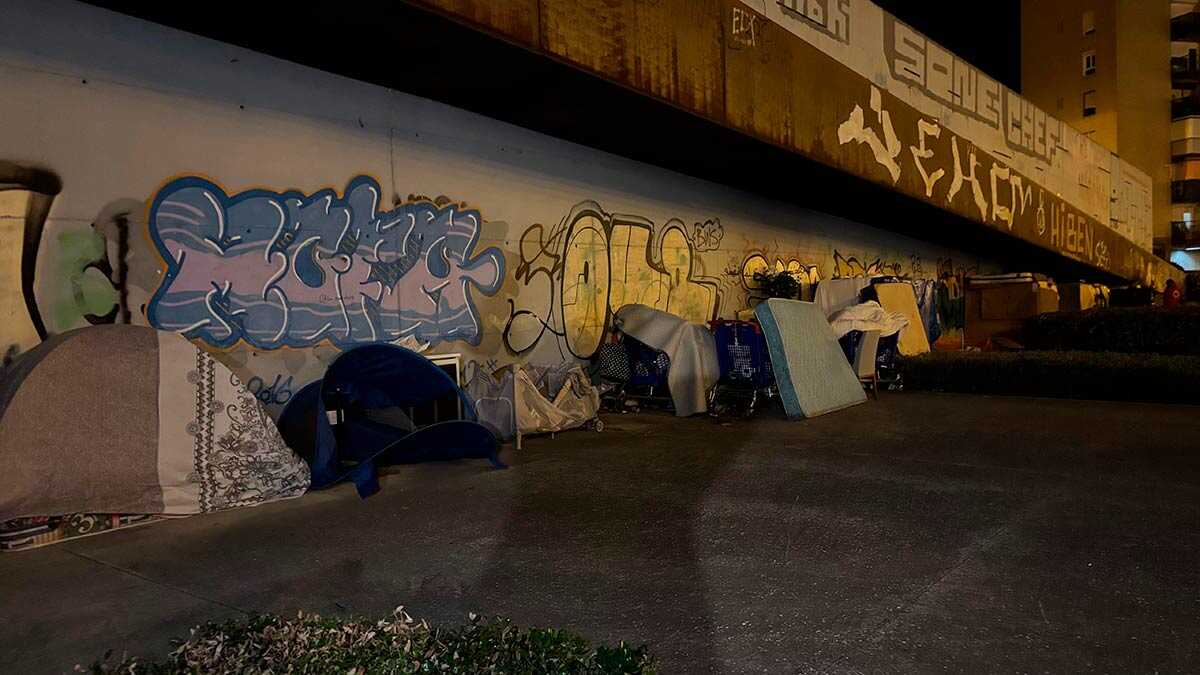
The size of the settlement has changed over time. Residents speak of around 14 permanent substandard dwellings and at least 14 permanent occupants. However, recent reports estimate that nearly 40 people now live at the site.
The situation particularly affects residents of nearby blocks, including those at numbers 99-103 and 94 on Avenida Navarra and number 72 on Torre Zaragoza. They insist that their demand is not to move the problem elsewhere in the city, but to find a response that guarantees decent living conditions for the people settled there while allowing the area to return to its usual use.
PUBLIC HEALTH PROBLEMS
"It is not that they are a nuisance, because they are there, they come and go, they live there and that is it," says Javier Tomás, a local resident, summarizing the position of some residents. He explains that his main concern is not the presence of these people, but the conditions in which they live and the consequences he believes the situation has for public space. "What concerns me most is the normalization of the situation," he says, referring to the possibility that younger generations, who pass through the area on their way to various schools and educational centers, may eventually become accustomed to seeing substandard housing as something ordinary.
Residents particularly remember a period when the area was affected by a significant rat infestation, a problem that, according to Tomás, appears to have diminished following cleaning work by Zaragoza City Council. Even so, they fear it could happen again. They also regret that elderly people have stopped using the benches where they used to sit. In addition, they say, it has become difficult to use the park entrances normally.
At the end of September, a group of residents prepared a dossier that they sent to all municipal political groups, as well as to the city government. Tomás says that only Vox replied, while the Mayor's Office sent them an email stating that the document had been forwarded to the relevant services. They also brought the matter to the attention of the Justice of Aragón, an institution that, according to the residents, requested a report from Zaragoza City Council.
In their submission, residents call for social intervention, housing alternatives, cleaning and disinfection of the area, and an inspection of the condition of the wall and ramp. They warn of possible structural problems and a crack in an expansion joint. "We do not want them to be evicted and taken somewhere else, but we do want them to be given something decent to live in," Tomás says. He also recalls that some of the people settled there appear to work on laptops at the site or get ready for work there before leaving each day to earn a living.
PUBLIC HEALTH REPORT REQUIRED BEFORE ACTION
Sources at Zaragoza City Council confirm that a report has been requested from Public Health regarding the site, a procedure they consider key to determining what action can be taken. In this regard, they point to a process similar to the one followed at Parque Bruil several months ago. The health assessment will therefore be one of the factors shaping the next steps.
The Social Services department says that municipal professionals have already visited the area and offered the available resources to the people there. According to the municipal authorities, they have chosen not to use them. Thus, in addition to the conditions at the site, there is the difficulty of persuading those affected to accept the support alternatives offered to them.
Tables, chairs, desks and paintings are piled up with other objects in this area of Delicias | Photo: Aragón Press
The Castillo Palomar Park case also comes amid a rise in homelessness in the city. The overnight count carried out by Zaragoza City Council and the Red Cross on October 27 found 382 people sleeping on the city's streets, compared with 266 recorded in 2025 and 166 in 2023. These figures cover Zaragoza as a whole, not the Delicias settlement, but they help illustrate the scale of a reality that extends beyond this site.
Meanwhile, Avenida Navarra is still awaiting the third phase of its renovation, whose preliminary design is being updated after an investment of 13 million euros in the two previous interventions. Residents hope that improvements to the area will be accompanied by a social response that does not merely displace people living on the streets, but instead offers them a dignified alternative and restores the public space.