
It was neither an affectionate nickname nor a neighbors’ joke. It was a fairly literal description of what happened there during the warmer months, when fruit shops and food stalls filled the street with goods and attracted insects. Joaquín Tomeo y Benedicto had already recorded the explanation in his treatise on the etymology of Zaragoza’s streets, published in 1870, when he identified the presence of numerous fruit shops as the origin of the name. Calle de las Moscas needed no legend to explain its baptism; simply passing through one morning was enough.
The street lies in the heart of the historic center, very close to where the old Cinegia Gate once stood and just a few steps from San Gil, in an area that for centuries concentrated shops, food stalls, taverns and warehouses. Long before terraces filled the sidewalks and El Tubo became one of Zaragoza’s best-known gastronomic areas, this was already a street for buying, selling, eating and drinking.
A RENOVATION THAT CHANGED THE STREET FOREVER
In 1858, Zaragoza began reforming its street system following the Royal Order of November 30 that year, which prompted a review of street names and the introduction of a new house-numbering system. The municipal process continued over the following years, and by 1863 the street was already listed as Ossau, while Las Moscas appeared as its former name. In 1870, Joaquín Tomeo y Benedicto would once again record both names in his treatise on the etymology of Zaragoza’s streets.
The new name paid tribute to a family linked to the city and, in particular, to José Pellicer de Ossau Salas y Tovar, one of the great Aragonese scholars of the 17th century. Pellicer was born in Zaragoza in 1602, according to local tradition on this very street, and eventually became a historian, genealogist, writer and royal chronicler, as well as the central figure in a high-profile dispute over the post of chronicler of the Kingdom of Aragon. He commented on Góngora’s work, associated with the leading figures of his time and became as widely cited as he was envied, to the point that Lope de Vega mocked him in Laurel de Apolo. Scholarship brought prestige during Spain’s Golden Age, but it also made enemies.
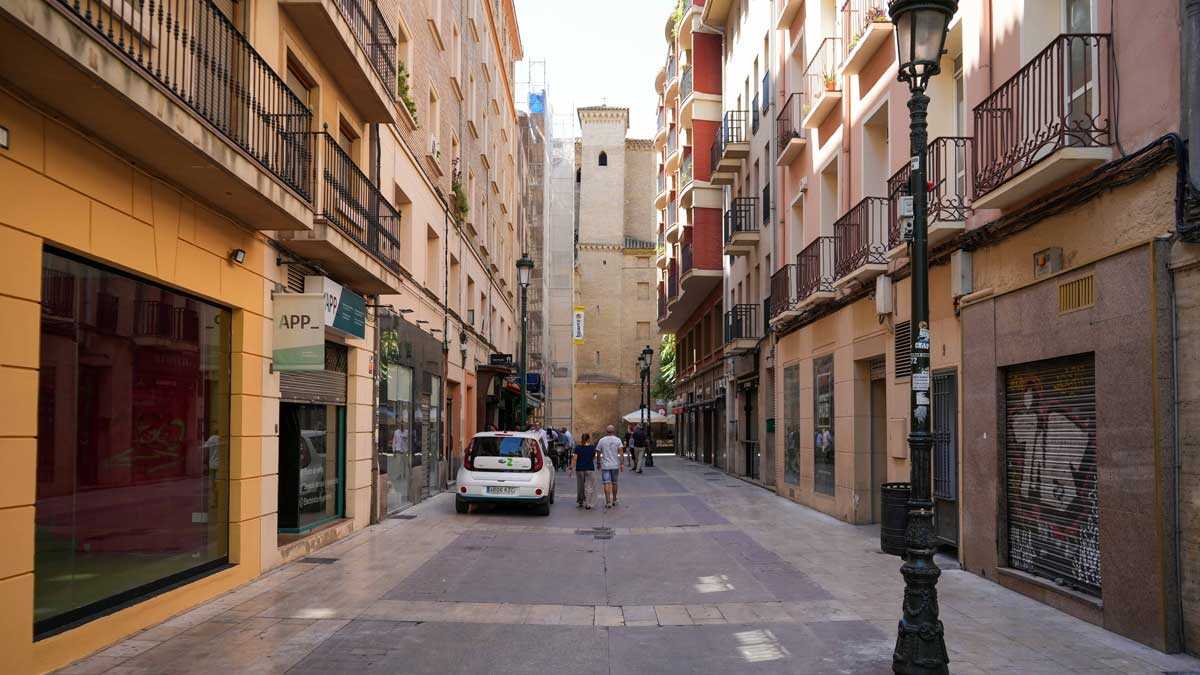
The street was renamed Ossau in honor of José Pellicer, a 17th-century scholar from Zaragoza. Photo: Lorena Dimofte
The change of name did not alter the area’s commercial vocation. Ossau continued to be a place of passage and business throughout the 19th and 20th centuries. At number 1, where tradition places Pellicer’s birthplace, Mantequerías Buisán opened in 1880, selling food products and remaining linked for decades to the area’s commercial life. The business disappeared years ago, but the surname is still associated with that corner. A few meters farther on, at number 9, Impact Hub Zaragoza now operates, a coworking space dedicated to innovation and entrepreneurship. Business plans now emerge from the same commercial surroundings.
Today, Ossau, together with Estébanes, Cinegio and other nearby streets, forms one of the most recognizable arteries of El Tubo. Where there were once fruit shops, warehouses and small businesses, there are now bars, restaurants and terraces filled at all hours. The goods have changed and so has the clientele, but the street’s function has not changed as much: it still brings people together around food.
The next time someone suggests meeting in Ossau for a drink, they should know that the street once had another name, considerably less elegant and much more descriptive. Las Moscas.



