
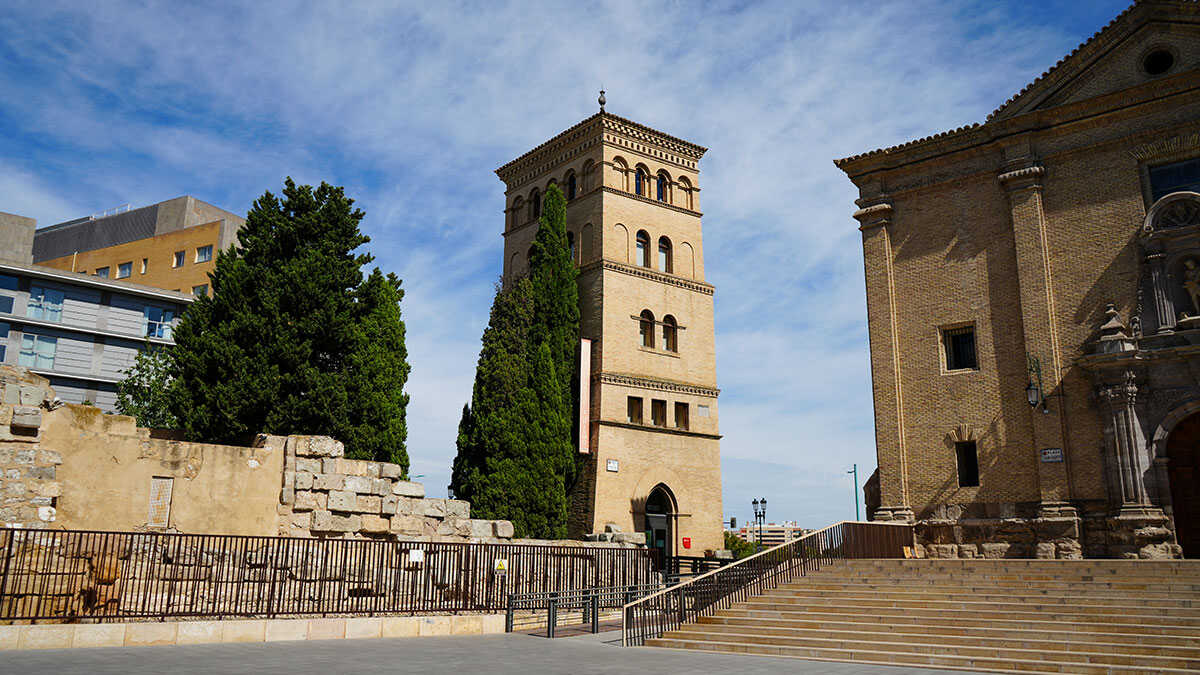
It is the Torreón de la Zuda, the keep of the former Zuda, Azuda or Sudda palace, which has since disappeared. It stands at the northwestern corner of the Roman walls beside the Ebro River and is now home to one of Zaragoza’s tourist offices. But it hides another secret: a spectacular, completely free 360º viewpoint, known as the Mirador de las 4 Culturas, offering spectacular views over the city center all year round.
THE LAST REMNANT OF THE MUSLIM FORTRESS
This site is the last surviving remnant of that Muslim fortress. The Zuda palace was built on one of the towers of the Roman walls and served as the seat of the Muslim governors and the kings of the Taifa of Saraqusta for centuries. In 827, a major rise in the Ebro River destroyed this section of the walls and the bridge, forcing the walls to be rebuilt and several towers to be reinforced—work that is still visible today.
In 1118, King Alfonso I the Battler of Aragon conquered the city, and his first act was to take possession of the Zuda, which became a palace for Christian kings until the 13th century. It later came under the control of the Hospitaller Order of the Knights of Saint John of Jerusalem. The order built a church dedicated to Saint John the Baptist, which was replaced by the current San Juan de los Panetes.
IT ALSO SERVED AS A PRISON AND HOSPITAL
It also served as a royal prison. In fact, James I the Conqueror and his wife, Eleanor, were held at La Zuda in 1224 following the uprising of the Aragonese nobility. It was also a hospital, known as the "Zuda del Hospital," where the knights of the Hospitaller Order of Saint John of Jerusalem welcomed the poor and sick.
In its current form, the Zuda Tower is the result of a rebuilding carried out in the 16th century on one of the former towers of the Roman walls and the Muslim fortress. After an initial restoration in 1885, it underwent several interventions throughout the 20th century. Following the demolition of the ruined buildings surrounding the Zuda, architect Francisco Íñiguez rebuilt the tower between 1946 and 1952, giving it its current appearance.



