
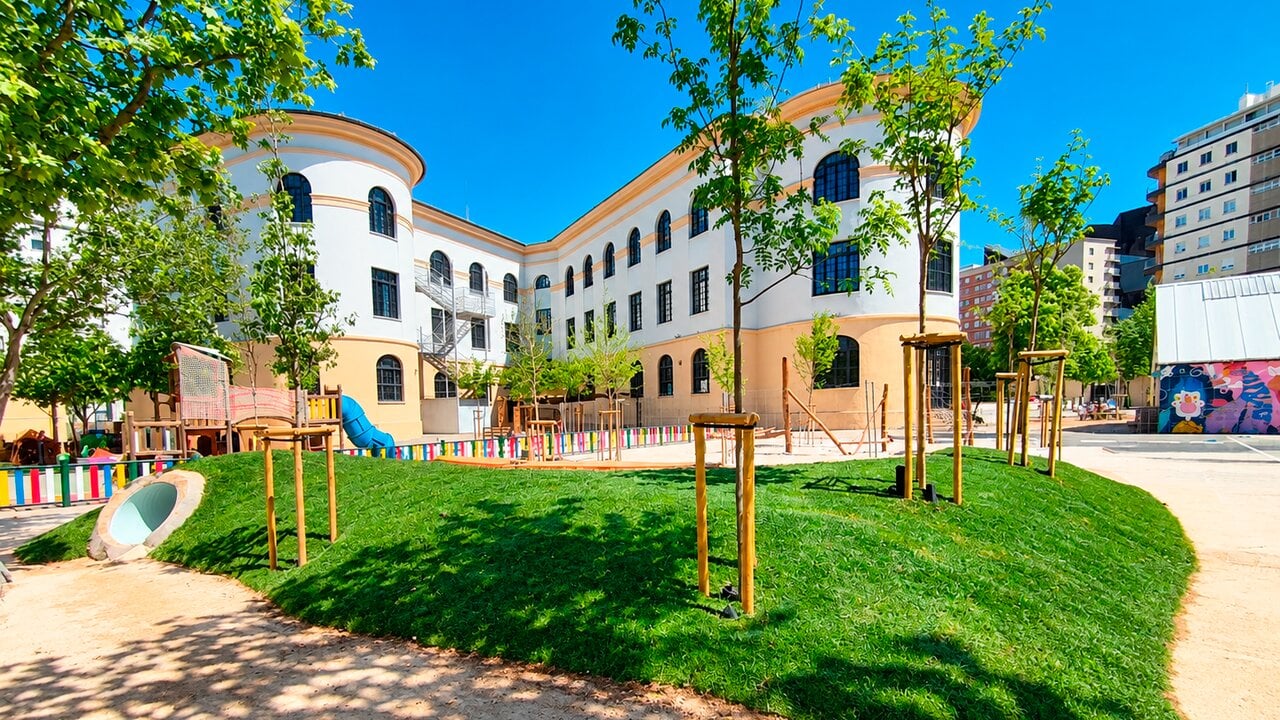
The Zaragoza entry is competing in category A, known as ‘Champions’, reserved for projects that have already been implemented or have begun to deliver results. Specifically, “Adapta tu patio” is a finalist in the “Enhancing circularity, sustainability and innovation” section, thanks to a proposal aimed at transforming educational playgrounds through nature-based solutions.
The programme promotes the addition of vegetation, the creation of new shaded areas, the adaptation of school spaces to withstand high temperatures, improvements to biodiversity and the replacement of grey surfaces with healthier environments. It also has a participatory component, involving education communities, students, families and the schools themselves in transforming these spaces.
This is not the first time that an environmental project promoted by Zaragoza City Council has reached the final of these awards. El Bosque de los Zaragozanos was also a finalist in 2024, likewise in the category for established initiatives. The council highlights that this new recognition comes just days after Zaragoza was named European Green Capital 2028.
Zaragoza’s councillor for the Environment and Mobility, Tatiana Gaudes, said the nomination already represents European backing for the city’s environmental strategy. “Being a finalist, as El Bosque de los Zaragozanos was two years ago, is in itself a major achievement because it represents recognition in Europe for the municipal green strategy and the fight against climate change,” she said.
AN AWARD OF UP TO 25,000 EUROS
Being a finalist in the New European Bauhaus Awards comes with a prize of 5,000 euros, a sum that could increase by a further 20,000 euros if “Adapta tu patio” wins its category or receives the award for the most popular project, based on votes from the public.
The New European Bauhaus Awards recognise initiatives linked to three major principles: sustainability, inclusion and beauty. In addition to the category in which Zaragoza is participating, the awards recognise projects related to local democracy and inclusion, art, culture and heritage, or models capable of facilitating urban transformation.
Zaragoza City Council stresses that reaching the final will also strengthen the city’s ties with other European cities working on new urban models. The New European Bauhaus specifically seeks projects that can serve as references and be replicated in other territories, particularly those capable of responding to challenges such as climate change, adapting cities to heat and biodiversity loss.



