
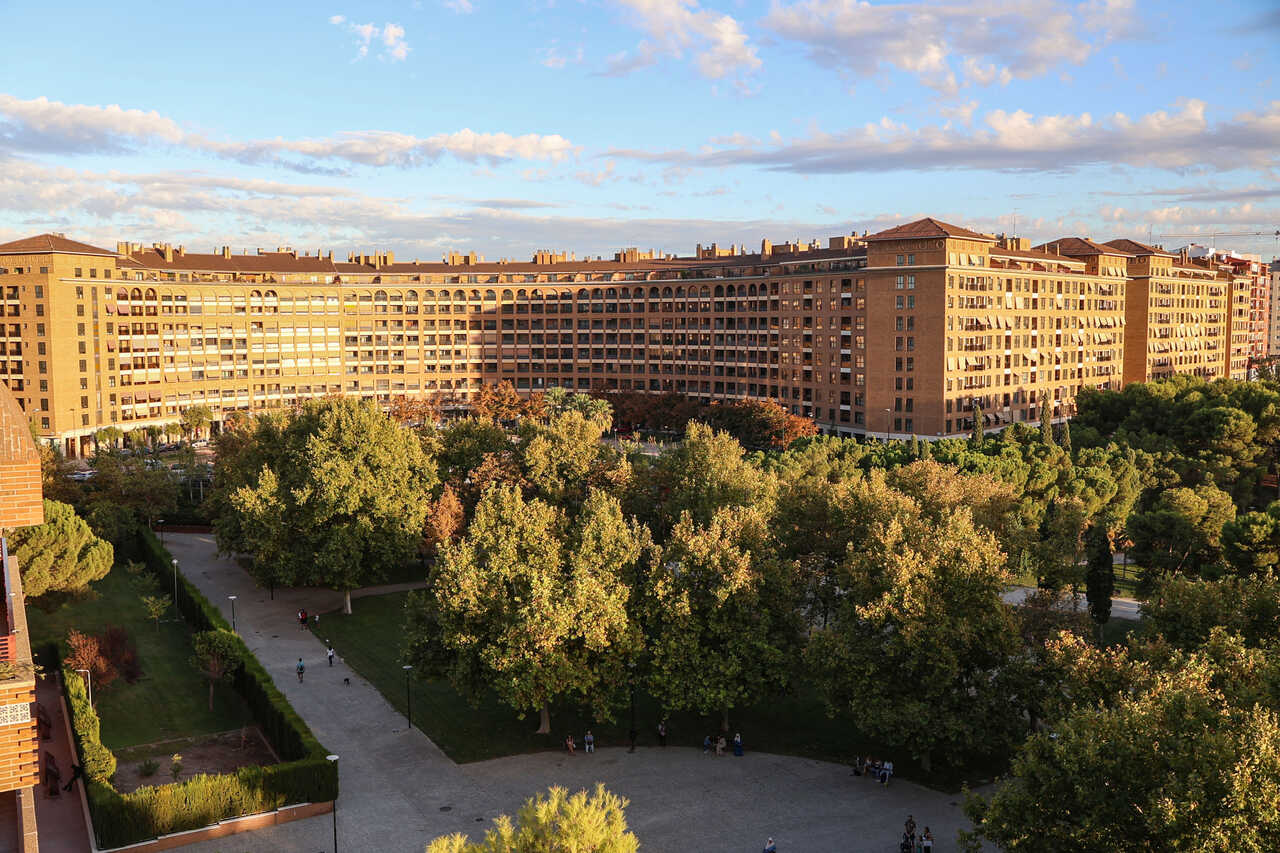
But beneath that same ground lies another, far less pleasant story: that of a factory that closed nearly half a century ago, whose waste remains buried in different parts of the neighborhood. The city grew over it, and the park eventually arrived. Above ground are the grass, paths and riverside walkways along the Ebro; underground lies part of La Almozara’s history, which Zaragoza ultimately covered.
LA ALMOZARA THAT GREW UP BESIDE THE EBRO
The name La Almozara comes, according to the most widely accepted etymological interpretation, from the Arabic al-musara, a term associated with open spaces outside the city walls used for walking, recreation and equestrian exercises. In Zaragoza, that former open area was located near the Puerta de Sancho, in an environment that was still agricultural and closely linked to the banks of the Ebro. The irony is hard to miss: centuries later, in that same outlying landscape, another generation of Zaragoza residents would once again seek out a place beside the river to spend the summer.
But it would be a long time before that beach appeared, and much of the city’s original relationship with the river had to be lost first. Zaragoza began to industrialize and expand, and La Almozara ceased to be the stretch of open orchards beside the river that it had once been. In the early 1870s, the railway bridge connecting the city’s stations crossed the Ebro and introduced a new boundary. The tracks brought the railway closer, but physically distanced the neighborhood from its riverbank, a contradiction that would shape much of La Almozara’s history.
THE CHEMICAL PLANT THAT LEFT ITS WASTE BENEATH LA ALMOZARA
In 1898, Industrial Química de Zaragoza was built beside those same tracks. Among other activities, it produced sulfuric acid by roasting pyrites and gave the neighborhood its lifelong nickname: La Química. The plant closed in 1979, but a team of researchers from the University Institute for Environmental Sciences Research of Aragón has shown in several geological studies that a significant portion of its waste remained there. For decades, it was used to level land and build defenses against flooding, since La Almozara sits on the Ebro’s floodplain itself. Those materials are now found beneath various streets, parks and green spaces, and when water comes into contact with them, it can produce solutions with a pH of 3.2 and mobilize metals such as copper, zinc and cadmium. La Almozara did not merely coexist with its factory; it was built, in part, on what the factory left behind.
It was in that same area, between Tiro de Pichón and the La Almozara bridge, that Playa de los Ángeles stretched out. The city government itself defined it in its project for the Ebro’s riverbanks and shores, placing it between the river to the north, Sierra de Vicor Street to the south, Tiro de Pichón to the west, and Plaza de Europa and the bridge to the east. It covered a stretch of about 525 meters, beginning near Almunia de Doña Godina Street. The original beach had no facilities or formal amenities, just an open stretch of stones that filled with people on hot days. In a working-class neighborhood with few green spaces, it is easy to imagine who found there a free way to spend the summer.
PLAYA DE LOS ÁNGELES, ZARAGOZA’S LOST BEACH
The end did not come overnight, nor was it summed up in a single order. The deterioration of the Ebro’s water quality and changing environmental conditions in the city made that recreational use increasingly rare, until swimming in the river stopped being a custom and became a memory. Municipal documentation on Zaragoza’s former bathing areas records that Playa de los Ángeles fell into disuse. It was not until the 2008 International Expo that the city once again turned its attention to that stretch of riverbank. The Riverbanks Plan transformed the former stony beach into today’s park and even preserved the name of the vanished beach at an old kiosk.
Playa de los Ángeles disappeared without Zaragoza needing to demolish it. It was enough for the river to change, the city to change and the way people viewed that shoreline to change. Today, it is hard to imagine someone spreading out a towel in that same spot to spend the afternoon. The beach did not need to disappear for Zaragoza to stop seeing it.



