
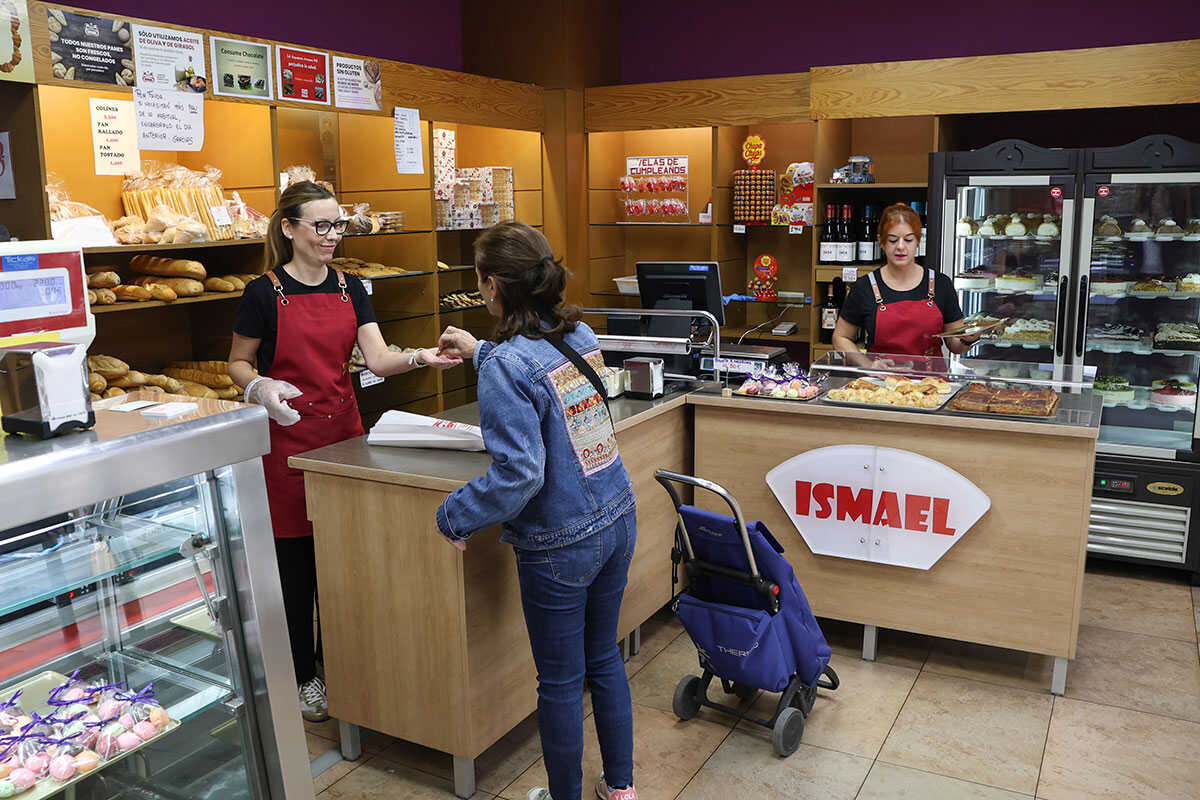
Horno Ismael has been part of Zaragoza’s pastry-making history since 1978. Over more than four decades, several generations have passed through its shops, turning some of its traditional sweets into essentials for celebrations, afternoon snacks and family gatherings.
Since its beginnings, the bakery has championed handcrafted production, a philosophy it continues to uphold today thanks to its own bakery workshop, one of the company’s main distinguishing features. Every day, it produces pastries, cakes and other baked goods, combining traditional recipes with a careful selection of ingredients and close attention to every stage of the process.
Over the years, Horno Ismael has grown to currently operate three shops in Zaragoza, on Juan José Lorente, San Vicente Mártir and Gómez de Avellaneda streets. But behind that expansion lies the same idea with which it began: making handcrafted sweets and maintaining a close relationship with everyone who walks through the door each day.
Horno Ismael currently has 3 shops across Zaragoza and its own bakery workshop.
A THIRD GENERATION TAKES THE REINS
A new generation is now beginning to take the reins at Horno Ismael. Raúl Ferrero, the current owner’s son, and his partner, Cristina Navarro, left their jobs in pharmacies to join the family business. He runs the bakery workshop, while she is mainly responsible for the shops.
Raúl Ferrero grew up closely connected to the family business, which is now undergoing its generational handover alongside Cristina Navarro.
Raúl grew up connected to the bakery and, like the rest of the family, always lent a hand whenever needed. "In reality, we have always been connected to the business. We did not work there continuously, but we did come in to help whenever needed, just like our cousins and the rest of the family," he explains.
The handover ultimately came about differently from what had been expected, and Raúl decided to take it on together with Cristina. They are now learning every day at the helm of the company, with the support of their family. "The good thing about a family business is knowing that you can call your mother, your uncle or your father and, if any problem comes up, they will be there to lend a hand. We are not alone," Raúl says.
Taking this step also means assuming a responsibility that goes beyond the business itself. "We are very enthusiastic, although also afraid. In the end, you take charge of a company, and it is normal to feel some concern," Cristina acknowledges.
THE SAME DOUGH THEIR GRANDFATHER USED TO MAKE
One of Horno Ismael’s key features is precisely that the passage of time has barely changed the way its products are made. The bakery workshop continues to operate by hand, using a formula the family has preserved from one generation to the next.
"In the morning, we make the dough using exactly the same formula our grandfather used. We still work practically the same way, even with many of the same utensils," Raúl explains.
The bakery workshop produces the items that are later delivered to Horno Ismael’s three shops in Zaragoza every day.
The work begins with the most basic processes. Eggs are cracked one by one, the fruit for Frutas de Aragón is cut and coated by hand, and the tea pastries continue to be prepared using a piping bag. Modern machinery plays a limited role compared with products that depend to a large extent on the hands of those working in the bakery workshop.
Cristina and Raúl have introduced some new products since taking over the business, but always within the same tradition. Among them is a larger croissant filled with and coated in chocolate. "Anything new we make has to fit with our pastries and with the way we work," they both say.
The decision also reflects what customers who have been visiting their shops for years expect. "People come to buy brevas and tell us: ‘They are the same as the ones I used to buy when I was a child.’ That flavor takes them back to their childhood. It has been preserved because we continue to make the products practically as we did at the beginning," they explain.
KING CAKES, CHRISTMAS AND THREE DAYS OF MADNESS
If there is one period marked in red on Horno Ismael’s calendar, it is Christmas. Work begins weeks earlier with turrón and continues with the sweets typical of the season, New Year’s Eve products and, finally, King cakes.
"Christmas is undoubtedly the busiest time of year. December and January," they explain. Turrón production begins in mid- or late November, followed by one of the year’s most intense campaigns. San Silvestre logs and other Christmas products follow one another until January 6.
On that day, the bakery workshop completely changes its usual pace. The family throws itself into the work, and any help is welcome. "You do not sleep that day. Any family member who shows up comes to lend a hand. It is absolute madness," Raúl recounts.
The figures help convey the scale of those days: they estimate that they can make around 8,000 King cakes over the three-day period, all through a process that begins long before the product reaches the display window. "The dough has to be kneaded, left to rise, baked and filled. When someone simply thinks of ‘a King cake,’ they may not realize all the time and processes behind it," Cristina explains.
A NEIGHBORHOOD BAKERY WITH LIFELONG CUSTOMERS
Horno Ismael’s three shops welcome regular customers who have been buying there for years, as well as people who discover the business by chance or through a recommendation. The personal service is one of the defining features of a relationship built over time.
Horno Ismael’s shop maintains its close personal service with a customer base made up of several generations of Zaragoza residents.
"Some people have been coming for a very long time. They are people you have practically known all your life, you know their names and there is a great deal of trust," Cristina says. At the same time, the display window continues to act as an invitation to passers-by who decide to come inside.
THE CHALLENGE OF REMAINING CLOSE TO CUSTOMERS
Horno Ismael’s future depends on maintaining this way of working while Raúl and Cristina finish assuming all the business’s responsibilities. The company currently employs 18 people, and both know that the generational handover involves much more than learning how to make the products.
"There is also the responsibility of preserving everything that has been built and making sure it continues to work. There are 18 of us, so sometimes it is a little daunting to think that there are 18 salaries to keep paying," Raúl acknowledges.
They intend to ensure that their relationship with the team remains as close as the one they have experienced within the family. "We try to make it function like one big family. If someone has a problem, we want them to be able to talk to us about it," they explain.
As the bakery workshop continues preparing doughs, pastries and baked goods that have accompanied several generations of Zaragoza residents, Horno Ismael is entering its next stage: with a new generation at the helm, but with its recipes, handcrafted work and close relationship with customers as its starting point. It is a traditional Zaragoza bakery looking to the future without abandoning the way of making pastries with which it began in 1978.



