
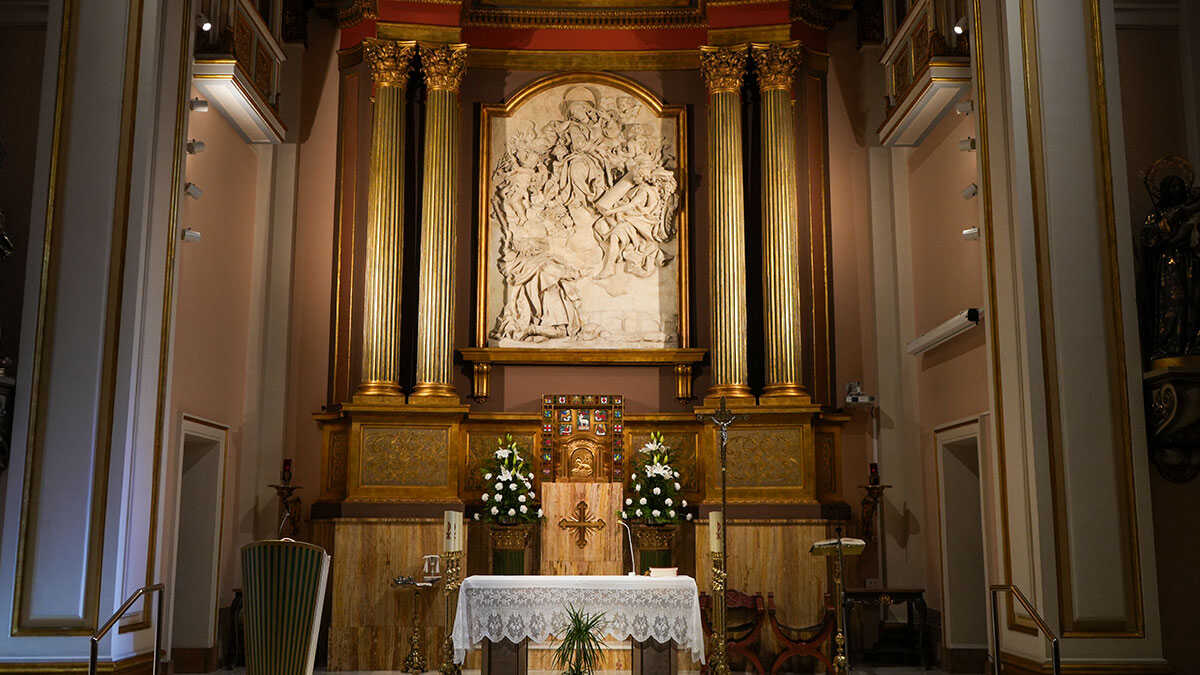
Before Serrano’s relief, there was another. Its creator was Zaragoza sculptor Antonio Torres Clavero, who had been working on it since 1943 and completed a first version around 1954. The work was never installed on the façade, but neither did it disappear. It still exists just a few metres away, in a chapel at the Hospedería del Pilar, where it remains practically hidden from visitors to the basilica.
THE STATUES OF ZARAGOZA’S PILLAR BASILICA THAT NO ONE LOOKS AT CLOSELY
Let’s start with what you can see, although you do not really see it all. Eight statues stand out against the sky above the façade’s balustrade. From below, they look like decorative figurines, almost ornamental. In reality, each one is three and a half metres tall and weighs around 20 tonnes—the equivalent of three city buses, up there since the 1950s.
Seven of those eight stone saints were carved by Torres Clavero. The eighth, Saint Vincent de Paul, was created by Félix Burriel. And here comes the first detail that changes the way you look at the façade forever: each statue was paid for by a different institution, almost as if Zaragoza had organised a religious crowdfunding campaign under Franco. The Chamber of Commerce funded Saint Braulio. The City Council paid for Saint Valerius. The Chapter paid for Saint James. The Piarists commissioned their founder, Saint Joseph Calasanz. The Knights of the Pillar paid for Saint Vincent Martyr.
And Saint Engracia? Take a look the next time you pass by: right beside her there is a coat of arms from Huesca. It is neither coincidence nor a stonemason’s mistake. The Huesca Provincial Council paid for that statue because the parish of Saint Engracia then belonged to the Diocese of Huesca. It is a detail you have been seeing all your life without knowing why it was there.
THE PILLAR BASILICA RELIEF THAT WAS NEVER INSTALLED
Torres Clavero, the same sculptor who carved seven of those statues, described his relief of the Coming of the Virgin as the crowning work of the entire monumental façade. He finished it in the same year he completed the balustrade statues, 1954. And then nothing happened. For 15 years, the relief simply was not installed, until a completely different, more modern version by Teruel-born sculptor Pablo Serrano was chosen in 1969. The one Torres had carved with his own hands was, quite literally, left without a place.
Coming of the Virgin on the façade of the Pillar Basilica. Photo: David Graner
No one destroyed the rejected work, at least. It is still standing, serving as an altarpiece in the chapel of the Angelic Mothers at the Hospedería del Pilar, a short walk from the main square. Eleven larger-than-life figures, nine metres high and five metres wide, with the Virgin surrounded by angels at the top and Saint James with the group of the Converts below. The façade that might have been has been waiting silently for more than 70 years in a corner where almost no one stops.
THE TWO ANGELS WHO HAVE NAMES AND SURNAMES
Look at the façade again. In the centre, above the Chapter’s enormous coat of arms—the one featuring the pillar and the mystical lamb—are two winged figures you have probably never noticed. They are not generic angels; they have names. The one on the left is the Angel of Prayer, with his head bowed and hands clasped. The one on the right is the Angel of Purity, standing upright with a lily stem in his hand.
And above each of the side doors there are more musical angels, each pair with its own symbolism. Above the Virgin’s door, one holds a lyre and the other a musical score, beside a coat of arms bearing the letter “M” for Mary; above Saint James’s door, they play the trumpets of the Last Judgment, beside a vase of lilies identifying the Chapter. From the square, all of this looks like background decoration. Up close, the façade tells a much more complex religious story than it appears to.
THE NAME LEFT OFF THE FAÇADE
There is also one final irony in Torres Clavero’s story. He created what would be the most important sculptural commission of his career, worked on it for more than a decade and received the City’s Silver Medal in 1955 in recognition. Even so, Zaragoza never held a retrospective exhibition dedicated to him during his lifetime. Today, his name is practically unknown even to those who pass his work every week.
We have been able to reconstruct all this thanks to his daughter, María Luisa Torres Perala, who kept her father’s graphic documentation and memorabilia at home for decades. Without that family archive, the other façade of the Pillar Basilica would remain, quite literally, invisible.



