
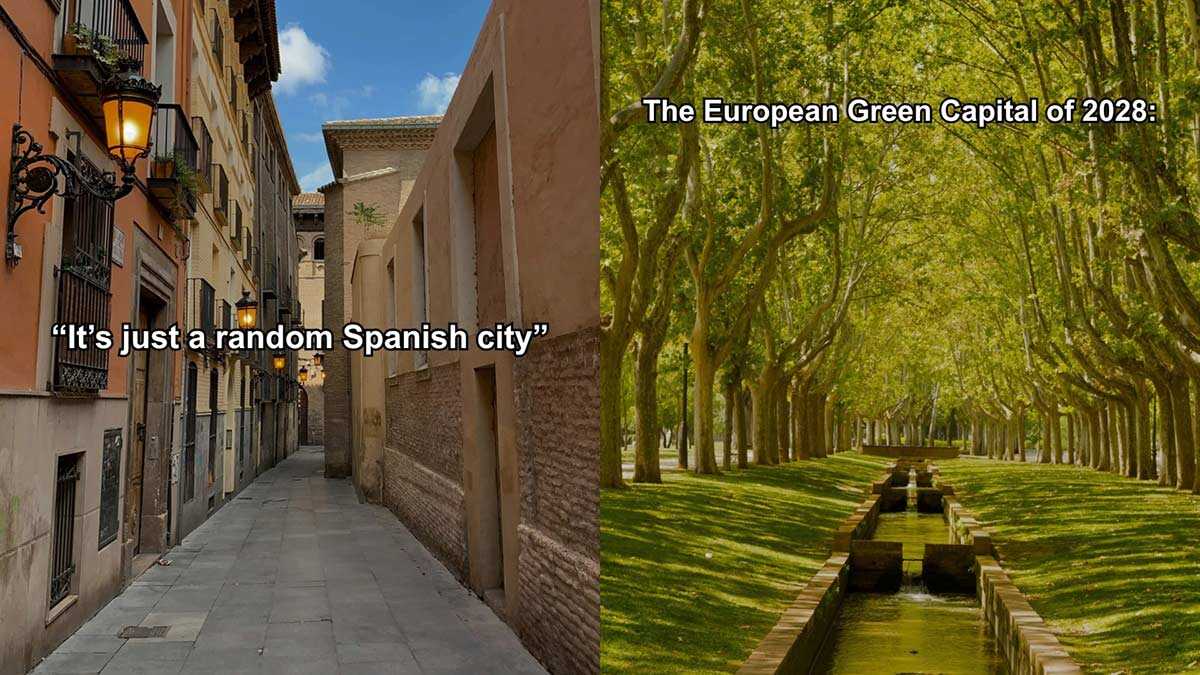
The post, which has also been shared by Environment and Mobility Councillor Tatiana Gaudes, among others, opens with the English phrase "It's just a random Spanish city" before presenting a series of recognizable images of the city. The streets of the Historic District, Parque Grande José Antonio Labordeta, the Basilica of El Pilar and the Ebro River share the spotlight with the tram and the Aljafería Palace in a visual journey showcasing both the Aragonese capital's historic heritage and its green spaces and urban life.
The message's light-hearted tone contrasts with the significance of the recognition the Aragonese capital has just received. The city was chosen as European Green Capital 2028 on October 8 in Guimarães (Portugal), following months of work to promote a bid that reached the final for the first time. The distinction provides important international exposure for Zaragoza and Aragon, as well as €600,000 in funding.
A FIRM COMMITMENT TO TACKLING NOISE POLLUTION
Beyond its images, the European Commission uses the post to explain some of the reasons Zaragoza earned the recognition. The institution highlights the city's long-term commitment to sustainability and environmental management, while also focusing on a problem that often goes unnoticed: noise pollution.
In this regard, Europe emphasizes the city's decision to anticipate noise problems rather than act only once disturbances have occurred. Planning quieter homes, using smart building design, creating green barriers and carrying out targeted interventions in the noisiest areas are among the measures cited in the post to help create healthier, more peaceful neighborhoods.
Zaragoza's challenge will now be to turn that recognition into reality on its streets during 2028. The city plans more than 150 initiatives linked to biodiversity, water, the circular economy, the energy transition and adaptation to climate change, including projects such as Ebro Vivo and proposals to strengthen citizens' commitment to the environment.



