
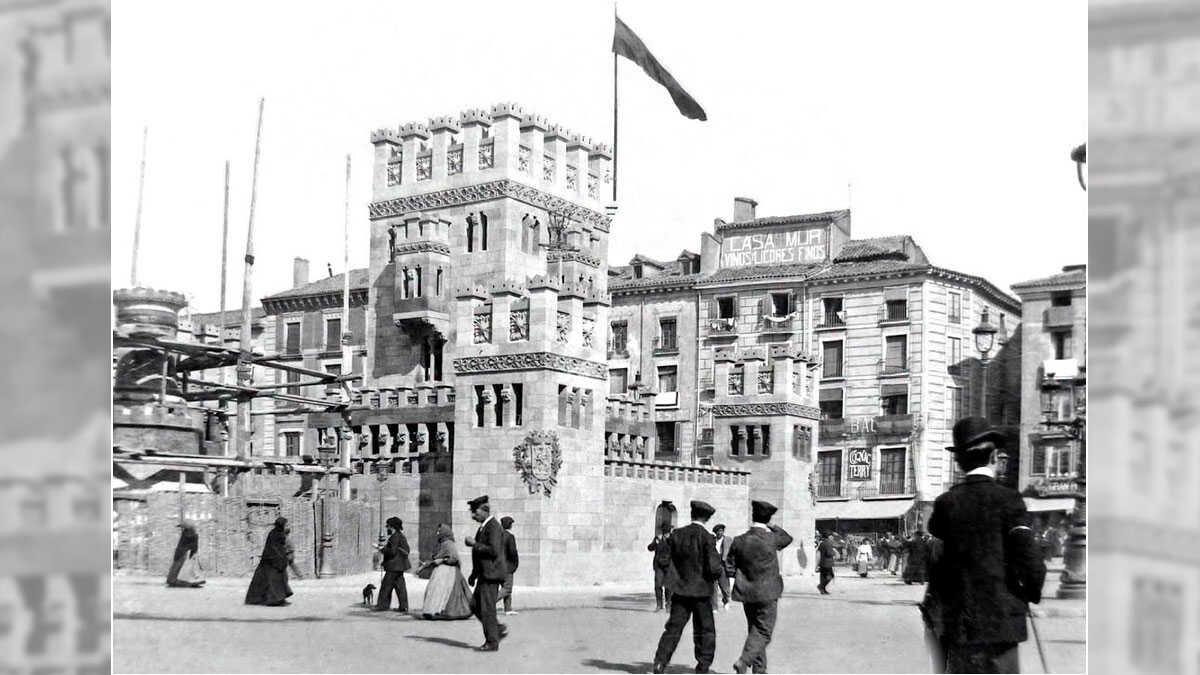
The curious thing is that the castle never caught fire—and this is where the story gets interesting, because it was saved by a monument that was about to be unveiled right in front of it and that, as we will see, also had a great deal to do with Zaragoza’s firefighters.
Fireworks castle erected for the 1904 Pilar Festival and designed by Ricardo Magdalena. Photo: Coyne, Provincial Historical Archive
A CASTLE BUILT TO BURN
In August 1904, the City Council commissioned Ricardo Magdalena to build a castle for the Pilar Festival. The press described it as an 18-meter-square structure standing 16 meters high in Plaza de la Constitución (now Plaza de España), with an office on the ground floor providing visitors with the addresses of guesthouses, fireworks and a volcano at the top, accompanied by a simulated fire-extinguishing operation on the final day of the festivities. In other words, it was a primitive visitor information office housed inside a structure designed to burn.
According to the study that reconstructed it, it was probably built from wood and papier-mâché made to resemble cut stone, with a 324-square-meter base, a central two-tiered keep, four corner towers, battlements everywhere and the city coat of arms among laurel branches at the corners. Magdalena’s pen-and-ink drawings, with decorative notes, are preserved in the Municipal Archive.
THE ARCHITECT IN CHARGE OF THE FIRE DEPARTMENT
Magdalena was no ordinary architect. At the time, directing the fire department was one of the duties of the municipal architect, meaning that the person who designed the city’s buildings was also responsible for putting them out when they caught fire. The idea of a drill was neither new nor particularly appealing to him. In 1897, firefighters had staged a fire in a small castle during a charity bull-calf event, and in 1900 Magdalena issued a report opposing another drill involving a small tower, citing its short duration and drawbacks. The project was shelved. Four years later, he was commissioned to do the same thing—this time with an entire castle.
Nor was it the first time he had drawn a fortress for the firefighters. For the 1895 parade celebrating the inauguration of the School of Arts and Crafts, which ended in Plaza del Pilar, he designed the municipal firefighters’ float, showing helmeted men standing guard before a square tower with a fire engine.
October 1904. Inauguration of the Monument to the Martyrs of Religion and the Homeland in Plaza de la Constitución. Photo: Coyne. GAZA Project, Gran Archivo Zaragoza Antigua
WHAT LASTS AND WHAT GETS IN THE WAY
The square had already hosted a similar spectacle. In October 1903, during the Pilar Festival, Alfonso XIII visited Zaragoza, and the future monument’s pedestal was decorated. A few meters away, the arch of the Royal Maestranza was erected, topped with a design imitating the railings that Guimard had drawn for the entrances to the Paris Metro. The press reported 88 arc lamps, plus another 26 installed by the municipality in streets and squares, as a field Mass was held before the pedestal. By those standards, a papier-mâché castle did not seem at all extravagant.
The press raised concerns about the heat from the fire potentially damaging the tram cables, the nuisance to local residents and the fact that, once completed, destroying the castle by fire would seem like heresy. But the decisive protest came from the Royal Aragonese Economic Society of Friends of the Country, which was concerned about the Monument to the Martyrs it was about to donate to the city and which stood only a short distance away.
There was no drill. The City Council, with construction already well advanced, used it for five nights to launch fireworks.
THE ANGEL THAT CAME FROM HAVANA
The castle had a monument in front of it that would change its fate. In 1897, a monument to the firefighters who died in the 1890 fire at the Isasi hardware store was unveiled at Havana’s Colón Cemetery. The work was created by Agustín Querol. According to a University of Granada study on monuments by Spanish sculptors in Latin America, it features 28 medallions with portraits of the deceased and is topped by an Angel of Faith leading a firefighter’s body into eternity. Years later, Querol revisited the figure in Zaragoza, where it was interpreted as the victorious angel holding the body of a dead baturro.
The base designed by Magdalena—octagonal at the bottom and cylindrical with a battlemented top, like a keep—looks like another castle. Thus, the city placed a cardboard fortress behind a monument so firefighters could put out a fake fire, while its angel had been created to carry a real firefighter to heaven.
THE CASTLE NOBODY WANTED TO BURN
On October 23, 1904, the square filled with people for the inauguration of the monument, with the castle still standing behind it. Days later, its demolition began, and contemporary accounts say that the governor was drafting the demolition order as the battlements came down, referring to it as the “obnoxious monument.”
Magdalena was also the person who, without charging a fee, designed the lanterns for the Mysteries of the Crystal Rosary procession held every October 13, and the brotherhood named him a Benefactor Brother in 1892. The lanterns designed to last have survived, while a castle designed to burn was lost without ever catching fire. One wonders how many things in this city have disappeared because they were in the way, rather than because they caught fire.



