
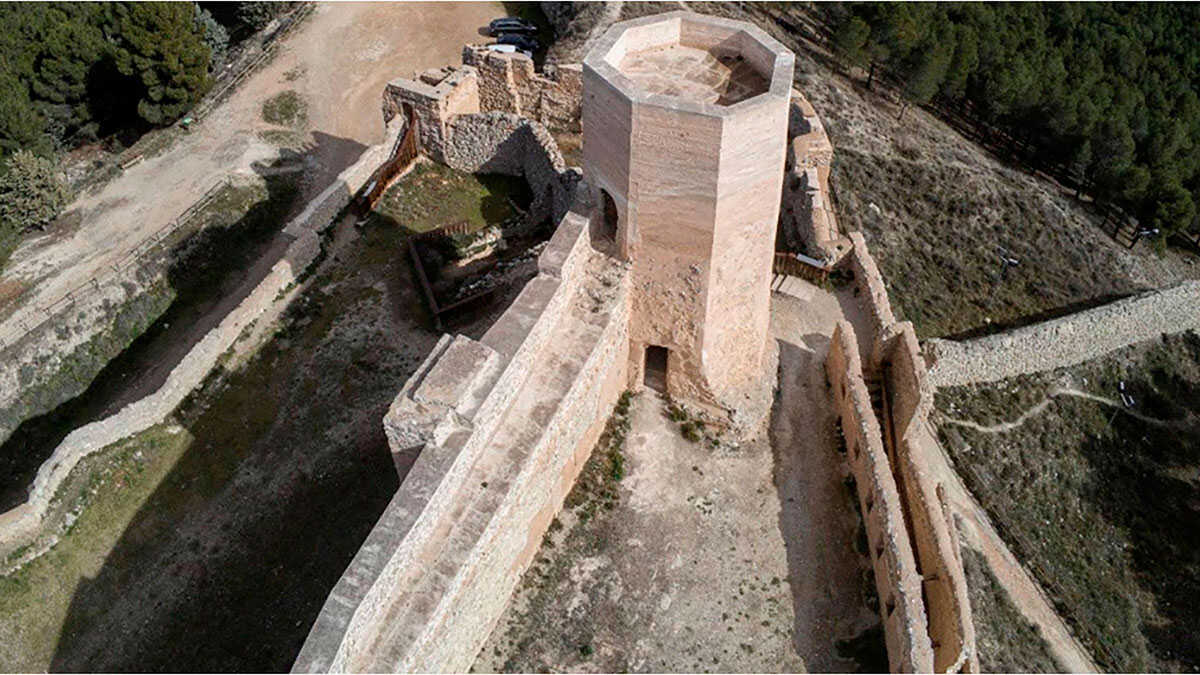
It is the fortified enclosure of Calatayud, a walled complex with an approximate perimeter of 4 kilometres that has remained virtually unchanged since its construction during the Islamic period. The original wall was probably built during the first half of the 9th century, when it surrounded the urban centre and connected several fortifications in the area. The enclosure was expanded in subsequent centuries, although questions remain about the exact layout of the walls built or modified during the 13th and 14th centuries.
AN ENCLOSURE CONNECTING FIVE CASTLES
The fortified complex consists of five castles connected by different sections of wall, forming an irregular enclosure of around 25 hectares. The defensive structure was built mainly with rammed earth and gypsum-stone facing, set directly on the bedrock, which was carved to artificially increase the height and strength of the defences. Remains of the former dry moat can still be found in some areas.
The fortified enclosure of Calatayud is divided into eight sectors, with the Castillo de Ayub, also known as Castillo Mayor, being one of its most representative features. The so-called Emiral Gate, incorporated into the section of wall linking Castillo Mayor with the Soria Gate, is another highlight. Its name refers to the era of Emir Muhammad I of Córdoba, and its construction has been dated to around 862, making it one of the oldest known Muslim architectural features on the Iberian Peninsula.
SIX YEARS OF WORK THAT IS STILL CONTINUING
The accumulated deterioration led to the fortified enclosure of Calatayud being included on Hispania Nostra’s Red List of Heritage in 2008 because of the risk of disappearance it faced. The situation began to change with successive projects promoted by Calatayud City Council in recent years. Between 2019 and 2025, a total investment of 4,249,254 euros was made to conserve, restore and enhance the complex.
The work carried out includes the restoration of the eastern tower and the front façade, the reconstruction of the northern wall of Castillo Mayor, the recovery of the Albarrana Tower and various projects involving the access point and the wall sections of the Torre Mocha enclosure. A network of trails and viewpoints has also been developed, and an employment workshop has been launched to restore the natural surroundings of Castillo Mayor.
This entire process has enabled the fortified complex of Calatayud to be included on the Green List. The enclosure, declared an Asset of Cultural Interest (BIC), now enjoys a new lease of life.



