
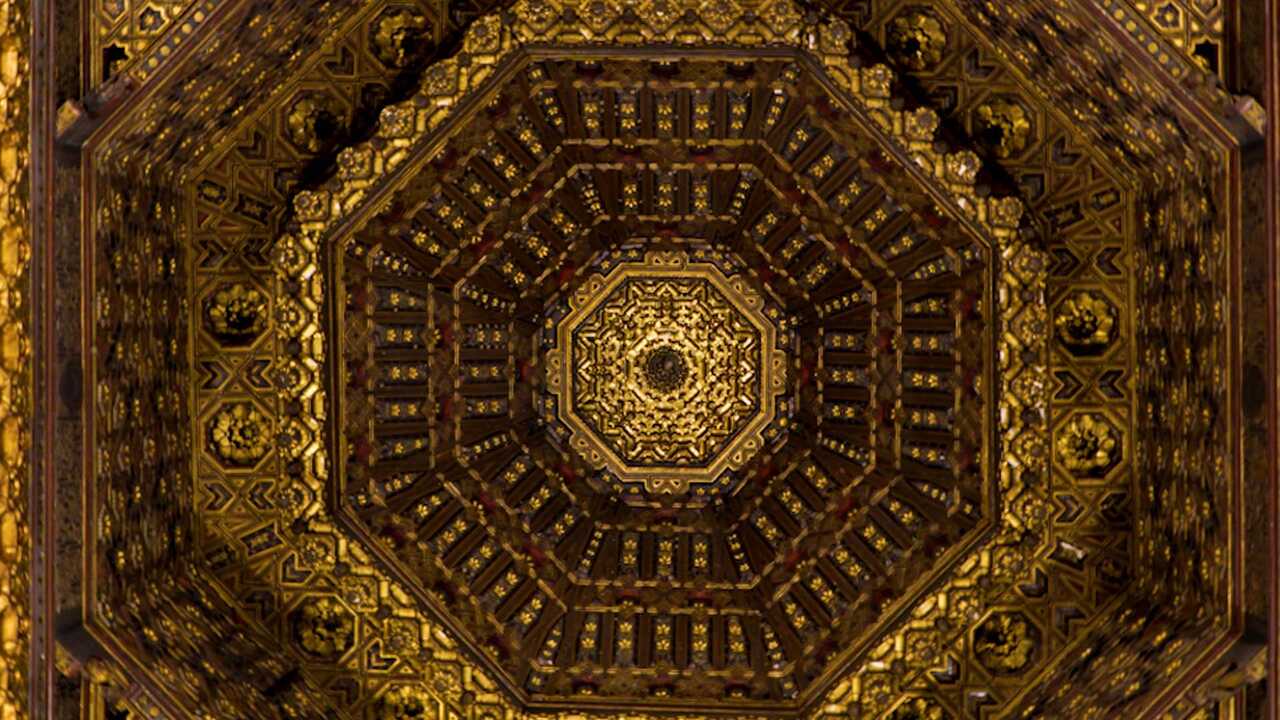
The Parroquieta, the popular name for the Chapel of Saint Michael the Archangel, was built in the 14th century at the initiative of Archbishop Lope Fernández de Luna, who conceived it as his own burial place. Considered one of the finest examples of Aragonese Mudéjar architecture, it is also one of the monumental complex of La Seo de Zaragoza’s spaces of greatest artistic and heritage value.
Directly beneath this chapel is the crypt of Saint Michael, an underground space reached by descending about six meters down a narrow stone staircase. The square-shaped room is one of the few surviving examples of 14th-century architecture in Zaragoza. As Daniel Granada, La Seo’s director of worship, explained to ARAGÓN DIGITAL, “it is one of the few surviving buildings from this period in the city, along with the Monastery of the Canonesses of the Holy Sepulchre.”
It is an underground space reached by descending about six meters down a narrow stone staircase. Photo by David Graner, exclusive to this article
The crypt was restored between 2011 and 2013, after being used for centuries as a coal cellar and storage room. The work brought to light a medieval space that had been practically hidden from the public and restored much of its historical value.
Among the room’s most notable features are its corbelled vaults, a primitive construction technique in which the pieces are placed in stepped layers, with each ring gradually closing toward the center until the space is completely covered.
A MEDIEVAL CRYPT BUILT WITH STONES FROM THE ROMAN WALL
The site’s uniqueness does not end there. The first layers of stone forming the walls came from Zaragoza’s Roman wall, built in the 3rd century. In this way, the 14th-century crypt reuses materials more than a thousand years old, creating a space where two fundamental periods in the city’s history coexist.
Among the room’s most notable features are its corbelled vaults. Photo by David Graner, exclusive to this article
During the 18th century, a bishop ordered a major renovation to adapt the enclosure to the Baroque taste. That intervention altered part of the original structure and left several religious sculptures unused. Because they were sacred images, they had to be buried beneath the floor of the crypt itself.
It was not until the restoration carried out between 2011 and 2013 that fragments of these pieces, hidden for centuries, were discovered.
The burial place of Don Lope Fernández de Luna is located directly above this space, crowned by one of the Parroquieta’s most distinctive structures. A dome rises over his tomb, transforming a square floor plan into an octagon. “Its golden decoration is not accidental: it symbolizes heaven and reinforces the funerary and spiritual character of the complex,” Granada notes.
THE PARROQUIETA MARKS 25 YEARS AS A WORLD HERITAGE SITE
The Parroquieta forms part of the Mudéjar Architecture of Aragon complex recognized by UNESCO as a World Heritage Site. Next December 12 will mark 25 years since the expansion of this designation, carried out in 2001.
Initially, the international recognition focused on several monuments in Teruel and nearby towns. Later, the designation was expanded to include buildings in Zaragoza, among them La Seo Cathedral and the Church of San Pablo.
At La Seo, the main surviving Mudéjar elements are the former apses, the exterior wall and the Parroquieta itself, considered one of the masterpieces of this artistic style.
Today, this space can be visited through guided tours organized by Zaragoza Tourism.
LA SEO’S BASEMENTS: A HISTORIC WINE CELLAR AND A 16TH-CENTURY ROOM
A visit to the cathedral’s underground areas also reveals other spaces that are usually closed to the public. Among them is a room beneath the Main Sacristy, reached via 16th-century ceramic stairs that connected the two levels of this part of the building.
The room retains a ribbed vault and masonry and stone walls. Although there is no absolute certainty about its original function, it may have been used for burials or storage work.
This site houses numerous large earthenware jars. Photo by David Graner, exclusive to this article
Another of the most striking spaces is La Seo’s historic wine cellar, located between the temple’s fourth and fifth former apses. It retains its original floor and houses numerous ceramic jars from Calanda, as well as early 20th-century barrels or vats.
The large jars, now empty, were formerly used to store grain and oil. The barrels, however, remain in use and contain wine from Cariñena intended for the cathedral’s liturgical celebrations. The wine arrives directly through an entrance on San Bruno Square and ages in this unique underground space.
Detail of the original floor. Photo by David Graner, exclusive to this article
The sacristans are responsible for preserving these spaces and the other elements related to worship. Granada recalls that La Seo’s daily activity has undergone a profound transformation in recent decades. “While half a century ago the cathedral had around 50 priests, today approximately a dozen serve the two Zaragoza cathedrals together,” he concludes.



