
This unusual passageway is now one of the town’s main tourist attractions. Its limited size draws the attention of travelers and fans of architectural curiosities, who come to this part of the Cinco Villas to discover one of the country’s most unique urban spaces.
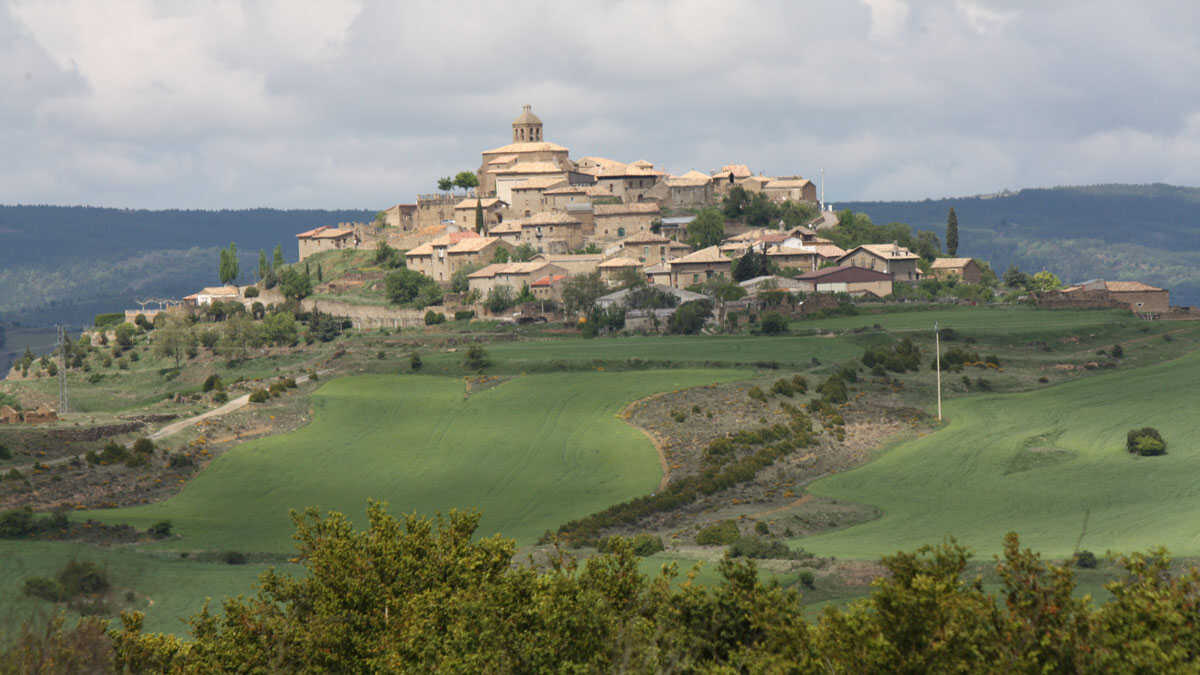
Urriés is located in the Bal d’Onsella and retains the peaceful atmosphere typical of Aragón’s small towns. However, the presence of “El Callejón” has given it special prominence, as the narrow street once appeared in the Guinness Book of Records and put the town on the map of Spain’s most curious destinations.
ORIGIN AND HISTORY OF SPAIN’S NARROWEST STREET
Although the exact origin of “El Callejón” is unknown, it is possible to infer why it has such a narrow structure. Urriés is a town of medieval origin, and its urban layout reflects the typical characteristics of that period. Narrow, winding streets were common in medieval settlements, as they offered defensive advantages by making it harder for potential invaders to pass through and created cooler, more pleasant microclimates for residents.
It measures 41 cm and attracts tourists: Spain’s narrowest street is in Aragón. Photo by Zaragoza Provincial Council on Facebook
Also known as Spain’s narrowest street, it is located next to the medieval church of San Esteban, in the town’s former Jewish quarter. One noteworthy detail in the street’s history is that it was closed to pedestrians for years because of hygiene and sanitation problems, as the accumulation of waste in such a narrow space made it difficult to clean. However, it was reopened to the public in 1955, allowing residents and visitors to rediscover this unusual corner of the town.
WORLDWIDE RECOGNITION
The street’s unusual structure attracted so much attention over the years that it eventually earned a place in the Guinness Book of Records and received the title it holds today as Spain’s narrowest street. At just 41 centimeters wide, Urriés’ “El Callejón” is narrower than other tight alleyways in Spain, such as Zanjilla Street in Soportújar, Granada, and Calleja del Pañuelo in Córdoba.
In fact, there is more: this narrow passageway, which is a challenge even for the slimmest people, is the second-narrowest street in Europe, surpassed only by Spreuerhofstrasse in the German city of Reutlingen, which is 31 centimeters wide. Its status as Spain’s narrowest street has made Urriés a curious and appealing destination for those interested in discovering the country’s most unusual corners.
WHAT TO SEE IN URRIÉS BESIDES “EL CALLEJÓN”
Urriés, a town located in Zaragoza’s Cinco Villas region, offers many more points of interest than simply having Spain’s narrowest street. Around 140 kilometers from Zaragoza, this small municipality invites visitors to explore its rich history and enjoy its impressive natural landscapes.
The town’s architectural gem is the Romanesque church of San Esteban, mentioned above, which is famous for its old linear Gothic murals, now preserved at the Diocesan Museum of Jaca. The building is not only a testament to Urriés’ medieval past, but also serves as a cultural center for residents and visitors.
Casa Borgas is another local landmark, representing the region’s aristocratic architecture. Walking through Urriés feels like traveling back in time, with every corner and alleyway telling stories from centuries of history.
Options for nature lovers in Urriés
Likewise, for outdoor enthusiasts, Urriés is an ideal starting point for hiking trips. The route to the Magdalena hermitage is particularly popular, offering an accessible and rewarding 13-kilometer round trip. The trail is not only perfect for families, but also gives hikers the chance to observe the local flora and fauna, culminating in spectacular views from several lookout points along the way to the hermitage.
From the summit, visitors can enjoy panoramic views over the Monte Cincovillés and spot neighboring towns such as Lobera de Onsella, Longás and Sos del Rey Católico, each with its own historical and cultural heritage. With its unique combination of history, culture and nature, Urriés is truly a destination with something special for everyone who chooses to explore this lesser-known corner of Aragón.
HOW TO GET TO URRIÉS
If you are looking to travel to Urriés, whether to see Spain’s narrowest street or visit the rest of its historical and cultural heritage, it is worth knowing that the town, located in Zaragoza’s Cinco Villas, can be reached by several forms of transport. Here is how to get there from Aragón’s three main cities:
From Zaragoza
From Teruel
Car / Motorcycle: Finally, traveling from Teruel involves the longest and most demanding journey to Urriés. First, take the A-222 to Villafranca de Ebro. Then, take the A-2 and A-23 to Villanueva de Gállego, followed by the A-1102 and A-127 to Urriés. The entire journey takes approximately three hours and 15 minutes.
In this way, Urriés not only holds history within its stone walls, but also conceals a unique corner that fascinates everyone who discovers it.



