
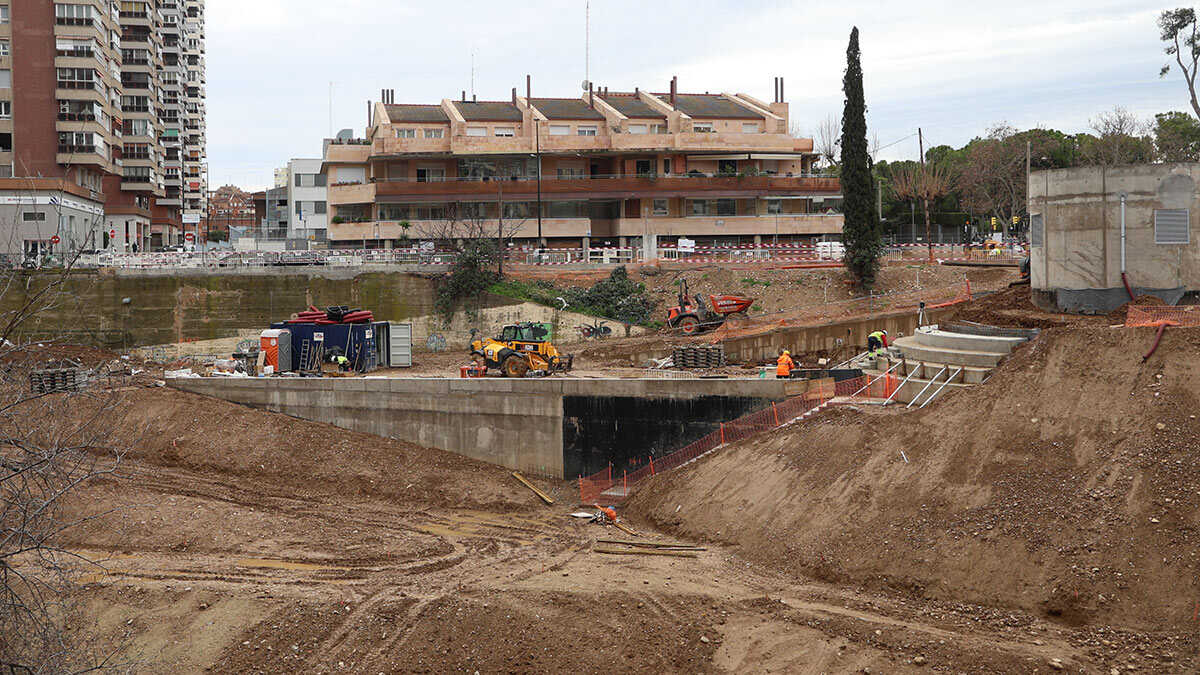
In the section between Blasco del Cacho Bridge and Gran Vía, the increase amounts to €1.16 million, 8.27% more than the municipal share of the contract. The main problem was found on the left bank of the Huerva, on Manuel Lasala Street, between Ventura Lacoma and Emperor Augustus Bridge. Rains in late September 2025 exposed old deposits made up of rubble, debris, bricks and plastics that did not provide sufficient stability. The solution has required large quantities of soil to be removed and replaced, as well as a redesign of the slope-retention system.
To stabilize the slope, the riprap wall initially planned has been ruled out, and bioengineering techniques have been incorporated in line with the criteria of the Ebro River Basin Authority. Wooden structures, known as loricatas, measuring 1.5 and 2 meters high, will be installed together with live-mesh structures and organic coconut-fiber mats.
MORE IMPROVEMENTS IN THE FINAL SECTION
In the second section, between Miguel Servet and the Huerva's mouth, the amendment adds a further €1.03 million, bringing the budget to €7.87 million. Here, a rise in the river caused erosion beneath the foundations of the retaining wall on Doctor Aznar Molina Street, making it necessary to carry out structural reinforcement through underwater concreting. Archaeological excavations also uncovered remains of the former San José Convent and more than a hundred skeletal remains, so the design of the green areas and the placement of topsoil have been modified to preserve them.
New measures to improve the area are also being incorporated. Finer, higher-performance filters will be installed in the drains to retain rubbish, plastics and other solids before they reach the Huerva, and the railings will be adapted to accessibility regulations. Public lighting and the irrigation system will also be improved, and new play equipment will be installed in the children's area.



