
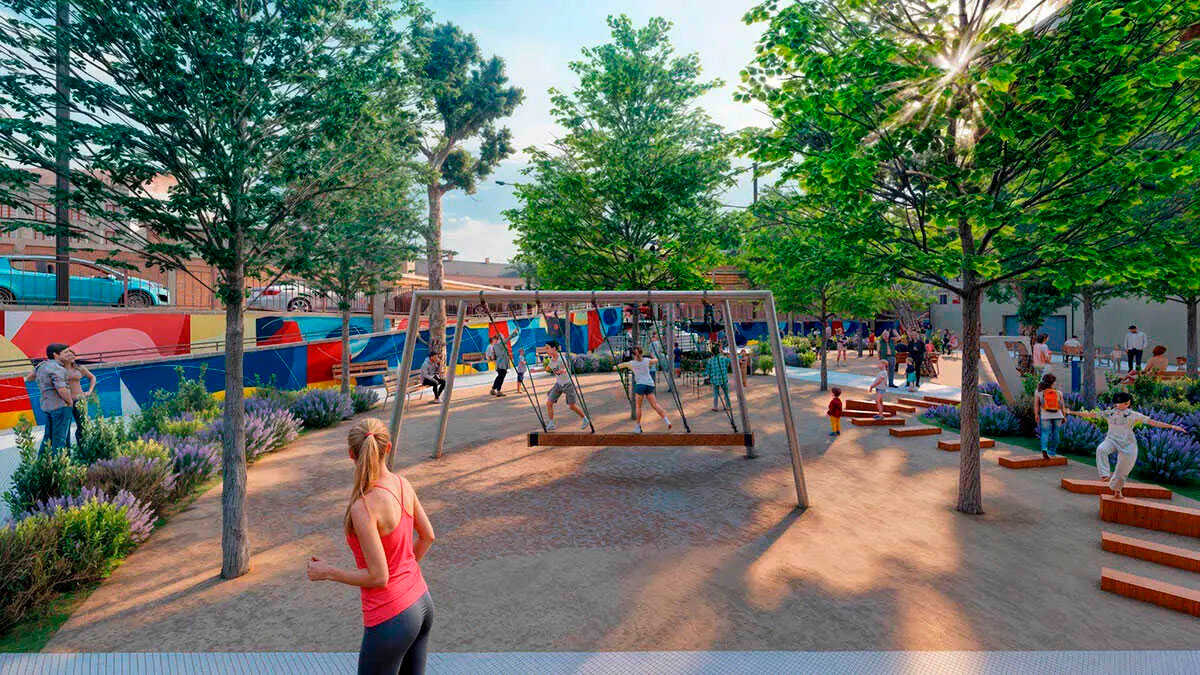
The case of Guimarães shows that sustainability is built not only through major projects, but through a strategy maintained over years and integrated into the life of the city. The Portuguese city has linked its bid to a commitment to climate neutrality by 2030, net-zero-energy public buildings and the One Planet Living model. It has also added almost 100 hectares of new green spaces and a network of green and blue corridors designed to address problems such as heatwaves and flooding. For Zaragoza, the challenge is to show how its numerous environmental initiatives form part of the same urban transformation and how they can translate into a more livable city.
And Zaragoza reaches the final with a considerable foundation of its own. Twenty-seven percent of its municipal area is protected, it has 12 Natura 2000 sites, and 76.5% of the population lives within 300 meters of a public green space larger than 5,000 square meters. The Bosque de los Zaragozanos project aims to reach 700,000 trees, and more than 37 million euros were allocated to rewilding and green spaces during 2026. In addition, air quality figures place average exposure to PM2.5 at 9.79 micrograms per cubic meter, while total waste generation fell by 15.93% between 2018 and 2025.
OTHER STRENGTHS OF ZARAGOZA
The bid can also draw on an environmental track record built over nearly two decades. Zaragoza entered the competition in 2010, 2012 and 2014, gradually incorporating advances in air, water, nature, waste and climate until reaching the final for the first time. Domestic water consumption stands at 100.4 liters per person per day, while total consumption has fallen from more than 105 cubic hectometers per year in the 1980s to 61 today. In terms of climate, emissions fell by 25% between 2005 and 2019, and the city plans to achieve an 80% reduction by 2030.
Against Zaragoza, the other finalists arrive with clearly defined strengths that explain the jury’s demanding standards. Aalborg brings its historic experience in sustainability, citizen participation and climate adaptation, as well as initiatives such as Green Hub Denmark; Bielsko-Biala has focused much of its progress on reducing emissions from buildings and heating and modernizing its district heating network; Košice stands out for its work on climate action, air quality and waste management; and Porto presents water management, climate change adaptation, sustainable mobility and integrated urban development as its pillars. Zaragoza will therefore have to demonstrate not only results, but also the ability to turn them into a recognizable and shared model.
Tatiana Gaudes, Zaragoza City Council Councillor for the Environment and Mobility
Zaragoza’s other major strength lies precisely in expanding the idea of a green city beyond environmental indicators. The bid incorporates health, accessibility, inclusion and citizen participation: Zaragoza is European Accessibility Capital 2026, has had 10,600 homes renovated since 2019 and more than 60 climate shelters, as well as an investment of 103.8 million euros in vulnerable neighborhoods. The city council, businesses, the university and civil society are involved in a quadruple-helix strategy. That will be Zaragoza’s opportunity in Guimarães on October 7 and 8: to present a city that already has environmental results, but must convince Europe that it knows how to turn them into a shared urban project sustained over time.



