
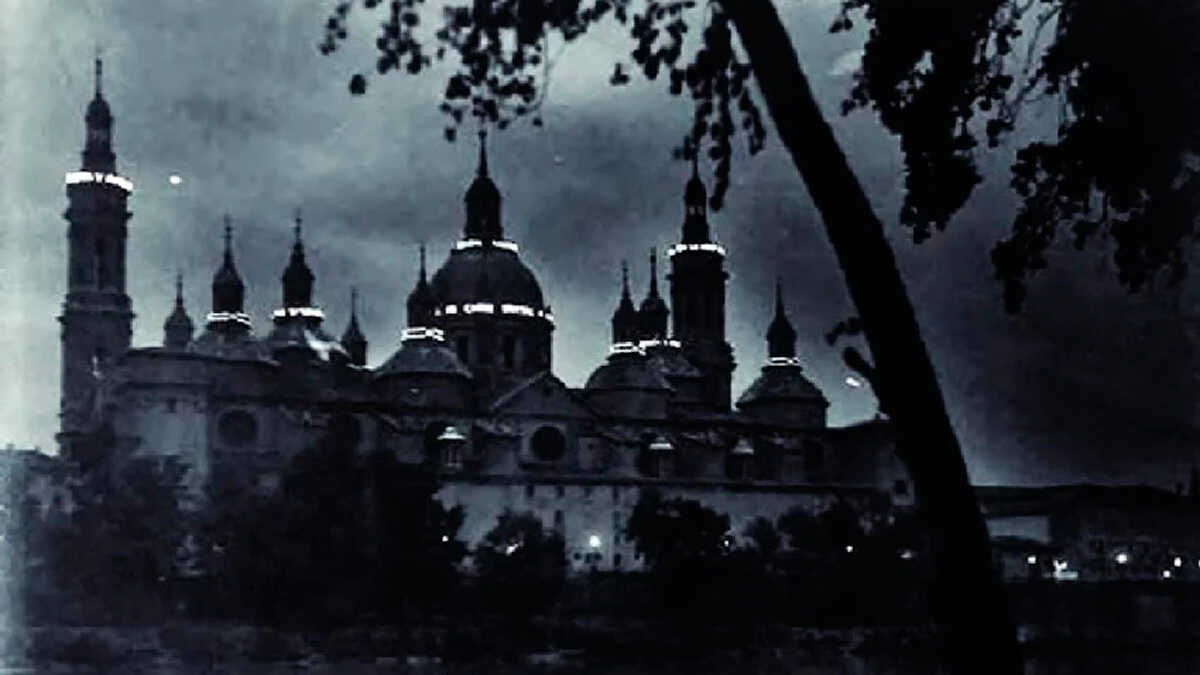
Looking out from the Stone Bridge or stopping along the Echegaray y Caballero promenade on a pitch-dark night offers a seemingly unchanging view: the 11 domes and four brick towers illuminated with golden light. Nothing in the current skyline suggests that for nearly 40 years of the 20th century, the Basilica of the Pilar was crowned by a gigantic neon and argon-gas sign that outlined its roofs with a bluish light visible from miles away.
That intervention brought monumental architecture together with one of the era’s most advanced lighting technologies and turned the Pilar’s silhouette into a message that could be read both from the newly laid-out Cathedral Square and from the left bank of the Ebro River.
FROM GERMANY TO CONDE ARANDA: MAKING THE PILAR’S NEON SIGN
The initiative was launched in late 1939, ahead of the imminent commemoration of the 19th Centenary of the Virgin’s arrival in Zaragoza. To solemnize the celebration with what publications of the time described as the most artistic presentation known to contemporary technology, plans were made to place atop the basilica the city’s most popular jaculatory prayer, composed by Francisco Agüeras, organist at the Holy Chapel: “Blessed and praised be the hour when the Most Holy Virgin came in the flesh to Zaragoza.”
The commission went to engineer Pedro Alonso, who traveled to Germany to learn firsthand about neon technology using vacuum tables. Upon his return, Alonso made the letters, high-voltage transformers, resistors and electrodes in his company’s workshop, located at number 33 on what was then General Franco Street, now the Paseo de Conde de Aranda.
The first letters were molded from glass tubing tinted on the inside and filled with neon and argon gas, giving them a faint blue color. The control panel was installed on the stairs leading to the roof, which were reached by crossing the Virgin’s sacristy and then passing through embrasures toward the domes. For maintenance work, the structure included a tiny platform along which workers had to move across the Pilar’s roofs.
THE 1940 DEBUT: THE NIGHT THE PILAR LIT UP OVER ZARAGOZA
The official lighting took place at midnight between January 1 and 2, 1940. The square, then known as Cathedral Square, had just opened after the demolition of the blocks of houses that had hemmed in the basilica for centuries. At midnight, as Agüeras’s jaculatory prayer played over loudspeakers, the roofs lit up and the neon signs switched on for the first time.
Contemporary accounts described thousands of people kneeling in the newly opened square while Ramón Serrano Suñer addressed the crowd. At that time, the basilica had only two towers, those on the western side. There, beside the main domes, the jaculatory prayer hung above the city’s postwar night.
Years later, driven by the 1954 Marian Congress and the completion in 1961 of the two towers still missing toward the Stone Bridge—those of Saint Francis of Borja and Saint Leonor—the installation was expanded with the support of Eléctricas Reunidas de Zaragoza and its chief executive, Juan Antonio Cremades. The sign completed the entire profile of the Pilar: the towers on the southern side carried the words “Be the hour,” while those on the northern side, facing the water, read “Blessed and praised”; the central dome displayed two rings, one on the lantern reading “When Most Holy Mary” and another on the drum reading “Came in the flesh to Zaragoza,” while the smaller domes bore crowns of illuminated crosses.
THE CIERZO, ROOF DETERIORATION AND THE NEON’S FAREWELL IN 1979
That lighting experiment remained above the basilica for nearly 40 years, although by the early 1970s the neon signs were barely working. Maintaining the installation on the roof was never easy. The cierzo wind, temperature variations and moisture from the river frequently damaged the tubes. Replacing the letters one by one over the vaults was difficult and, by the early 1970s, the jaculatory prayer spent long periods switched off or incomplete.
The final problem was structural. The metal substructures supporting the letters eventually damaged the basilica’s roof and caused waterproofing problems that required urgent repairs.
On July 12, 1979, the same day as the fire at the Corona de Aragón Hotel, workers finished dismantling the last letters from the roofs. With them disappeared an element that had formed part of Zaragoza’s nighttime landscape for decades. The neon was never switched on again, but the jaculatory prayer outlived the installation. Even today, it is broadcast over loudspeakers across Pilar Square three times a day.



