
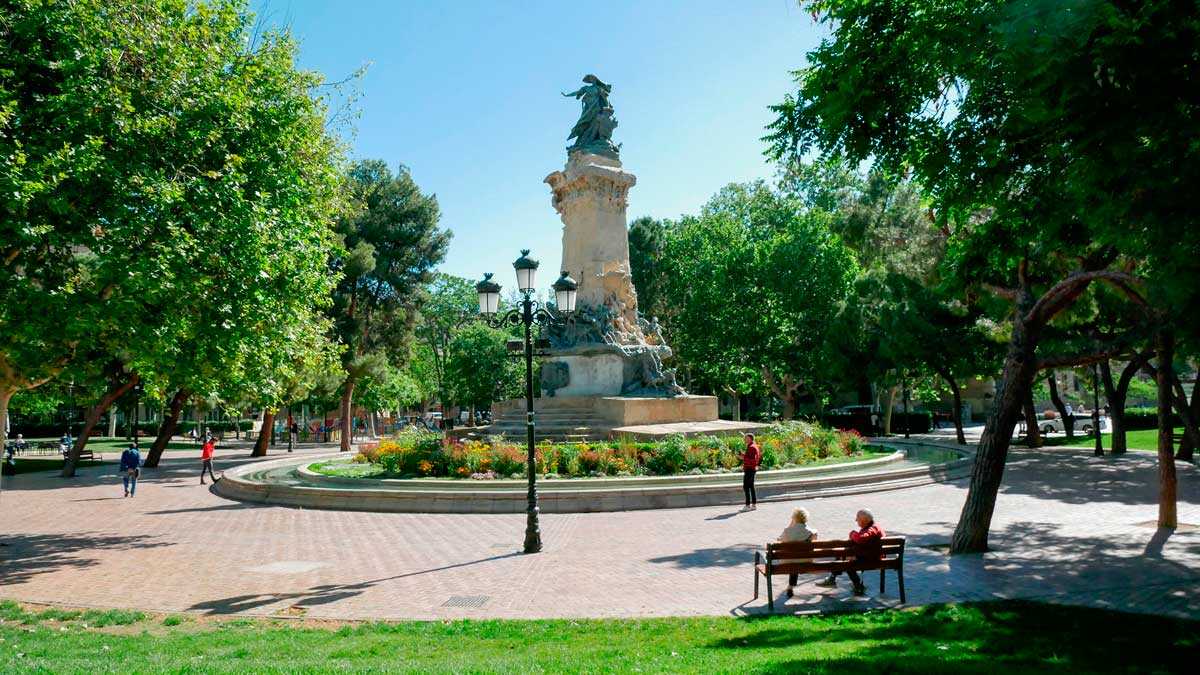
The work has provided an excuse to return to the archives and confirm that the official version of this square, the one told by its plaques and tourist brochures, almost always falls short on the most interesting details. Here are five secrets that rarely appear in tourist guides.
THE KING INAUGURATED A PLASTER MODEL
Let us start with the monument itself, because that is where the first curiosity lies. On October 28, 1908, Alfonso XIII and Queen Victoria Eugenia attended its inauguration with all the pomp the occasion demanded, and pulled the cord that was supposed to unveil Agustín Querol's work before half of Zaragoza. What they did not know, or at least what no one dared to explain to them in detail, was that the 50000 kilos of metal provided by the Ministry of War and taken from decommissioned cannons had not yet been fully cast in bronze. The solution came just days before the ceremony: the plaster models Querol had prepared for casting were painted to imitate the color of bronze and placed on the already completed plinth. The king and queen had, in reality, inaugurated a disguised model; the definitive pieces would arrive months later.
THE SCHOOL THAT BECAME A MILITARY HOSPITAL
The second secret lies just opposite, in the elliptical corner frontage of Colegio Gascón y Marín, which we have mentioned before. Between 1937 and 1939, those classrooms fell silent because there were no lessons. The Army requisitioned the building and suspended its educational activities, turning it into one of the three pavilions of the so-called Muslim Hospital of Zaragoza, intended for Moroccan soldiers in the rebel army. The General Military Archive of Ávila preserves, under the heading Muslim Hospital (Zaragoza), the documentary collection that confirms this; an academic study by the University of Zaragoza places the center within the healthcare network of the conflict, and an article in the University Journal of Military History specifies that the hospital's three buildings eventually had a combined 800 beds, treating wounded soldiers from Brunete, Belchite, Teruel and the Ebro.
THE PLAQUES THE CITY LOST ALONG THE WAY
The third secret is not in any particular building, but scattered throughout the square and much of the historic center. To mark the centenary, the organizing committee, together with other organizations, commissioned numerous commemorative plaques to remember the protagonists and episodes of the Sieges. Two of them still remain on the facade of the former School of Arts and Crafts, next to the museum, while others gradually disappeared over time. Some were moved and others were lost completely.
Among them is the plaque Zaragoza dedicated to Valero Ripol, who was not a general but a chocolate grinder who, on December 17, 1808, single-handedly captured around 90 French soldiers in Calatayud, an achievement for which Palafox promoted him to infantry lieutenant. The plaque the city dedicated to him in 1901 was removed when a new building was erected on the site, today number 13 Aguadores Street, and was kept by the construction company.
The plaque dedicated to General Antonio Torres Gimeno has an even more remarkable story, because Alfonso XIII himself personally installed it in 1908 at what had been the general's home, to honor his role as the city's defending commander. According to the Royal Academy of History, which records the episode in its biographical dictionary, the plaque's current whereabouts are unknown. The square we walk through today is, in reality, what survived a century of construction work, demolitions and municipal neglect.
THE FACE THAT IS NOT AGUSTINA'S
The fourth secret takes us a few meters away from the square, to the Portillo, but it was born in the same centenary year and deserves to be told alongside the others. One day after the monument to the Sieges was inaugurated, on October 29, 1908, the monument to Agustina of Aragon, the work of Mariano Benlliure, was unveiled. The bronze face that generations of Zaragoza residents have identified with the heroine is not actually Agustina's; it is that of Lucrecia Arana, a celebrated zarzuela singer and, coincidentally, the sculptor's life partner, whom Benlliure chose as his model because, in his own words, she shared the same energy and strength of character.
The bronze face that generations of Zaragoza residents have identified with the heroine is not actually Agustina's; it is that of Lucrecia Arana. Photo: Pilar Álvarez
THE BANDSTAND THAT LEFT AND IS NOW RETURNING
The fifth secret is the one that best connects the past with the present. The modernist bandstand we now automatically associate with José Antonio Labordeta Grande Park was born exactly in the center of this square in 1908. It was designed by the Martínez de Ubago brothers, with an explicitly stated inspiration from Hector Guimard's Parisian awnings. It stood here, left, returned, and in 1967 the city moved it again, this time to Grande Park, where it would ultimately remain permanently.
Zaragoza has that strange habit of hiding its truths in plain sight, trusting that no one will look up too much. You only have to do it once for the familiar square to stop looking the same.



