
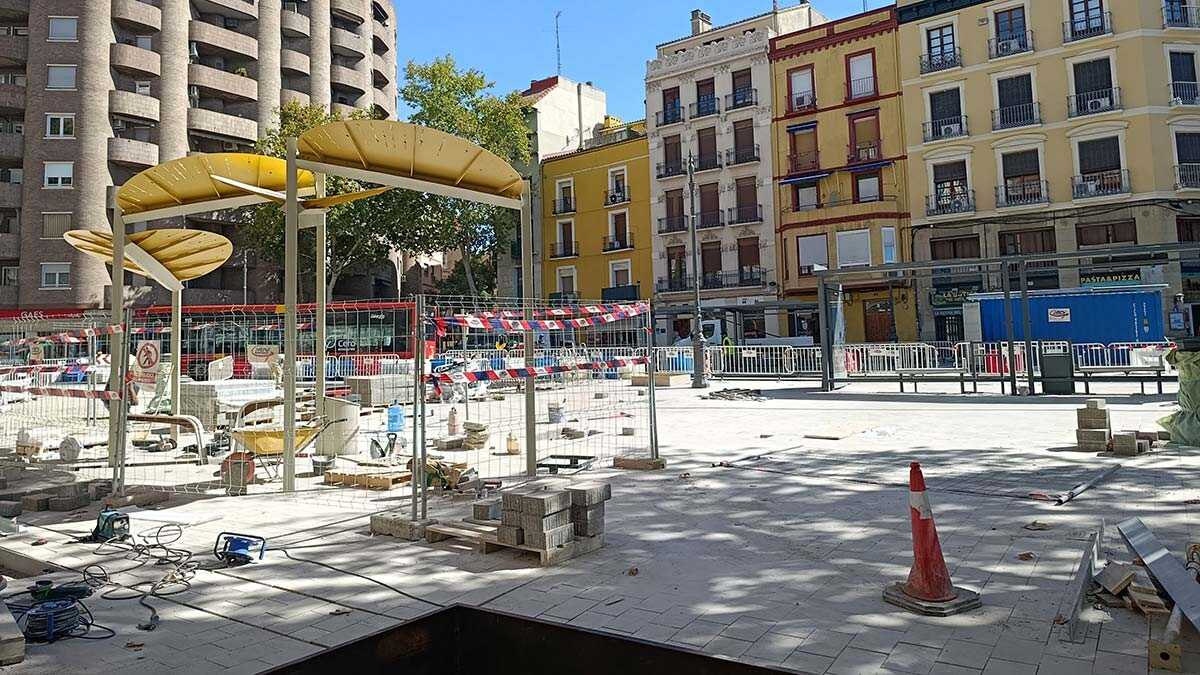
The environmental group is focusing particularly on the trees. It claims that around 20 of the 39 mature trees previously in the square will remain, while the original project initially envisaged planting 27 new specimens. The group says Zaragoza City Council has ultimately announced the addition of 14 trees, including lindens, tulip trees and pear trees, and believes that the species and planned size will not provide enough shade in a square where, in its view, paved and tiled surfaces are gaining ground.
It has also raised concerns about the condition of the trees preserved during the construction work. The group says several have been affected by trenches dug alongside them and by the installation of the new concrete slab, which, according to its account, is damaging the outermost roots and the trunk. It also criticizes the small size of the tree pits and regrets that former empty spaces intended for trees have not been restored.
CRITICISM OF THE NEW DESIGN
In its analysis, the Tree Council also questions the partial replacement of tree-filled green areas with planters, small trees and large paved surfaces. The group likewise casts doubt on the new metal pergola’s ability to lower temperatures in the square, despite Zaragoza City Council presenting it as one of the elements intended to turn the space into a climate refuge.
The structure will feature an on-demand water-misting system, LED lighting powered by solar panels and a water-play area. Zaragoza City Council maintains that the pergola will provide shade and cooling, and that the studies used for the project anticipate temperature reductions of several degrees under certain conditions. The renovation also includes the renewal of utilities, wider pavements, accessibility improvements and archaeological work.
For the Tree Council, however, the chosen model will not resolve the livability problems the square will continue to face during the summer months. The group warns that pedestrians will remain exposed to the heat and also points to noise and road traffic as factors affecting the space. It also places the project within a broader debate over other urban renovations in Zaragoza where, it claims, paving has increased at the expense of trees and shaded areas.



