
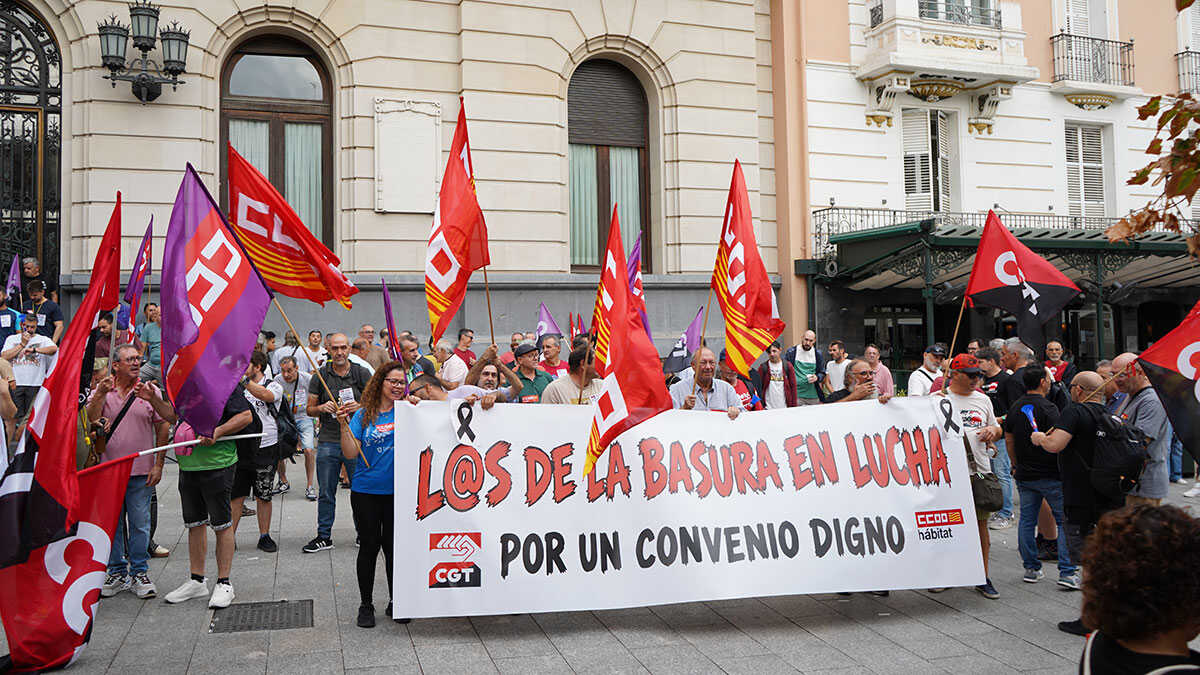
Around 100 people took to central Zaragoza on Wednesday in a large demonstration, coinciding with the start of work stoppages in Zaragoza’s street cleaning and waste collection services. FCC and unions have been demanding improved working conditions for cleaning crews for months and warn that, if these improvements are not secured before October 7, an indefinite strike will begin, directly affecting the Pilar Festival.
The concessionaire held its latest mediation meeting with Zaragoza City Council last Monday in an attempt to unblock the agreement covering Zaragoza’s cleaning and waste collection services and avert the strike. The meeting not only ended without an agreement but, according to Mario Blasco, the Comisiones Obreras union delegate at FCC, the offers being put forward by the City Council “are getting smaller and smaller.” For the union, this “lack of willingness to negotiate” is “incredible after 20 months.”
A 20% LOSS OF PURCHASING POWER
Through negotiations, FCC and the unions are seeking to safeguard workers’ purchasing power, “because over the past 10 years we have lost approximately 20% of our purchasing power compared with the CPI,” he lamented. They are also demanding improvements in working conditions, such as better work-life balance. “There are shifts covering 363 days a year here, people work from Monday to Saturday, and what we are seeking is a reduction in working hours so our families can also enjoy our presence,” Blasco said.
In contrast, the company is calling for the allocation of full-time schedules to be expedited, claiming that “there are weekend workers who work only one or two days a week, and many of them have spent 15 and 16 years on a waiting list for a 40-hour workweek. This cannot continue.” Ultimately, the mobilizations aim to “seek a little justice” and make the company aware that these people are available, so that it does not hire workers from outside.
For the cleaning crews, the city council is the “direct party responsible” for the loss of purchasing power they have suffered for years. Therefore, if an agreement is not reached in time, they have reiterated that “we will be the first not to be comfortable with that situation, because citizens are not to blame.” They stressed that “citizens deserve to have a clean city in good condition” and, to achieve this, considered it essential to have “well-paid workers.”



