
There are nearly 11,000 deaf people in Aragon with a recognized disability rating of at least 33%, according to the latest census by the Aragonese Institute of Social Services. However, this figure does not include those without such a certificate and represents only part of a highly diverse group.
“Every deaf person is very different,” explains Jesús Carlos Laiglesia, head of Institutional Relations at the Association of Deaf People of Zaragoza and Aragon (ASZA). Some use sign language, others rely on hearing aids or implants, and some combine different resources. However, for Laiglesia, the main problem they all continue to share is “access to communication and information.”
A DISABILITY THAT CANNOT BE SEEN
The situation has improved in recent years thanks to technological advances and greater social awareness. Public administrations have also begun to incorporate accessible resources, although Laiglesia believes there are still “many things to improve” so that deaf people can use any service on equal terms.
One of the main problems is that deafness is an invisible disability. “You see a deaf person on the street and do not know they have hearing loss until you try to communicate with them or a need arises,” he points out. That is when difficulties emerge that could be reduced with a few basic guidelines.
Speaking clearly, facing the other person or using writing can make a conversation easier. Shouting does not help, nor is it advisable to touch someone abruptly to get their attention. In certain settings, illuminated signs and changes in lighting can replace signals that are usually conveyed through sounds.
PROCEDURES THAT STILL REQUIRE ASSISTANCE
These barriers also limit autonomy when dealing with public administrations. People who use sign language often need the support of an interpreter to make inquiries, submit documents or understand the information they receive. For Laiglesia, this dependence could be reduced by installing video-interpretation systems directly in public offices.
Through these systems, when a deaf person arrives at a public office, they “would request the service and, directly through that virtual access point to video interpretation, there would be a call center of interpreters who would provide the interpretation remotely,” Laiglesia explains. This would allow, he adds, “faster and more immediate” access to communication.
COMMUNICATION, KEY IN AN EMERGENCY
Training is especially important when an emergency occurs. Police officers, firefighters and other professionals may encounter a deaf person who does not understand instructions or has difficulty explaining what is happening. The absence of suitable resources can increase confusion at a time when every minute is crucial.
ASZA provides training on how to appropriately interact with deaf people and the systems that can be used to communicate with them. “If they know how to act and how to treat a deaf person when these problems arise, there would be no communication problems that made the situation worse,” says its head of Institutional Relations.
The association also works to combat the prejudice and fear some people feel when they have to communicate with someone who cannot hear. Knowing a few basic guidelines or signs can help people approach the conversation naturally and prevent the deaf person from being left out.
TECHNOLOGY HELPS, BUT IT ALSO CREATES ANOTHER DIVIDE
Mobile phones, WhatsApp and video-interpretation services have brought about a major change. A call that once required the help of a third person can now be handled through an interpreter connected by video. ASZA offers in-person and remote interpretation services through its ASZA-SVils application, as well as text and call interpretation.
ASZA has been working for more than nine decades to eliminate communication barriers and improve the quality of life of deaf people and their families
Technological progress, however, does not guarantee inclusion on its own. Laiglesia warns that the speed at which new tools emerge can widen the digital divide if it is not accompanied by accessible training. Artificial intelligence opens up new possibilities, but it can also leave behind those who lack the knowledge or support needed to use it.
ACCESSIBILITY FROM THE VERY BEGINNING
ASZA has been working for more than nine decades to eliminate communication barriers and improve the quality of life of deaf people, people with hearing disabilities and their families. The organization offers interpretation, employment, social intervention, psychological support, assistance for families and older people, sign language training and accessibility advice.
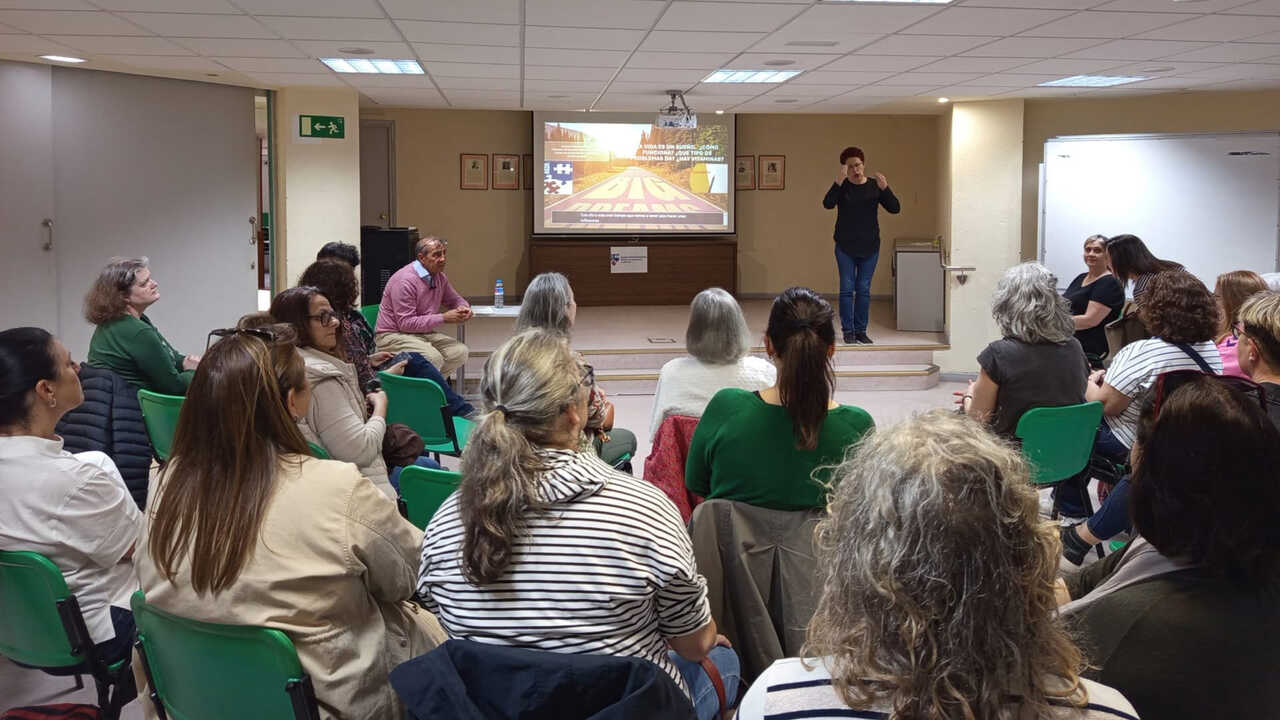
The association also runs workshops in schools, training centers, companies and social and healthcare organizations to dispel myths and explain how to communicate with a deaf person. During 2024, these initiatives reached 2,722 people, including 1,826 minors, 691 young people in training and 205 professionals.
ASZA's main message to mark the International Day of Deaf People is aimed especially at public administrations. “If it is not taken into account from the outset, we will continue perpetuating these barriers,” Laiglesia warns. Accessibility, he argues, must be incorporated from the moment a building, service, application or administrative procedure is designed. This year's observance also commemorates the 75th anniversary of the World Federation of the Deaf, founded in 1951 to defend the collective's ability to fully enjoy its rights.



