
The discoveries reveal different periods of Zaragoza’s history, from the early Imperial Roman period to the 19th and 20th centuries, the City Council said. The excavations were carried out during trenching to renew water, drainage and electricity networks, as well as during the earthworks required to install tree pits and other urban furniture.
The councillor for Culture, Education and Tourism, Sara Fernández, explained that preserving the remains led to adjustments to the construction schedule whenever necessary so they could be studied. The City Council’s Cultural Heritage Unit supervised the work in coordination with the Heritage Department of the Government of Aragon.
A ROMAN SEWER AND REMAINS OF 11TH-CENTURY HOMES
Roman remains have been found across practically the entire square. Archaeologist and municipal head of the Cultural Heritage Unit José Juan Domingo said these layers date from the early years of the colony of Caesar Augusta to the final third of the 1st century AD. They yielded abundant materials, particularly pottery, as well as a notable discovery: a section of sewer that appears to belong to the first urban planning program of the Roman city.
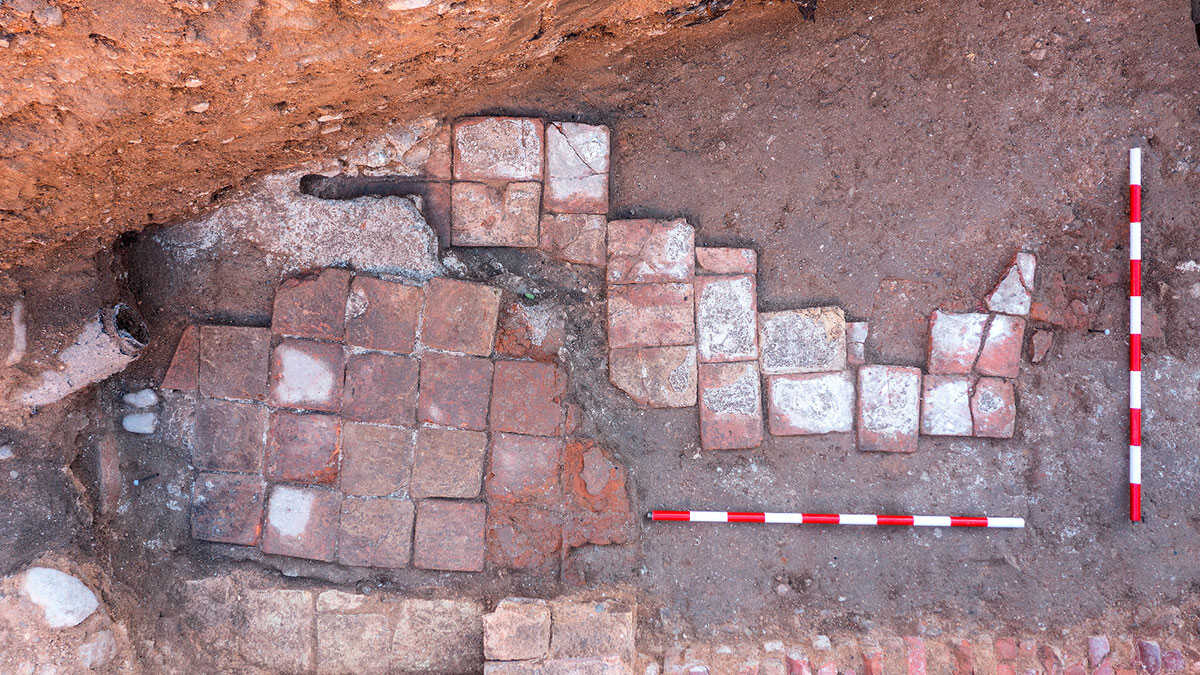
The work also uncovered materials from the Islamic period and domestic structures from the Taifa period in the 11th century. One notable find is part of the floor of a courtyard paved with ceramic tiles, evidence of the homes that once occupied the area.
Numerous ceramic pieces dating from the 13th to the 15th centuries have been found from the medieval period, along with remains of the former parish cemetery of San Miguel. Archaeologists documented more than 30 individual burials, although very few were preserved intact. They also located a large quantity of poorly preserved skeletal remains that were no longer in anatomical connection.
THE CITY WALL, THE PUERTA DEL DUQUE AND THE FORMER FOUNTAIN
Another discovery is the foundation of a section of the medieval and modern-era city wall, which crossed the square from side to side. Its analysis confirmed that there was no gate in this part of the enclosure before the 19th century, while the structure retained its defensive function, Domingo explained.
The foundations of the Puerta del Duque were identified above the remains of that wall. The gate was opened in 1856 to connect San Miguel Square with the new San José Bridge, completed two years earlier. These remains help document the urban transformation carried out between 1856 and 1863, when the square was opened toward the Coso and the Huerva River.
The excavation also uncovered remains of the fountain built in 1862, which stood in the center of the square until 1925. Its location adds another piece to the reconstruction of the changes this area of Zaragoza has undergone.
The discoveries have not led to the widespread removal of the structures. “Practically all of the construction remains found during this work have been preserved underground in the square after being documented and properly protected,” Fernández said. The movable artifacts and the remains from the medieval burials have been transferred to the municipal archaeological services for cleaning, cataloging and study.



