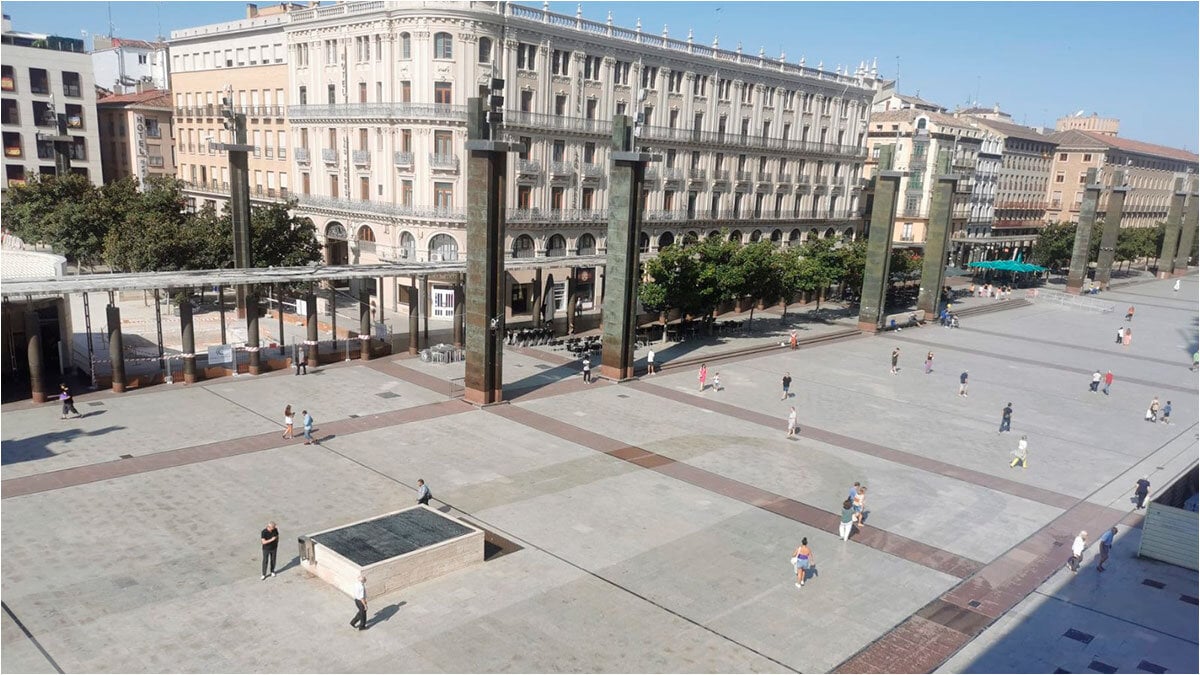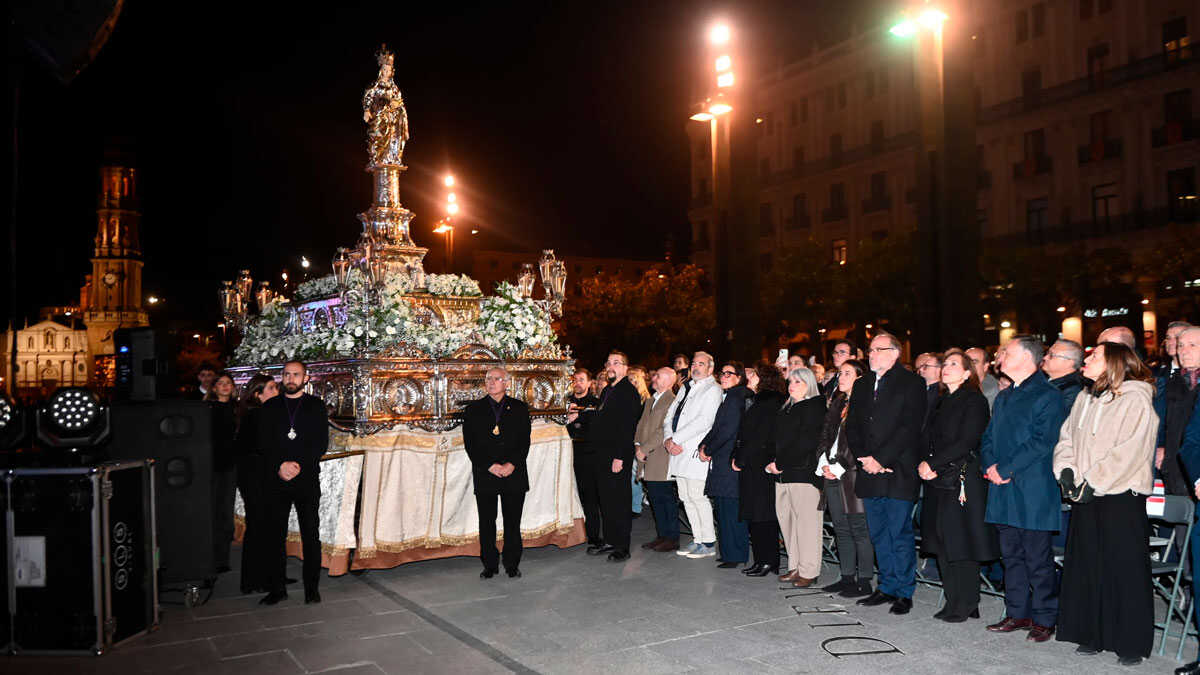
Pilar Square hosted the inauguration of the gathering this Friday, held under the motto "Faith, an immortal pillar." Zaragoza Mayor Natalia Chueca and Aragon's Minister for the Environment and Tourism, Luis Biendicho, took part in the ceremony and highlighted the role of younger generations in preserving traditions, as well as the religious, cultural, social and tourism value of Holy Week.
Biendicho recalled the importance of young people in ensuring the continuity of these celebrations. "You are the ones guaranteeing that one of the deepest-rooted traditions in our history remains alive and has a future," the minister said, stressing that belonging to a brotherhood involves commitment, civic coexistence and solidarity throughout the year. "It means taking on an inheritance that does not belong to us, of which we are custodians, and that we have a responsibility to preserve and pass on," he said.
Natalia Chueca welcomed participants in front of Pablo Serrano's bas-relief depicting the arrival of the Virgin of Pilar and invited them to discover Zaragoza's heritage and the distinctive features of its Holy Week. "This is your home, and this is your Holy Week," the mayor said, encouraging young people to enjoy the city during these days of fellowship, faith and tradition.
Zaragoza Mayor Natalia Chueca has highlighted the role of young people in the future of the brotherhoods. Photo: Zaragoza City Council
The mayor also focused on the future of the brotherhoods and fraternities, praising the arrival of new members and the contribution of younger generations: "Our Holy Week rests on you. You bring fresh air, energy and positive changes."
HOLY WEEK AND RELIGIOUS TOURISM GENERATE MILLIONS IN ARAGON
Zaragoza's Holy Week, declared an International Tourist Interest Festival in 2014, has more than 16,000 members, 25 brotherhoods and fraternities, and 53 processions. It is joined by Holy Week in Bajo Aragon, where drums and bass drums are among its main distinguishing features. The Drum and Bass Drum Route comprises nine municipalities: Albalate del Arzobispo, Alcañiz, Alcorisa, Andorra, Calanda, Híjar, La Puebla de Híjar, Samper de Calanda and Urrea de Gaén.
Both celebrations are among the main reference points for religious tourism in Aragon, which generates an economic impact of around €187 million. Of this amount, approximately €29 million corresponds to Zaragoza's Holy Week and another €10 million to the Drum and Bass Drum Route.
Aragon's religious heritage also includes sites such as the Basilica of Pilar, which receives around four million visits a year, La Seo, the Torreciudad Sanctuary and the Monastery of San Juan de la Peña. They are joined by the Way of Saint James and the churches, monasteries and hermitages in the region's three provinces. This heritage is linked to initiatives such as Aragon with Soul and the region's participation in the World Religious Tourism Network.
"But the importance of religious tourism goes far beyond the figures. Behind every celebration are families, associations, artisans, musicians, small businesses and establishments in our towns and cities. And above all, there are communities keeping a tradition alive," Biendicho said.
Environment and Tourism Minister Luis Biendicho has highlighted the importance of preserving traditions. Photo: Government of Aragon
The mayor also acknowledged the brotherhoods' work beyond the processions. "Your work lasts 365 days a year. In charity drives, in activities for children and those who need help, in support and fellowship," she said. "Brotherhoods build the city and create community," she stressed.
Chueca also expressed Zaragoza's pride in the more than 15,000 members who commemorate the Passion, Death and Resurrection of Christ and in the 53 processions that travel through its streets and squares. It is a public expression of "faith, devotion, tradition and emotion" in which drums, bass drums, timbales, heraldic bands, bugles, bells, rattles and matracas coexist alongside silence. As an example, she recalled the Meeting of Our Lady of Sorrows and Jesus on the way to Calvary, which brings together thousands of members, residents and visitors in Pilar Square every Holy Wednesday.
The Virgin of Pilar also featured prominently in the mayor's remarks because of her connection with Zaragoza and its brotherhoods. "A pillar supports, and faith is what supports us: for centuries, it has supported our city and today it supports you," she said, referring to the gathering's motto.
EXTRAORDINARY PROCESSION WITH 23 FLOATS TO CROSS ZARAGOZA THIS SATURDAY
The 13th National Meeting of Young Members of Religious Brotherhoods and Fraternities began with the opening of the "Ad Salvatorem" exhibition at the Cathedral of the Savior, La Seo, attended by Aragon Government Vice President Mar Vaquero. The exhibition can be visited until 4 p.m. this Saturday. The opening ceremony in Pilar Square was preceded by flower offerings from the delegations to the Virgin and included a display of Zaragoza's Holy Week, jota performances, a reenactment group and a performance of the Rosary of Crystal.
One of the central events of the gathering will take place this Saturday, October 24, at 6:30 p.m., when an extraordinary procession will depart from La Seo and travel through Zaragoza's historic center. The procession will feature 23 floats, from the Entry of Jesus into Jerusalem to the Resurrection, as well as around 220 young people from the JOHC Group playing bass drums, timbales and drums.
Saturday's program also includes a presentation on the future of the brotherhoods, the presentation of bids to host the next edition of the gathering, a traditional instrument workshop and an inter-brotherhood meal.
The gathering will conclude on Sunday, October 25, with a thanksgiving Eucharist at the Basilica of Pilar, the transfer of Saint John the Evangelist to San Cayetano, the reading of the conclusions and the announcement of the city that will take over from Zaragoza as the JOHC host. Biendicho encouraged participants to share experiences and keep their traditions alive: "A people who know and respect their roots, who know how to pass them on to future generations, is a cultured people," he concluded.