
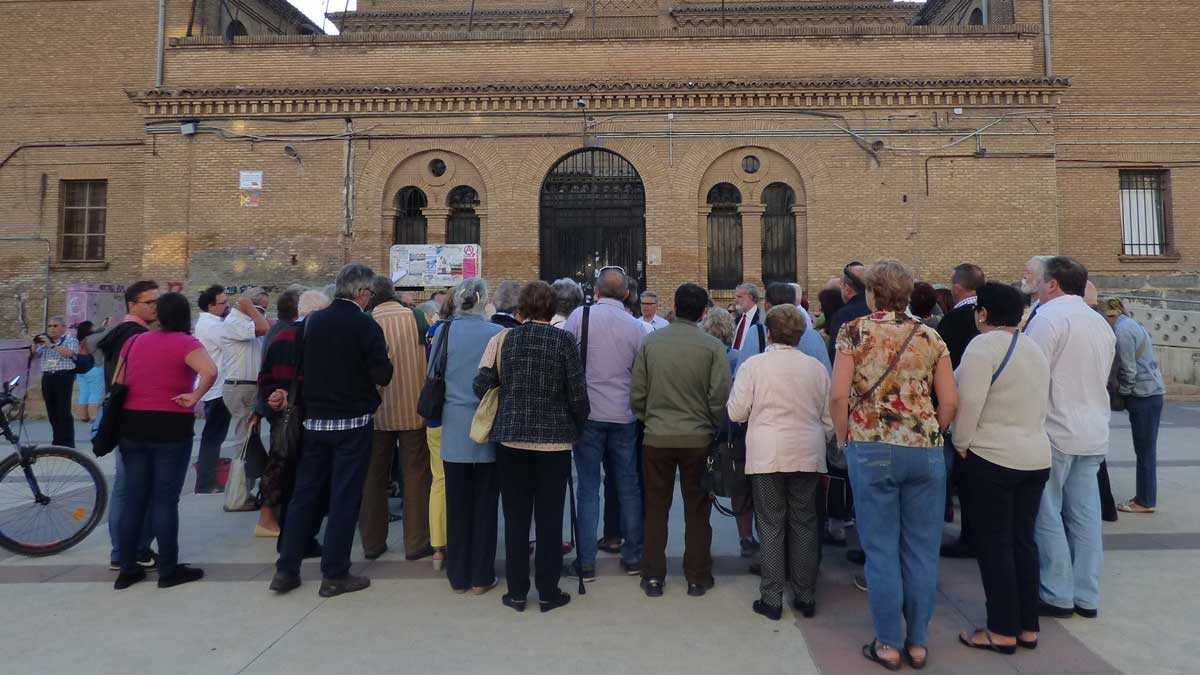
The participants, including numerous relatives of Republican exiles and people who disappeared during the Spanish Civil War, had come from France and various parts of Spain, including the Basque Country and Navarre. The day began at 9:00 a.m., when two buses departed from El Pilar for the former Torrero prison.
There, they learned about the history of a prison inaugurated in 1928 with capacity for around 160 people which, during the Civil War, came to hold more than 3,000 prisoners. Writer Iván Heredia, author of Torrero Prison, explained the layout of the facility and how trucks carrying detainees from across the province arrived “almost every night.”
The next stop was Torrero Cemetery. Municipal architect Ramón Beltrán explained the execution process that began on July 18, 1936, and showed relatives the trenches of the mass graves and the firing wall, where more than 1,300 people lost their lives. The day also included music and a floral tribute in memory of those who disappeared.
The organizers also called for a Democratic Memory Law for Aragon, better treatment of the subject in classrooms and greater access to documentary archives on the War. The meeting concluded with a closing ceremony at the Zaragoza Provincial Council.
The tour of the former prison, the mass graves and the Torrero firing wall defined that day of remembrance and protest. This is how Aragón Digital reported it ten years ago, in the original story about the 6th Cross-Border Meeting of Democratic Historical Memory Associations.



