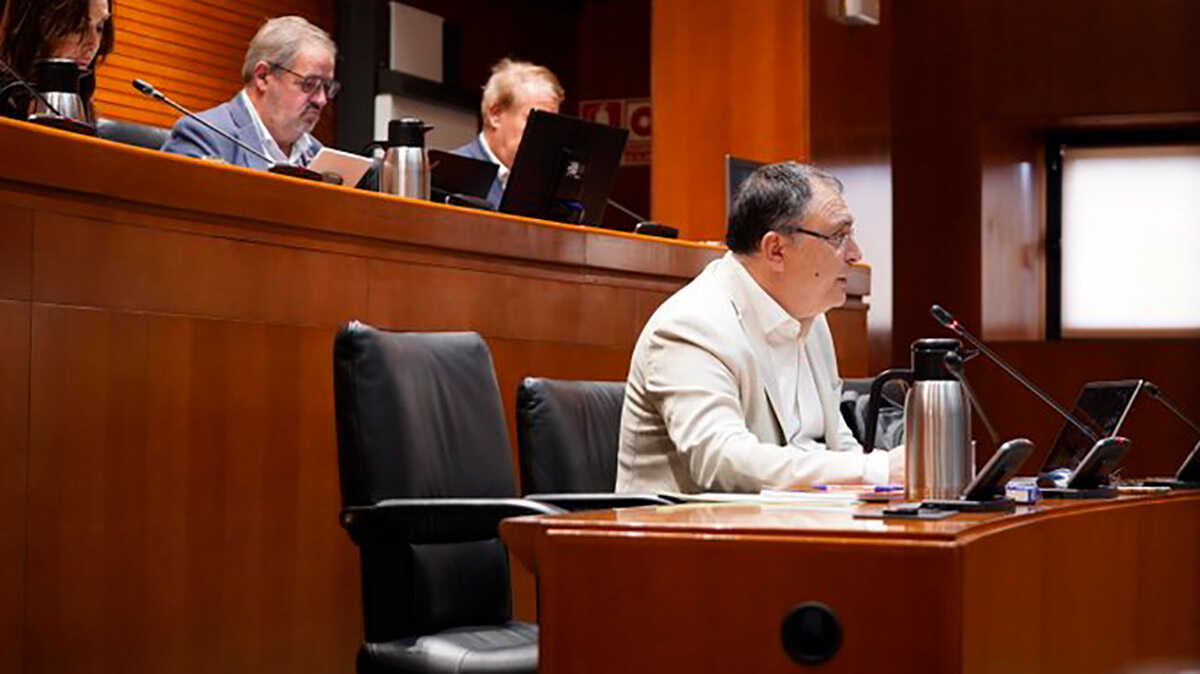
“We must set as future priorities the challenge of continuing the electronic processing process, staff training, reviewing fees, establishing a quality and audit department to raise the Institute’s quality standards, and creating a division specializing in livestock activities,” Simal said during his appearance, requested by the regional minister responsible, Luis Biendicho, Chunta Aragonesista and Aragón-Teruel Existe.
NO LONGER DEPENDENT ON EXTERNAL COMPANIES
The director general recalled that the agency had been in a state of collapse in 2023 and 2024, which led to the proposal of an improvement plan that, in his view, worked. He explained that the document identified several shortcomings: insufficient technical staff, limited use of electronic processing capabilities and heavy dependence on external companies.
According to Simal, one of the main changes has been the reorganization of staff: “Administrative tasks were handled by 49% of employees; now the figure is 30%, while the number of technicians has risen from 30 to 57.” The head of INAGA also highlighted progress in digitalization. “Nearly 85% of cases are now processed through the new digital system, significantly reducing resolution times,” he said.
He also noted that dependence on external consulting firms has declined: while they were involved in more than 300 cases in 2021 and 2022, none were recorded in 2023, 2024 or 2025. Regarding the recommendations made by the Audit Court, he said that “the report has been practically fulfilled in most respects.”
OPPOSITION CRITICISM OF INAGA
Jorge Pueyo, a lawmaker from Chunta Aragonesista, called for a public agency with sufficient resources and technical independence. “INAGA must be a strong public agency, with sufficient staff, technical independence and the ability to rigorously assess projects, rather than what it has become: a one-stop shop whose sole mission is to issue permits that destroy the territory and are requested only by major developers,” he said.
Pueyo warned that “streamlining procedures cannot mean conducting poorer assessments or turning administrative deadlines into pressure on technicians.” He also demanded “verifiable results” and called for “knowing whether assessments are more rigorous and whether citizens will have greater guarantees.”
Tomás Guitarte, of Aragón-Teruel Existe, criticized the agency’s management and the way its accounts were presented. “With you at the helm, the accounts for three financial years were approved all at once, and the information you provided to the Audit Court arrived late and in questionable condition,” he said. He also noted that “Teruel accounts for 27% of the cases, but 36% of the capacity.”
The lawmaker also questioned the economic contribution of projects established in the area. “Rural areas have provided the land, the landscape and the patience, but how much has the party occupying it paid? For the assessment, practically nothing,” he added.
Socialist lawmaker Carlos Ros, for his part, expressed his “deep concern about the direction, collapse and shadows threatening the Aragonese Institute for Environmental Management, which is the true guarantor of the sustainability of our territory.” He also maintained that “the report presented by the Audit Court completely dismantled the narrative of efficiency that the Popular Party is trying to sell us.”
However, Susana Cobos of the Popular Party defended the view that “the Institute has undergone a radical turnaround” and said that “reports are now prepared by technicians, not politicians, and the law is being followed to the letter.” Finally, Sergio Marco of Vox highlighted that “the largest staff increase in the Institute’s history has been carried out.” He also said that “80% of applications are processed through the new system, and the process has gone from taking months to being resolved in days.”