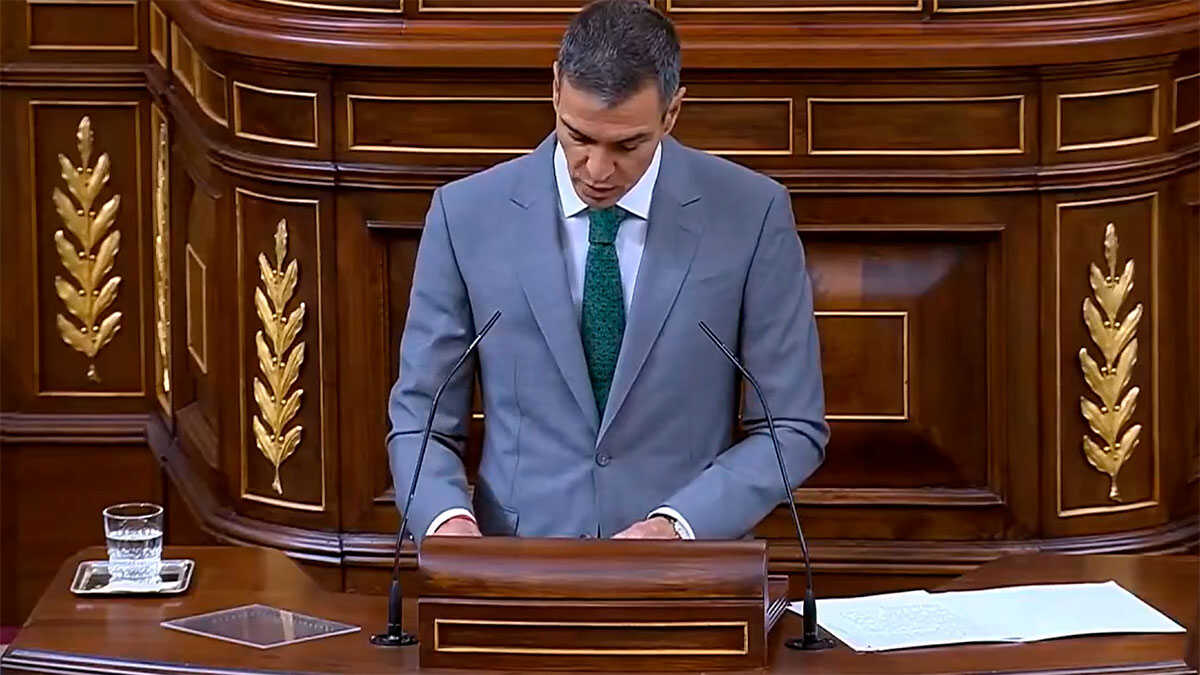
Sánchez gave these explanations during his appearance before the Congress of Deputies regarding what happened in Ceuta. He insisted that, in the days before this “crisis”, the government did “not” receive “extraordinary alerts or warnings anticipating what happened afterwards”. “The answer is clear: it did not.”
“We examined all the reports, all the messages and verbal notes from the State Security Forces and Corps, as well as from our National Intelligence Centre, which were sent both to political authorities and to the Government Delegation in the autonomous city of Ceuta,” he added.
He said that “none went beyond describing the data or issuing a routine warning” and that “none foresaw either the scale or the likelihood of what ultimately occurred”. He said he wanted to recall this because there had been “a great deal of noise and many hoaxes in recent days that should be debunked”.
“HOAXES”
According to Sánchez, one of these “hoaxes” is that Frontex “issued a warning a month earlier”, a claim that “those interested in spreading that disinformation have echoed”, but which “is not true”. What the agency did was produce a “routine report informing of the greater viability of this migration route and the detections recorded during the quarter”.
“It did not foresee anything remotely similar to what happened on July 30 and 31,” he asserted. He also criticized claims that the National Police “had warned a week earlier of a high risk in Ceuta” because “that is not correct”. That report “did exist, but it referred exclusively to maritime arrivals on the mainland and in the Balearic Islands, not to the Ceuta border”.
He also recalled claims that the Ceuta government had warned his office on July 27 about what was going to happen, “and that is not true either”. Its president, Juan Jesús Vivas, “had a brief call with Moncloa in which he pointed out that the number of people swimming across had risen from 10 to 20 a day and that, at that rate, he was concerned the city would have 200 more migrants by the end of the week”.
The Interior Ministry was immediately put “on notice”, as requested by the president of Ceuta. In fact, he said that on the same day the Ceuta police sent the National Police a “form reporting relevant events” informing it “of the increase in crossings by swimming”, but “issuing no forward-looking warning”.
SWIMMING CROSSINGS
Regarding the work of the CNI, Sánchez said that in the month before the crossing it prepared two situation reports, and in both “described something known” to the authorities that received them: “that crossings at the breakwater were increasing, and recommended taking the utmost precaution”.
On July 29, there was “a communication by messaging between the Government Delegation in Ceuta and the Civil Guard which was intended to warn of a social media call to try to cross into Ceuta the following day; that is where the famous figure of 180,000 people appeared”.
He clarified that this figure “was not a forecast of how many people were going to cross” prepared by the CNI, but rather “the number of members of a Facebook group” that circulated the call. “It is worth knowing that this type of appeal on social media is not exceptional,” Sánchez said.
He also explained that the “increase in crossings at the breakwater recorded during the week before the mass crossing was in no way exceptional”; in fact, “there is a recurring seasonal pattern that is perfectly documented”. “Attempts to enter Ceuta by swimming multiply every year between June and July,” he said.
INFORMATION NOTES
Finally, he addressed the information notes prepared by the National Immigration and Borders Centre (CNIF). He explained that it prepared a note on July 28 containing a “detailed analysis of the situation and concluding that the movement on social media was not worrying”, but that the “good sea conditions suggested” a “gradual increase in attempts to enter via the breakwaters”.
According to Sánchez, the July 29 note referred to “a potential risk of irregular entries into Ceuta and Melilla” and included a “table of scenarios assigning a high probability to further swimming crossings, but with low and medium impact”, and a “medium and low” probability to “a coordinated movement of swimming crossings and fence jumps”.
Based on this note, “alerts” were issued to border posts, the first on July 29. He therefore said that the government “has nothing to hide”, so much so that he ordered the publication of “a dossier containing all the reports” so that citizens could “examine them for themselves”.
“TRANSPARENCY”
“Absolute transparency, publication of all documents so that the exact truth about this matter is known,” he said, adding that “one thing is detecting that swimming crossings were increasing” and another is “saying that precautions must be stepped up to anticipate the arrival of 70,000 people in Ceuta within hours”.
“No report did that”, at least “none that reached the hands of the Spanish government”, and saying so “is not a way of evading any responsibility”, but rather “telling the truth and acknowledging the exceptional nature of what was experienced” in Ceuta and pointing out that “we have to strengthen our capabilities”.
He therefore called it “absurd” to think that the government was “warned and deliberately did nothing, as PP and Vox leaders have openly said”. “What kind of person would think that?” he asked, insisting that the competent bodies “reacted as soon as the threat materialized and did so with all the resources at our disposal”.


