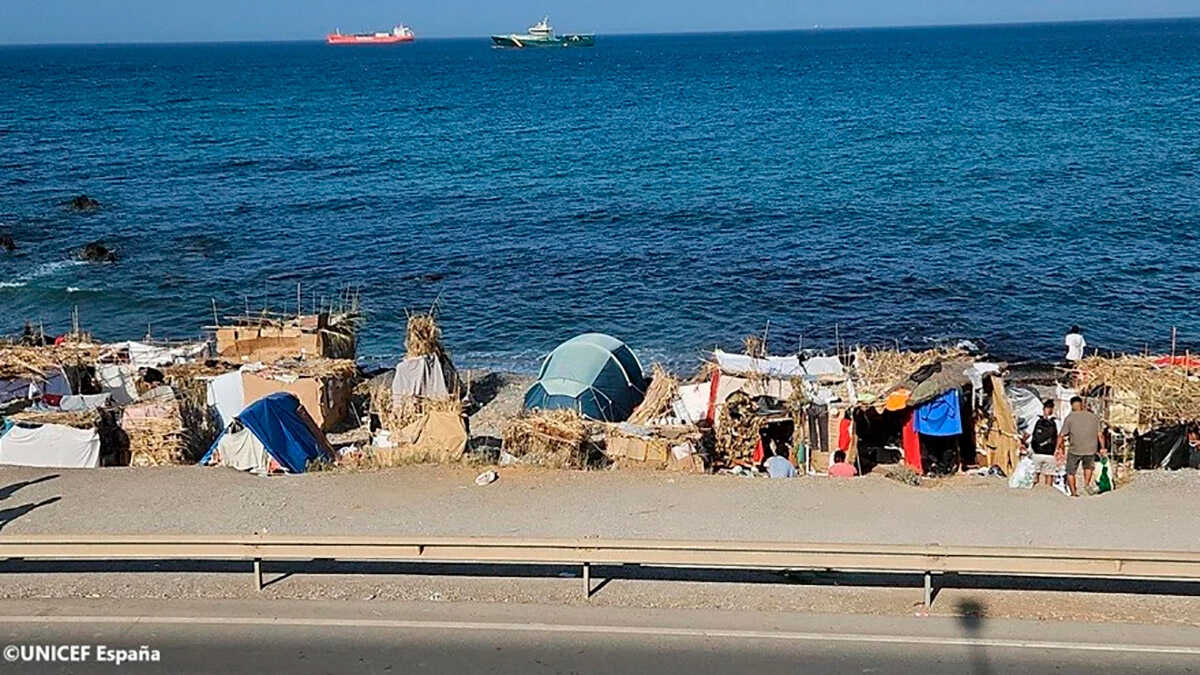
Morocco's government has warned Spain amid the controversy over the mass arrival of migrants in Ceuta. Rabat refuses to "serve as an electoral tool" and also rejects becoming "a scapegoat for political score-settling," according to an official statement issued after an internal debate over the response Spain should adopt toward its neighboring country.
The Moroccan statement came just hours after Congress approved a bill to offer the restoration of Spanish nationality to Sahrawis. The issue had sparked concern over the possibility that it could strain relations with Rabat.
The Ministry of Foreign Affairs, African Cooperation and Moroccans Abroad begins its statement by recalling that the country "has sovereignly chosen to establish, together with the Kingdom of Spain, a relationship based on geographical good-neighborliness, political understanding, economic partnership and security cooperation," whose fullest expression was the joint declaration of April 2022.
That Declaration, Morocco says, "marked a new stage in relations, based on the fundamental principles of mutual respect, reciprocal trust, permanent dialogue and the aspiration to a mutually beneficial partnership."
MOROCCO DEFENDS COOPERATION WITH SPAIN
Thanks to this approach, it continues, both countries "have managed to decisively foster what unites them and narrow their differences in order to address them with calm and respect, far from any attempt to impose faits accomplis. In this way, tangible results have been achieved, particularly in the economic sphere (Spain is Morocco's main economic partner; the Kingdom is Spain's second-largest trading partner outside the European Union) and in security cooperation (lives have been saved and terrorist and criminal networks dismantled, often at the cost of human and material losses suffered by Moroccan forces)."
The statement also highlights that cooperation on migration "has always been coordinated and effective" and acknowledges that "the regrettable events of last July undoubtedly require a thorough examination to clarify the circumstances, identify interference, denounce manipulation and, above all, ensure that they do not happen again."
"Now, setting aside controversy and rhetoric, common sense and the truth demand that direct questions be asked: Why maintain accusations against Morocco when no data, fact or report establishes any involvement by the Moroccan authorities? Why are illegal immigrants not returned, despite the Moroccan government having officially committed to readmitting them? Why are unaccompanied minors being kept away from their families when Morocco has repeatedly requested their return?" the Moroccan Foreign Ministry asks, asserting that the answer to all this "should not be sought in Morocco, but among the Spanish actors involved."
RABAT ATTACKS POLITICAL AND MEDIA SECTORS
In this regard, Morocco regrets that "certain Spanish political and media sectors continue to instrumentalize the Kingdom according to an internal agenda" and considers it "particularly deplorable that historic parties —with extensive experience in government— could have entered this swampy terrain, where irrational and populist escalation prevails over common sense."
It also considers it "regrettable that respected legislative and judicial institutions should engage in ill-advised initiatives that open the door to discord. These developments —in which discernment gives way to simplification and objective analysis to accusation— are part of a fear-based strategy that harms everyone," it warns.
Finally, the ministry stresses that Morocco "refuses to serve as an electoral tool and will not accept becoming a scapegoat for political score-settling." "Geographical proximity is an immutable reality. It is political leaders who, through their courage and broad vision, turn it into an advantage for the future" but, "on the contrary, strategic blindness will transform this asset into a source of chronic mistrust and recurring tensions."


