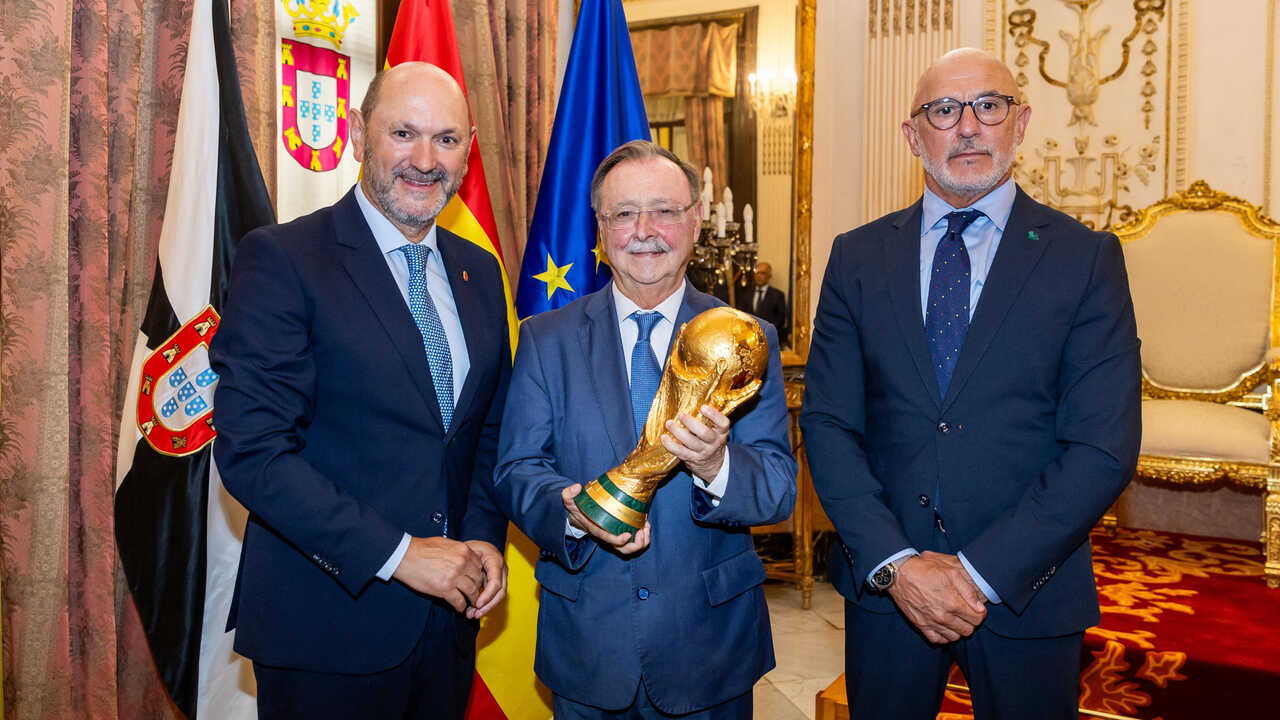
That was the message he delivered during an event attended by the president of the Royal Spanish Football Federation, Rafael Louzán, to present the World Cup trophy to the people of the autonomous city. De la Fuente, who admitted he was “moved, proud and grateful” for the “opportunity” to visit Ceuta “during very difficult and very painful times,” wanted to convey to the people of Ceuta “the support and encouragement of an entire country, of all Spain.”
CEUTA, “AN EXAMPLE FOR THE REST OF SPAIN”
“We stand united with you,” he said, adding that “all the people of Ceuta” had “become our idols” because they had “shown composure, strength and dignity” that made them “an example for the rest of Spain.” “An example of how to conduct yourselves during the very difficult moments we all have to face in life, but which you are experiencing with remarkable composure and dignity, setting an example for all of us,” he added.
DE LA FUENTE: “YOU ARE NOT ALONE”
Finally, he assured the people of Ceuta that they “are not alone.” “You have all your fellow citizens with you; we will not let you down. We will stand with you until the end and, insofar as we can humbly contribute that grain of sand—or that entire beach—that football can represent, we will be there, giving everything we can,” he added. He also said he hoped the crisis would “be resolved very soon with the help of all Spaniards” and announced that Spanish football would be “pushing for that to happen.”
WORLD CUP FINAL
Regarding the 2030 World Cup final, which Spain will host, the national team coach told the media that “it is a tremendous country, with a fantastic infrastructure, exceptional facilities and a great footballing history.”
“We are the current world champions, so what better place to play a World Cup final than in one of the cities of the country that would still be the reigning world champion at that moment,” he said, although he recalled that the choice of venue “is ultimately an institutional matter.”
THE WORLD CUP TROPHY BEGINS ITS TOUR IN CEUTA
For his part, federation president Rafael Louzán conveyed “a great deal of affection to each and every one of Ceuta’s 83,000” residents and celebrated the fact that the national team “has managed to unite this country and bring us a great deal of joy lately.” He said the “most important” achievement was winning a World Cup trophy that “begins its tour of Spain” in Ceuta.
At this point, Louzán wanted to “recognize and thank everyone for the excellent work” being done in Ceuta “also during difficult times,” aware that “Spain is Ceuta and Ceuta is Spain.”
After stressing that the purpose of the visit was to “show that the heart, emotion and feelings come together around everything that makes this wonderful city,” Louzán lamented the “evident concern” affecting the people of Ceuta over an issue that, in his view, “must have a solution, and sooner rather than later it will.”
“Now, truly, a united Spain is working to help all of you find a solution very soon,” he stressed, offering Ceuta “all the strength, encouragement and affection of the great family that makes up the Spanish Football Federation.”
VIVAS THANKS THEM FOR A “BOOST OF ENCOURAGEMENT”
In this context, the president of Ceuta, Juan Jesús Vivas, thanked De la Fuente for visiting a city that is “going through a very difficult time,” saying that the coach’s presence and the World Cup trophy represented “a boost of encouragement and support for a city that is suffering greatly.”
He recalled that on July 19 all the people of Ceuta took to the streets to celebrate the national team’s victory and that, just days later, they experienced what he described as “the biggest blow this city has suffered throughout its history,” with the arrival of nearly 80,000 migrants, “the equivalent of Ceuta’s entire population.”
CEUTA, “IN A PRESSURE COOKER”
In a serious tone, the president of Ceuta stressed that “few cities would be able to cope with such trauma,” emphasizing that Ceuta had set “an example of maturity, composure and determination.” At the same time, he made clear that “the consequences are terrible.” “Ceuta is living in a state of permanent stress, in a pressure cooker that could explode at any moment,” he emphasized.
He insisted on this point: “Ceuta is distressed, living on tenterhooks. The people of Ceuta long for nothing more in the world than to return to the city they had on July 29, to return to normality.”
After arguing that “Ceuta is not for sale, will not surrender and will defend itself,” Vivas once again thanked the Spanish Football Federation for bringing the coach and the trophy, which “belongs to all Spaniards” and, “in a very special way, to Ceuta.” Because, he concluded, “Ceuta is the heart of Spain today.”


