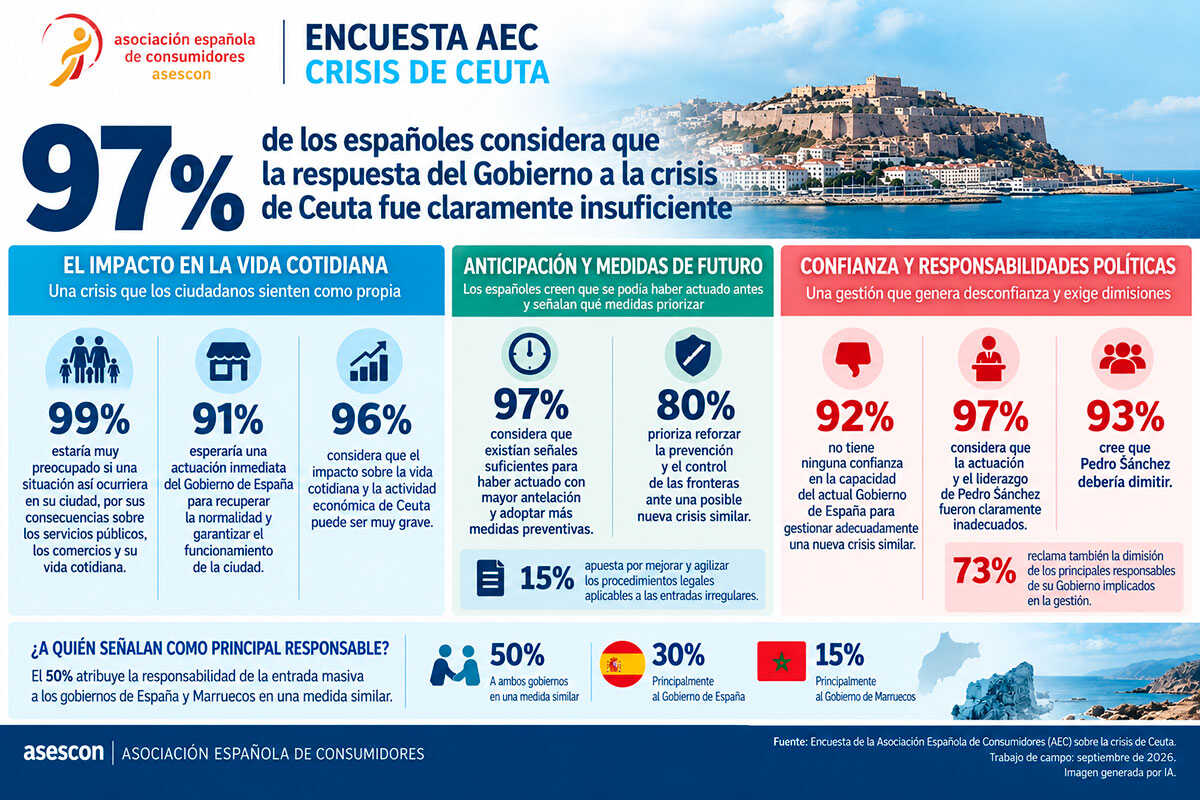
Citizens also take a critical view of the overall management of the crisis. Ninety-seven percent rate it as negative or very negative, with 76% describing it as “very negative.” In addition, another 97% believe there were sufficient warning signs to act sooner and adopt more preventive measures.
The survey reflects both the view of Spain as a whole and that of residents of Ceuta and Melilla, who account for 15% of the responses. In this way, the study also incorporates the perspective of citizens directly connected to the two autonomous cities.
“The results show a very clear perception that the response fell short in a situation that extraordinarily disrupted the normal functioning of a Spanish city. But they also reflect something particularly relevant: citizens believe there was room to anticipate events and adopt measures that would have enabled better preparation for a scenario of this kind,” said Miguel Ángel Ruiz, president of the Spanish Consumers Association (AEC).
CONCERN ABOUT THE IMPACT ON DAILY LIFE
The AEC survey also examines, beyond political management, how Spaniards perceive the consequences that a situation of this kind could have on the daily lives of citizens, families, workers, consumers and business owners.
Ninety-nine percent say they would be very concerned about the possible consequences for public services, businesses and their daily lives if an exceptional situation capable of suddenly disrupting the normal functioning of a city occurred where they live.
This concern is also evident among those who live and work in Ceuta. Ninety-six percent believe that a crisis of this kind could have a very serious impact and significantly disrupt both their daily lives and the city's economic activity.
The survey also considers the possibility of living with one's family in Ceuta during a similar crisis. In that scenario, 91% would primarily expect immediate action from the Spanish government to restore normality and ensure the city's functioning.
“When we bring this reality closer to home, concern is practically unanimous. We are talking about how an exceptional situation can affect everyday matters such as accessing public services, opening a business, going to work or carrying on family life normally. Ceuta cannot be perceived as a distant reality: behind this crisis are citizens and consumers whose daily lives have been directly affected,” Miguel Ángel Ruiz added.
PREVENTION AND CONTROL
The survey also asks about the responsibility citizens attribute for the origin of a mass entry of this kind. Fifty percent point to the governments of Spain and Morocco to a similar extent. Among those who primarily blame one of the two governments, 30% point to the Spanish government and 15% to the Moroccan government.
Looking ahead, one measure stands out above the rest. Eighty percent believe the Spanish government should strengthen border prevention and controls in case of a new similar crisis. As a second option, although by a considerable margin, 15% favor improving and speeding up the legal procedures applicable to irregular entries.
Assessments of what happened also shape expectations regarding future crises. Taking into account both previous episodes and the one recently recorded, 92% say they have no confidence whatsoever in the current Spanish government's ability to properly manage another situation of this kind. Another 6% say they have little confidence.
Opinion of the prime minister's specific actions follows the same pattern. Ninety-seven percent consider Pedro Sánchez's actions and leadership during the Ceuta crisis to have been clearly inadequate.
This assessment has also led to calls for political accountability. Ninety-three percent of respondents believe Pedro Sánchez should resign as prime minister. Specifically, 73% call for both his resignation and that of the main members of his government involved in managing the crisis, while 20% believe the prime minister should resign. Another 4% do not call for Sánchez's departure but do believe that the government officials directly involved should resign. Overall, therefore, 97% are calling for the resignation of at least one political official over what happened.
For the Spanish Consumers Association, the results highlight the need to draw conclusions from what happened and advance mechanisms that can anticipate exceptional situations, protect the normal functioning of services and economic activity, and provide citizens with a rapid response when events of this magnitude disrupt their daily lives.


