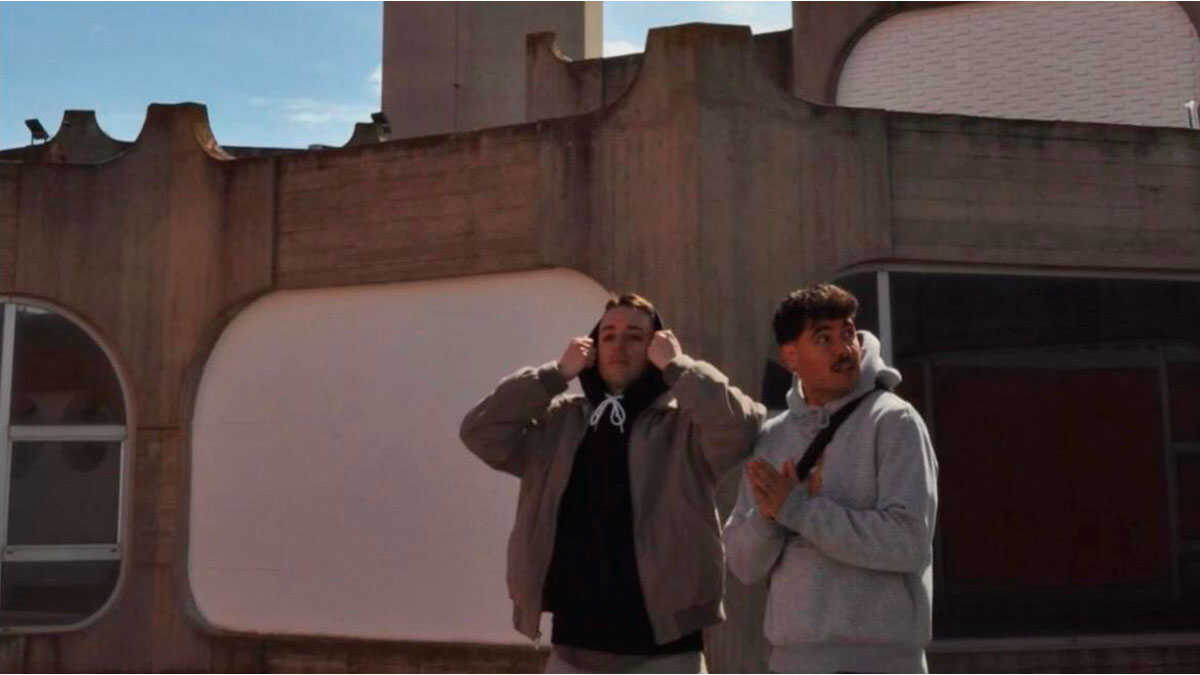
Thus, buildings that Zaragoza residents often overlook and that some even consider ugly have served Manu and Javi as inspiration and a setting for five musical tracks that are gradually being released. “What interests us is that architecture does not function solely as a backdrop; each building forms part of the song’s concept and visual identity,” they explain.
The songs, which can be heard on their social media (@ninosdelebano) and on Spotify, use locations such as the staircase of the former Opel Iglesias Zavisa dealership (on Avenida Cataluña), Torre Pikolín, the Faculty of Mathematics at the University of Zaragoza, Parque Roma and the Correos building on Avenida Anselmo Clavé.
SONGS THAT ENGAGE WITH BUILDINGS AND BUILDINGS THAT INSPIRE
The first building they chose is the former Opel Iglesias Zavisa dealership on Avenida Cataluña, where Los Niños del Ébano set the song “Mesas largas.” The focus falls especially on its distinctive concrete spiral staircase, one of the most recognizable features of a building that received the Ricardo Magdalena Trophy in 2007 for its design. After the dealership closed and part of the facilities was demolished, the structure remained as one of the few reminders of that complex.
The series continues with “Volver a verte,” whose visuals were filmed in the Correos building, and “Rey de la cancha,” which took the project to the facilities of the Faculty of Mathematics at the University of Zaragoza. In this latest release, the group itself summed up one of Brut Series’ aims: to make “brutalist architecture and music join hands” while highlighting the heritage of their city.
Another of the protagonists is Torre Pikolín, built in 1973 and designed by architect Ángel Colás, with a ceramic mural by C. Ramírez. The building provides the setting for “Como Pikolin,” another piece in a series that finds in concrete, bold forms and urban spaces the visual language with which to accompany its songs.
A ZARAGOZA THAT IS THERE, BUT IS NOT ALWAYS SEEN
“This project starts from there: structures that withstand more than they show, everyday life, brutalist architecture, music with friends in 12 square meters. That is Brut Series,” its creators explain. It is an idea in which the buildings end up functioning almost like another member of each song.
And it is precisely there that Los Niños del Ébano find the definition that encapsulates everything they are building with Brut Series: “This is not just music. It is emotional concrete.” The series looks toward Zaragoza’s concrete to speak, in reality, about the people and stories that unfold around it.