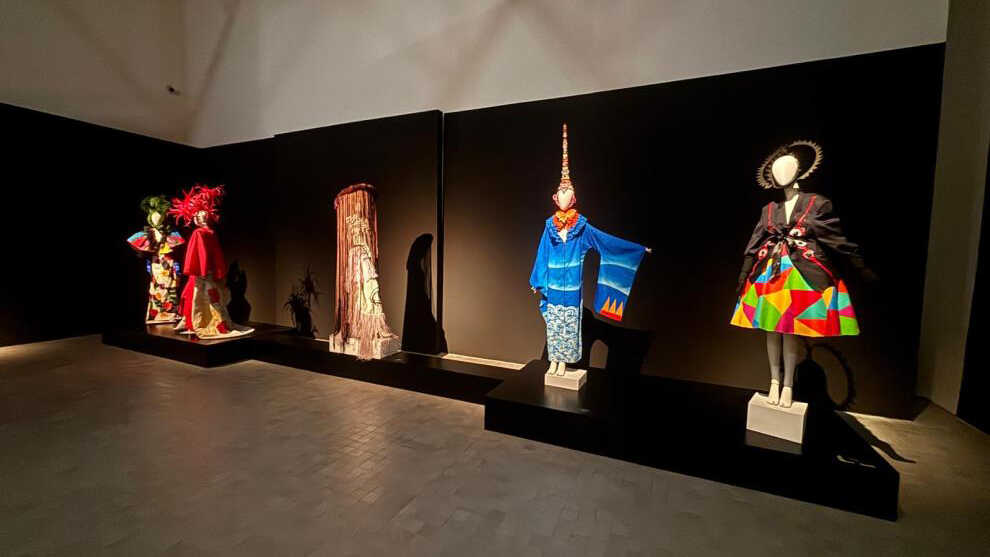
Two moments from a creative career built around the dialogue between fashion and art come together in the same room: “Fashion Art 20th Anniversary” and “What Do I Have in My Head?”, two exhibitions that, under the umbrella of designer and artist Manuel Fernández, offer an overview of a decades-long exploration that has blurred the boundaries between creation, design, image and artistic expression.
Fernández represents a singular contemporary figure at the international intersection of fashion design and art. His career has been built precisely in that hybrid territory where fashion ceases to be merely a discipline associated with clothing and becomes an artistic, cultural and emotional language.
Far from being conceived as two independent projects, the exhibitions establish a dialogue. On the one hand, “Fashion Art” presents fashion as an artistic medium and a meeting point for visual artists, while “What Do I Have in My Head?” takes that relationship into the realm of photography, turning the body, face, garments and color into tools for exploring the inner world.
FASHION ART: TWENTY YEARS OF DIALOGUE BETWEEN FASHION AND ART
“Fashion Art” was born from an apparently chance circumstance. After a Manuel Fernández fashion show at the Círculo de Bellas Artes in 1998, the designer decided to alter, together with artist Juanjo Castillo, a dress that had not met his initial expectations. That intervention gave rise to a project that would later bring together renowned visual artists to transform Fernández’s designs into authentic works of art.
Since then, Fashion Art has built an international track record, with more than 30 exhibitions in museums and cultural venues attracting more than three million visitors, and has incorporated more than 300 pieces altered by artists from 46 nationalities.
The collection brings together leading names in contemporary art, including Manolo Valdés, Juan Genovés, Luis Gordillo, Rafael Canogar, Eduardo Úrculo, Ouka Leele, Grimanesa Amorós, Miquel Navarro, José Manuel Ciria and Suso 33, among others. In 2026, artists Leticia Martínez and Sylvia Pennings will join the “Fashion Art 20th Anniversary” collection at the IAACC Pablo Serrano.
The exhibition also has an essential characteristic: “Fashion Art” is a living project. Its journey through different cities has made it possible to incorporate new artists and generate new interpretations in each context, turning it into an experience in constant evolution.
This artistic dimension coexists with a strong social and sustainable vocation. Since 2007, Fashion Art Institute has developed workshops and projects focused on training, recycling, empowerment and awareness-raising in different countries and among diverse groups, understanding creativity as a tool for social transformation.
“WHAT DO I HAVE IN MY HEAD?”
In contrast to the collective nature of “Fashion Art,” “What Do I Have in My Head?” explores a more intimate dimension. Through a series of highly symbolic images, Manuel Fernández turns the face and body into territories where the personal and collective meet.
His portraits function as windows into the subconscious. Gestures, fabrics, shapes and colors create overlapping atmospheres that make visible silenced thoughts, restrained emotions and mental states shaped by the acceleration of the present. The exhibition brings together different photographic series that form an authentic visual and emotional map.
In “Mystics,” figures suspended between serenity and pain appear in a bare space rendered in black and white. The absence of color intensifies the gestures, textures and gazes. In “Yellow,” the monochrome transforms color into an atmosphere and envelops the portraits in a sense of luminous calm, inviting contemplation and reverie.
“Black” explores the tension between restraint and freedom, while “Red” takes color to the point of dominating the entire narrative, intensifying gestures, silences and presences until the symbolic becomes a physical and emotional experience.