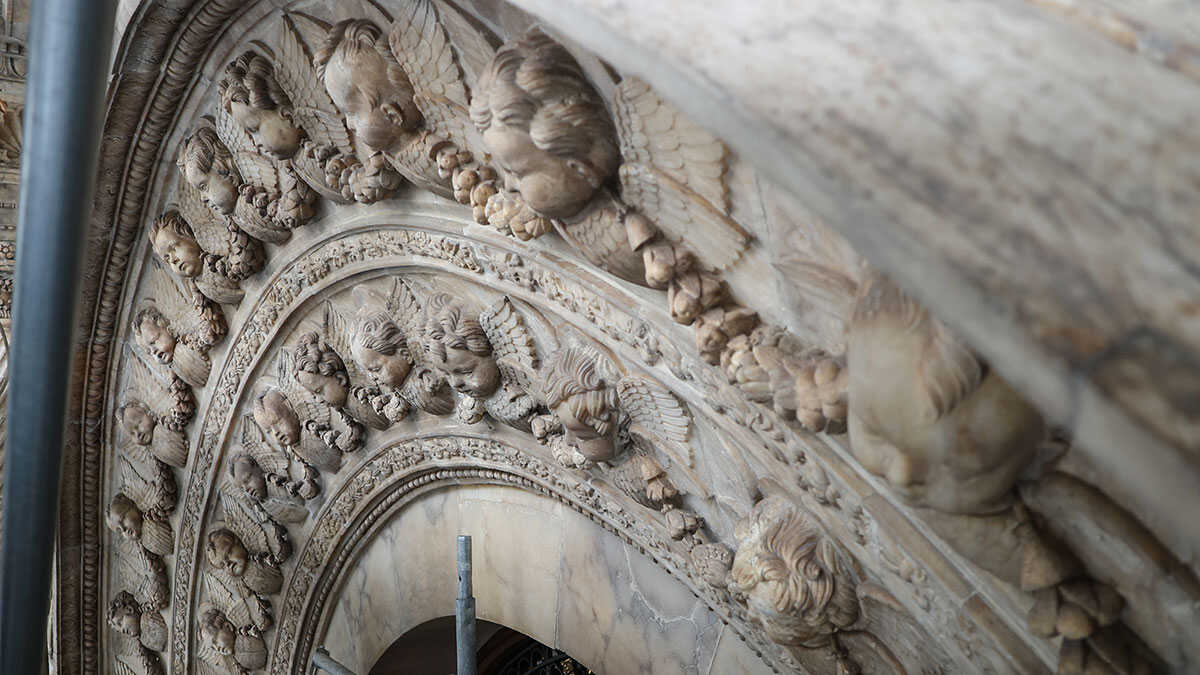
The Renaissance façade was created by Gil Morlanes the Elder (él started it and his son completed it) and is made of alabaster. This was precisely where the restoration team from the In Situ-Ecra joint venture (the company awarded the contract promoted by the Directorate-General for Culture) encountered the greatest difficulty, as neither aqueous treatments and systems nor abrasive methods could be used to clean it, the central focus of the project. Cracks and fissures have also been sealed, unstable fragments have been attached and stitched, and loose fragments repositioned.
"Cleaning was the most complicated part of the work, but we ultimately managed to remove all the black crust that had built up on the façade using laser technology operating at infrared frequencies, thanks to the Institute of Nanoscience and Materials at the University of Zaragoza. The last intervention took place in the 1990s, when cutting-edge products were used, but over time they have proven to have degraded. They are polymers, chains of polymers, and removing them has been somewhat difficult," acknowledged Leticia Sanz and Nieves Ciórraga, the restorers in charge of the project.
The restoration of the entrance door to the church and the stained-glass window (which was dismantled and taken to Segovia for restoration) were among the other works carried out in a project that involved an investment of 280,000 euros. "It was an intervention of the highest technical difficulty because previous work had consolidated a layer of dirt that prevented it from being properly viewed. The technical quality of restoration professionals in Aragon must be highlighted at a time when it is being called into question by the Sijena issue," said the director-general.
The use of corrosive materials and the passage of time, together with exposure to the elements (rain, wind and sunlight), caused Santa Engracia Basilica to lose its splendor over the years. The work will now focus on applying a coat of color, carrying out a general cleaning and reviewing the pigeon-control system, which, although dating from the 1990s, "is one of the most effective," the restorers said. Before that, last year the archbishopric undertook work to eliminate dampness from the façade and improve its finishes.
"The façade was commissioned by Ferdinand and Isabella to create a political program. It is part of the heritage tradition of Aragon, and this façade contains the political program behind the creation of a united Spain from Aragon and Castile. It tells of the commitment of the Aragonese nobility and the Kingdom of Aragon to the construction of the idea of Spain, and it does so with all possible splendor," concluded Director-General Pedro Olloqui.