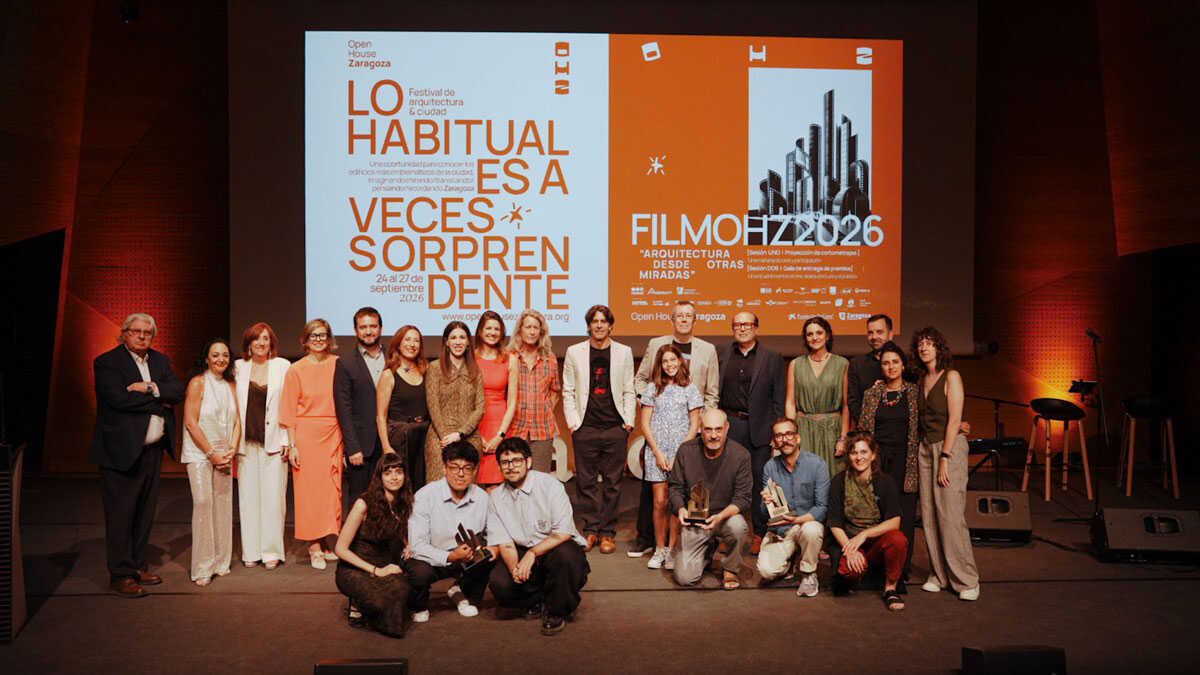
The award ceremony was part of a gala in which cinema and architecture shared the spotlight and the first Filmohz winners were also announced. The short film "Construyendo una casa por el tejado," directed by Bastian Ponce González and Leire Uche Luño, received the competition’s top prize. Second place went to "Catálogo de uma cidade sem tecto," by Portuguese filmmaker Diogo Cunha; the Special Mention went to "Fractal Cities," by Haotian Zhang; and "Chacanahe," by Helena Millán and Carlos Soriano, won the Audience Award.
The competition brought together 12 works about the relationship between cinema, architecture and the spaces we inhabit. In the morning, audiences watched the selected short films at CaixaForum Zaragoza, shown in four screening blocks, and voted for their favorite. The subsequent gala, hosted by Javier Vázquez, was attended by representatives of the Government of Aragon, Zaragoza City Council, the Aragon Audiovisual Cluster, the Aragon Film Commission and other festival sponsors and partners.
The Zaragoza-born filmmaker received the 2026 Filmohz Honor Award from actor Eduardo Noriega and praised the beauty of the Aragonese capital. Photo: Canelita Estudio
"The festival is becoming firmly established, and it is worthwhile to show our city and our emotions to the world through new formats," said Open House Zaragoza director José Javier Gallardo, who also noted that architecture and cinema are deeply connected: "architects reveal the relationships between space and form, and cinema does that too. In addition, the seventh art needs to find locations, and architecture is, in itself, a meeting point for all these factors."
LAMATA AND HIS CONNECTION TO ZARAGOZA
Lamata accepted the Honor Award with humor and gave part of the spotlight to the city itself. "It is true that awards are satisfying, especially those you do not deserve. If anyone deserves it, it is the city," he joked.
The filmmaker also recalled "Nuestros amantes," one of his best-known films, in which Zaragoza serves as the backdrop. The movie brought some of the Aragonese capital’s landmarks to audiences in different parts of the world. "In most of these screenings, it received all kinds of praise. In New York, for example, they asked me which city was so beautiful. Many people were amazed, and there has always been a great fascination with the city," he said.
Eduardo Noriega also dedicated a few words to the Zaragoza-born director, whom he described as "an extraordinarily creative, funny and talented person. I greatly admire his work as a director, producer, promoter and writer because, in addition, he is a tireless and devoted worker."
Aragonese director Javier Macipe joined the tribute through a video in which he highlighted both Lamata’s career and his personal generosity. "Daring to shoot a zombie film in Zaragoza, I believe, opened the way for cinema to be made again in the city and for an entire generation. Since I was 19, you have always helped me, with infinite generosity, without any ego and without keeping anything for yourself. That is truly admirable," he added.
The evening alternated the presentation of awards with footage from the short films and musical performances by Silvia Solans, Jorge Bermejo and Cristian Baquero. Under the motto "Architecture Through Other Perspectives," Filmohz was created within Open House Zaragoza to promote the dissemination of architecture through cinema as a cultural and educational tool and to encourage filmmaking focused on the urban context.
FROM THE WATER TOWER TO HOTEL HIBERUS
Cinema was one of the highlights of the third day of Open House Zaragoza, which also opened various spaces in Zaragoza and its surrounding area to the public. The Water Tower hosted a tour of the hidden side of the Pavilion and a night visit, during which the three Filmohz winning short films were also screened.
The program also included the helicopter emergency base in Villanueva de Gállego, Mobility City and Ibercaja’s central building. At the latter venue, participants were able to explore 150 years of the institution’s history through a guided tour.
The day continued with the Filmohz 2026 Party at Hotel Hiberus, where architecture moved into the performing arts with the show Harria Herria. Based on Dimegaz’s short film of the same name, the production combined vertical dance, music, poetry and video mapping on the building’s exterior walls in a site-specific performance designed to reveal the form and space of this Expo 2008 complex building from a different perspective.
Open House Zaragoza is part of an international network present in 60 cities and shares with the movement the goal of bringing architecture closer to citizens and making visible spaces, buildings and stories that usually remain outside the customary routes.