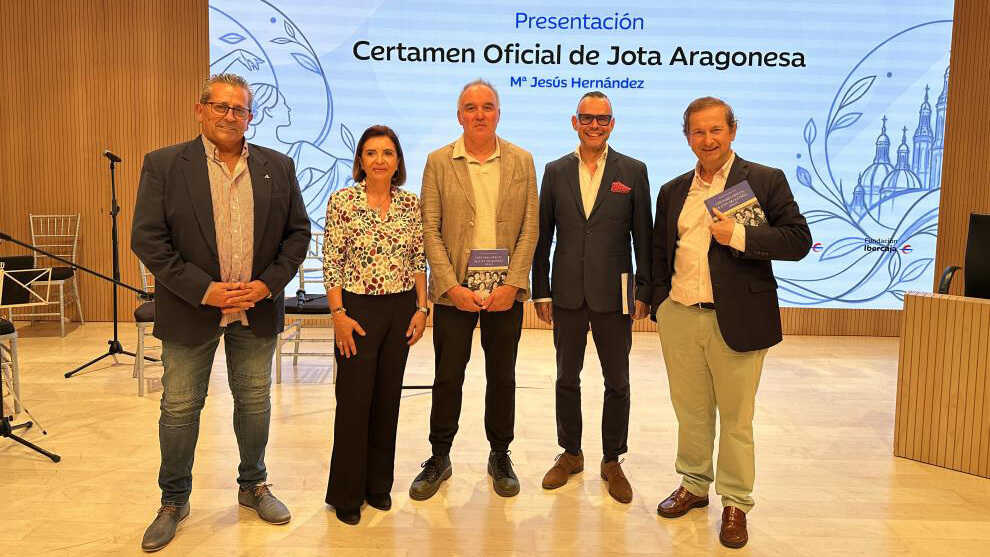
At the event, Olloqui recalled that the jota is the “most widely shared and universal” expression of Aragonese culture and a demonstration “of the modernity and depth of our culture,” he stressed. “It is a living genre that is constantly renewed, and the Official Jota Contest is an example of this ability to modernize after 140 editions.”
The director recalled that, “in all likelihood,” the jota will be declared Intangible Cultural Heritage of Humanity this year at the assembly that UNESCO will hold in China, “and everything points to this long-awaited good news being confirmed by citizens.” He therefore called for this year’s Fiestas del Pilar and Jota Contest to become “a major call to celebrate the designation of the jota as World Heritage.”
The book presentation was also attended by writer and member of the jury of the International Jota Contest of Aragon José Luis Melero, and by Jesús Martín Ferrer, president of the Academy of Folklore and Jota Arts of Aragon. Angelines Hernández, José Luis Urbén, María and Sergio Ripol, and a rondalla also performed.
A FIESTAS DEL PILAR TRADITION
Every year, during the Fiestas del Pilar, Zaragoza hosts one of its most cherished traditions: the Official Aragonese Jota Contest. What began in 1886 as a rondalla competition organized by the Festivities Board to preserve jota singing has, over time, become an event inseparable from the patron saint festivities and the history of the Aragonese jota.
The book covers the contest’s 140-year history and highlights the most notable aspects of each edition. It reviews the rules that governed its operation, the rondallas that accompanied singers and dancers, and the winners of every edition, as well as the anecdotes, stories and curiosities that have become part of its history.
The author, María Jesús Hernández Viñerta, a jota singer and researcher, approaches the subject from a dual perspective: with the rigor of someone studying a fundamental part of the history of the Aragonese jota and with the insight of someone who has experienced it from within.
María Jesús Hernández Viñerta is also the author of several genealogy books published by the Fernando el Católico Institution, as well as reference works on folklore and ethnography, such as ‘Our Aragonese and Universal Jota’ (El Periódico de Aragón, 2022) and ‘Ricardo Compairé, the Pharmacist Who Portrayed the Soul of the Alto Aragón’ (IEA, 2025).