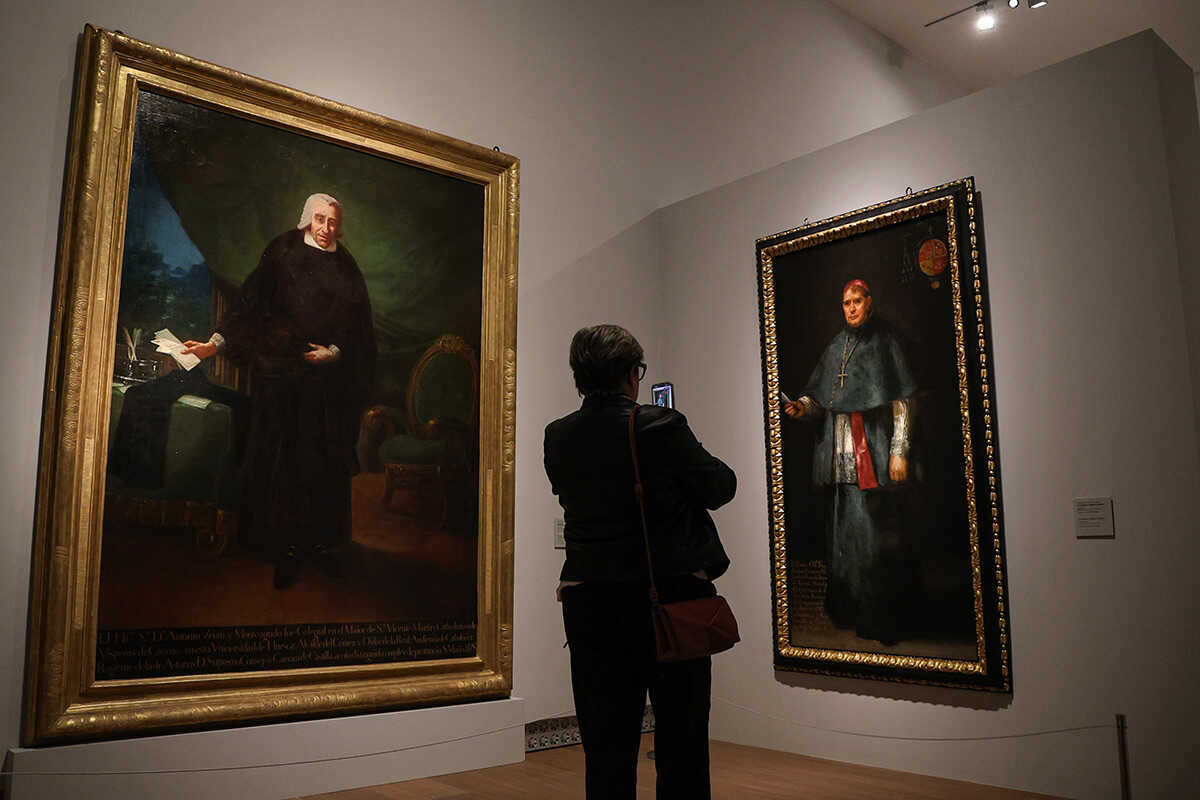
The exhibition, which can be visited until January 10, seeks to explore the distinctive way of seeing that made Goya one of the great geniuses in the history of universal art. His gaze on power, people, affection, violence and the human condition forms the backbone of a display featuring "exceptional" works.
"The Duchess of Alba," "La Tirana," "The Marchioness of Villafranca Painting Her Husband," "The Parasol," "The Injured Mason" and the celebrated "Self-Portrait in the Studio" are among the works that can be admired throughout the exhibition. The display is organized into three main sections: "Light and Shadow," "The Power of Portraiture" and "The Bonds of Affection."
"You are witnessing a miracle. Over the past 18 months, we have worked very hard to bring together these 40 new works by Goya, and the question was always the same: "¿Will the museum be ready?" Most of those lending the works had the audacity and generosity to agree. There are many museums in Madrid where work began much earlier and has now come to a standstill. That is why this is a miracle made possible by many people," acknowledged the exhibition’s curator, Luis Fernández-Galiano.
GOYA’S THREE WAYS OF SEEING: FROM LIGHT TO HIS MOST PERSONAL PORTRAITS
The first section, "Light and Shadow," contrasts the luminous scenes from Goya’s early years with the darker and more critical images of his maturity. Highlights in this space include "The Parasol," from National Heritage; "The Injured Mason," from the Prado Museum; and "Cannibals" dismembering their victims, which has arrived from the Museum of Fine Arts and Archaeology of Besançon, France.
The second, “The Power of Portraiture,” brings together paintings of figures from the aristocracy, the Church, the military and the bourgeoisie. Through them, Goya reflected both their appearance and their personalities and contradictions. Among the most important works are "The Duchess of Alba," from the Casa de Alba collection; "La Tirana," from the Royal Academy of Fine Arts of San Fernando; and "María Teresa de Vallabriga on Horseback," from the Uffizi Gallery in Florence.
Finally, “The Bonds of Affection” reveals the painter’s most intimate side through portraits of relatives, friends and close acquaintances. This section includes "Self-Portrait in the Studio," from the Royal Academy of Fine Arts of San Fernando; "Uncle Paquete," from the Thyssen-Bornemisza Museum; and portraits of his in-laws, Martín Miguel de Goicoechea and Juana Galarza de Goicoechea, from the Abelló Collection.