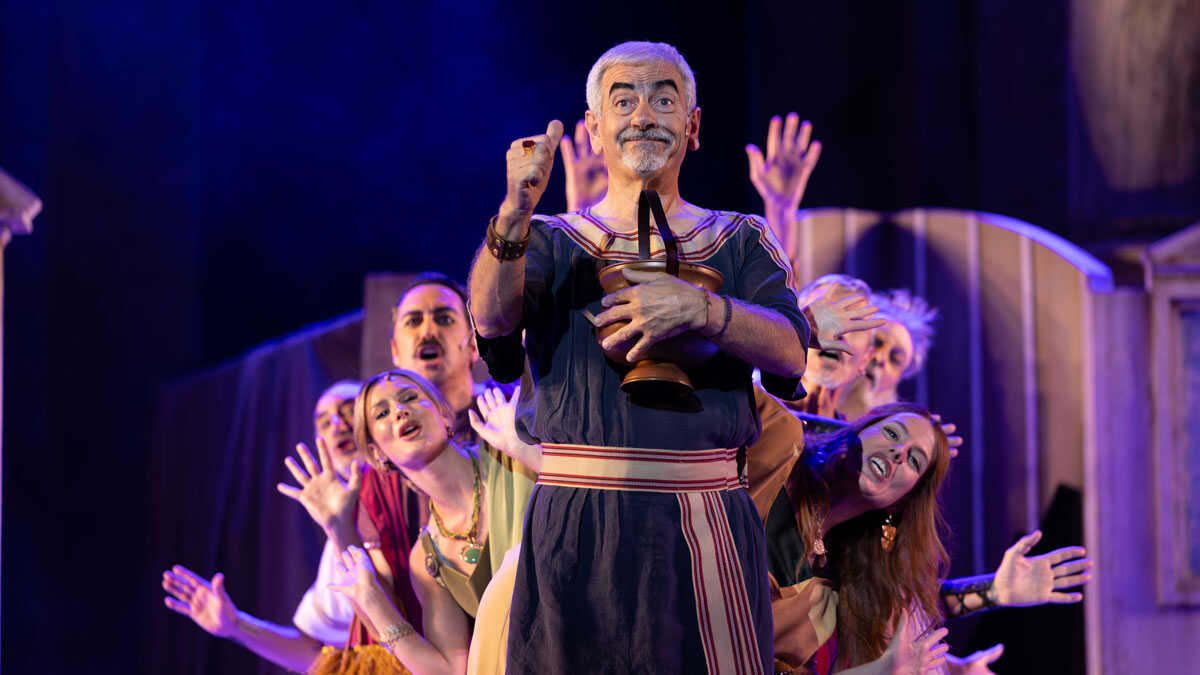
QUESTION.— You are returning to the Teatro Principal, once again with a Plautus classic after "Miles Gloriosus.” How has it been to step into Euclio’s shoes? ANSWER.— It has been great fun. He is the quintessential miser, the character who later inspired Molière’s "The Miser" centuries afterward. It is a play full of misunderstandings and love affairs, and it is extremely enjoyable to perform because it is so rewarding. The audience laughs out loud at many points during the show, so it has been a pleasure.
Q.— Are we so different from those Romans, or have we changed very little? R.— No. We have changed, but for the worse (laughs). The good thing about the classics is that they dealt with major issues and great problems of humanity, and those remain unchanged despite the passing of centuries. We are still the same as before, exactly as clumsy, just as eager for money and power, and not very concerned with being and solidarity.
Q.— It is a play written 2,300 years ago, yet it remains as relevant today as it was then. R.— It is absolutely relevant, and in an almost fierce way, isn’t it? Greed is like love, an excess of power or any other deeply human feeling. It is so much a part of us that it does not die with the passage of time. Whatever the subject, it is always relevant.
Q.— Juan Luis Iborra, the play’s director, says comedy is a very serious matter. Is it harder to make people laugh than to make them cry? R.— Oh, I think so. Emotion is easier to achieve because dramatic writing, when it is well written, has tremendous power; all you need to do is deliver it credibly. Comedy, however, has two problems. First, you need to have a comic instinct, which not everyone has. Second, comedy’s rhythm has an internal mathematics. If it fails, the joke falls flat. You have to wait the necessary amount of time, as in music, to keep the beat. If you skip it, you affect the melody, so it is complicated. On top of that, humor differs from person to person. Everyone sees or understands things in one way or another; drama does not. Drama always has a single interpretation.
Q.— The play breaks the fourth wall. Does the audience respond well to that closeness? R.— I think so. So far, it has responded wonderfully, because the good thing about breaking that wall is that we do not do it abruptly, but by following the plot of the play. When we come down into the auditorium, we are doing so because something is happening during the performance; we involve the audience in resolving that conflict, so it does not feel artificial at all. Then we do it comically, we play with the people... And spectators always like that very much.
"Actors love theater above everything else because it is the only place where we control our work"
Q.— I imagine some of the humor must have been updated to bring it from the way Plautus conceived it into the present day... R.— Well, as far as the structure is concerned—in other words, the situations of misunderstandings, clashes and conflicts that Plautus creates—the classic preserves 100% of what he wrote. It is true, however, that the verbal gags have been adapted, because they are obviously not the same as those he wrote 2,300 years ago. It is necessary to adapt them, otherwise it becomes a little more difficult, but it is a very respectful adaptation. Anyone who has read Plautus will find that more than 80% of the text belongs to him.
Q.— You are one of Spain’s most recognizable television faces, and some people may be surprised to see you on stage. What does theater give you? R.— Actors love theater above any other medium because it is the only place where we control our work. In film, or when you are shooting a series, there are a thousand factors that influence your work. Not in theater: it is you and the audience. Contact with the audience, feeling the atmosphere created within a set—that is magical, almost liturgical, I would say. Money cannot buy it; it is the most beautiful thing there is for an actor.