Some of these stories have been preserved so well that they seem frozen in time. In the Aragonese Pyrenees, this feeling is even stronger. From walls to deserts, every village hides treasures worthy of the big screen.
Among them is one that no longer has any residents but does have a monumental history: Muro de Roda, an ancient Christian stronghold perched at more than 1,000 metres above sea level. This village in Huesca, now uninhabited, preserves three architectural gems declared Cultural Heritage Sites, including the Hermitage of Santa Bárbara and the fortified Church of Santa María. And although time has stood still within its walls, every stone continues to speak.
MURO DE RODA, THE ABANDONED VILLAGE IN HUESCA THAT HAS CAPTIVATED NATIONAL GEOGRAPHIC
Muro de Roda, located in the municipality of La Fueva, in the Sobrarbe comarca, is an exceptional example of defensive and religious architecture from medieval Aragon. This village in Huesca, uninhabited for decades, has been recognised for its historical and architectural value, attracting the attention of publications such as National Geographic.
The Muro de Roda complex includes an oval wall that follows the mountainous terrain, incorporating the rock formations into its defensive structure. Inside the enclosure are the Church of Santa María de la Asunción and the Hermitage of Santa Bárbara, both declared Cultural Heritage Sites. These buildings reflect the strategic and spiritual importance the site held in centuries past.
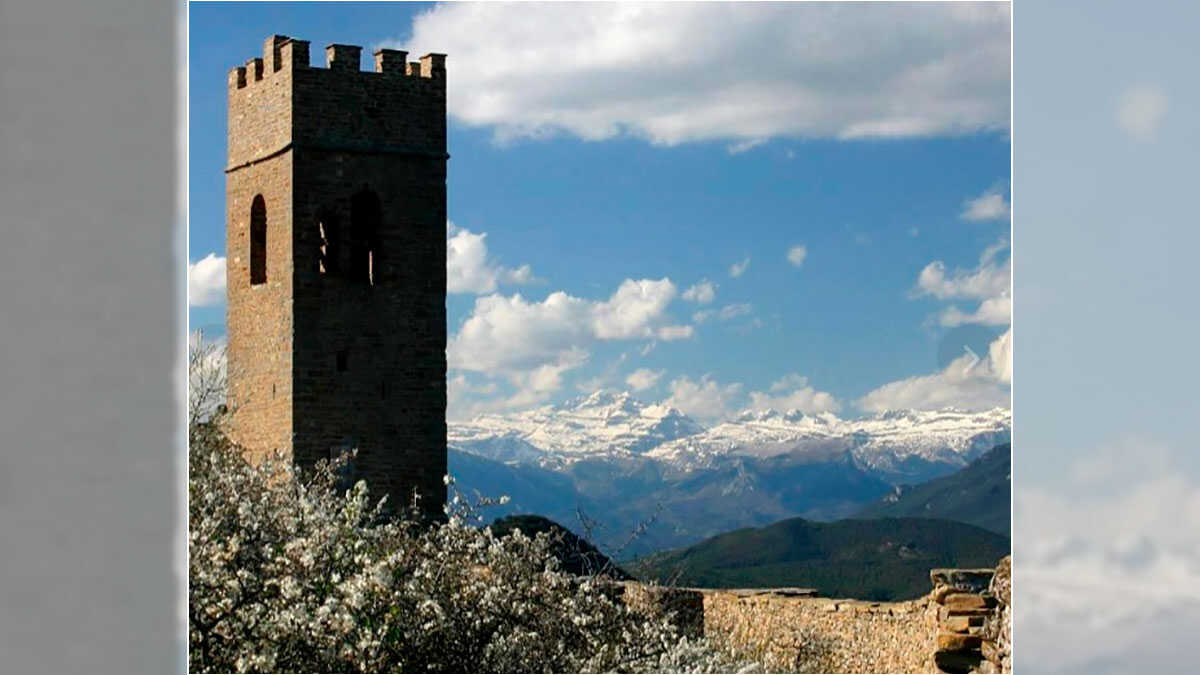
Visiting Muro de Roda means embarking on a journey into the past. Photo: Vallede la Fueva
WHAT TO SEE IN MURO DE RODA
Visiting Muro de Roda means embarking on a journey into the past. The Romanesque Church of Santa María de la Asunción stands out for its three apses and its integration into the wall, serving both as a place of worship and a fortification. The Hermitage of Santa Bárbara, built in the 17th century, is located at the southern end of the enclosure, completing the walled complex.
The Hermitage of San Bartolomé also does not go unnoticed. Although it is neither part of the walled enclosure nor declared a Cultural Heritage Site, it is a small but essential stop when visiting this place.
In addition, the walk along the wall-walk path offers panoramic views of the La Fueva valley and the surrounding mountains. The combination of architecture and landscape makes Muro de Roda a unique place in the Aragonese Pyrenees.
HOW TO GET TO MURO DE RODA
To reach Muro de Roda from Huesca, it is recommended to take the A-131 towards Monzón, continuing as far as Barbastro. From there, continue along the A-138 and A-2206 to La Fueva. Once in the town, follow the signs to Muro de Roda, ascending along a forest track that leads to the walled enclosure. The journey takes one and a half hours.
It is advisable to complete the final section on foot or in vehicles suitable for mountain roads, as access can be difficult in certain weather conditions.