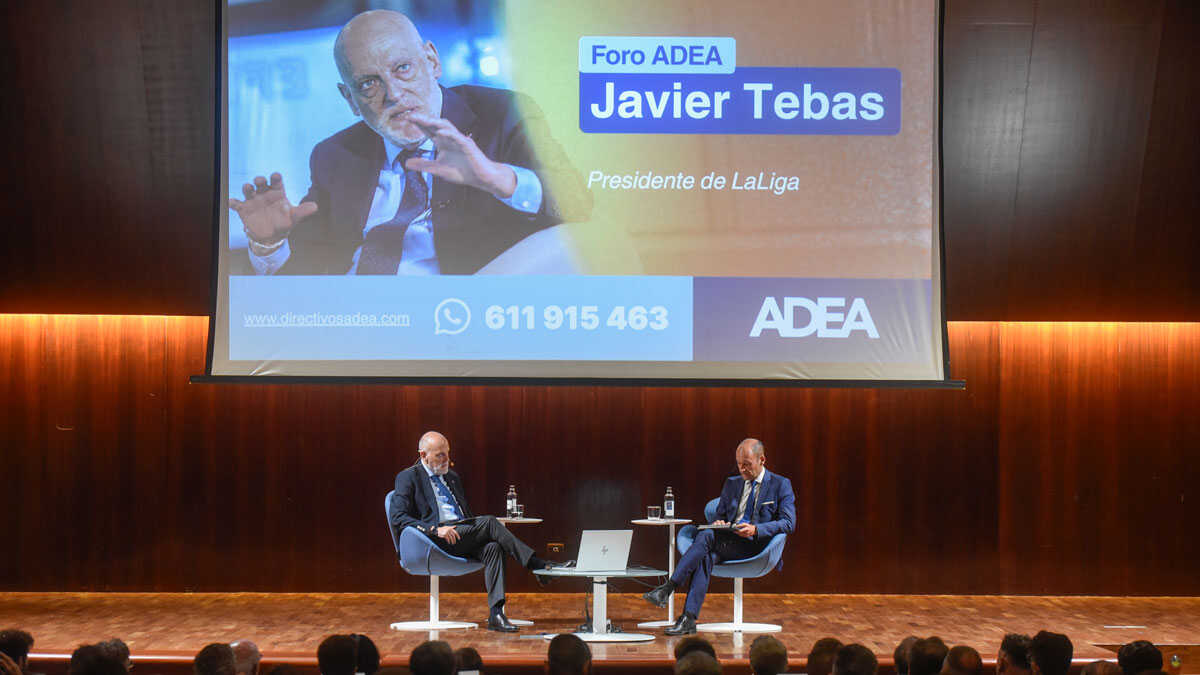
The event, held in the assembly hall of the Huesca Provincial Council, also served to review LaLiga’s development over the past thirteen years. Tebas discussed the main decisions adopted since he became president in 2013.
The day began with "The Social Minute," the ADEA Forums’ initiative aimed at giving visibility to third-sector organizations. On this occasion, the invited association was Valentia, an organization committed to inclusion and creating opportunities for people with intellectual disabilities. In addition, ADEA president Fernando Rodrigo introduced the speaker, highlighting his role as "one of the main driving forces behind the transformation of professional football, positioning LaLiga as an international benchmark not only in sport, but also in sustainability, innovation and business management."
FINANCIAL OVERSIGHT, KEY TO LALIGA
During the event, Tebas focused on the economic and business dimension of professional football and argued that the competition should be understood as a genuine industry. "Behind what happens every weekend are thousands of families who make a living from this activity and a sector that accounts for around 1.7% of Spain’s GDP," he explained. In this regard, he stressed that strategic decisions must consider their long-term impact on the entire ecosystem.
The LaLiga president recalled the transformation that has taken place since he took office in 2013. Among the main milestones, he highlighted the centralized sale of audiovisual rights, which has increased revenue from €860 million to more than €2 billion and considerably reduced economic inequality between clubs. He also discussed LaLiga’s international expansion, with offices currently located across different continents and a digital community of more than 277 million followers.
He also argued that financial fair play has been "the differentiating factor" in ensuring the competition’s sustainability and strengthening clubs’ transparency. As he explained, financial oversight is not intended to limit sporting competitiveness, but to enable clubs to grow on solid, sustainable foundations and prevent debt situations that could jeopardize their future.
ARTIFICIAL INTELLIGENCE AND FOOTBALL’S CHALLENGES
Innovation also featured prominently in his address. Tebas explained that LaLiga has been incorporating artificial intelligence-based solutions for more than a year to optimize internal processes, improve decision-making and increase operational efficiency.
"If we do not adapt, no company will truly take advantage of the benefits of artificial intelligence," he said, delivering a message applicable to any organization undergoing digital transformation.
During the discussion, Tebas also addressed the growing pressure that international competitions are placing on domestic leagues. The LaLiga president expressed concern about the expanding sporting calendar and the economic impact that certain decisions adopted by FIFA and UEFA may have on national leagues, defending the need to preserve the competitiveness and balance of the European model.


