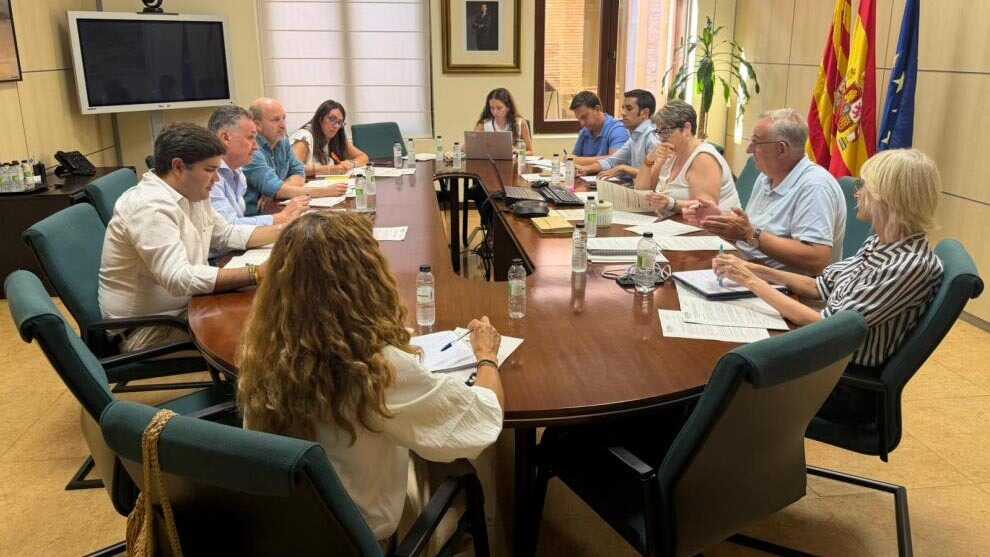
With this aim, Agriculture, Livestock and Food Minister Arancha Simón and Environment and Tourism Minister Luis Biendicho chaired a new meeting of the African Swine Fever Prevention Committee on Tuesday, held at the headquarters of the Agriculture Department. During the meeting, they analyzed the draft Protocol for Action in the Event of Suspected African Swine Fever in Aragon, a document that will serve as the basis for defining and coordinating the response to a possible suspected case.
The protocol is being drawn up to establish communication channels, the intervention of the various agencies and coordination among veterinary, environmental, emergency and laboratory services. Simón stressed that the work being carried out by the Government of Aragon reflects a commitment to prevention and responsibility. “We want to anticipate events and ensure that everyone and every service involved knows what to do from the moment a suspicion arises,” she said.
The minister recalled that the pig sector is one of Aragon’s main economic and agri-food industries, supporting thousands of jobs and playing an essential role in many rural municipalities. “Working on prevention does not mean creating alarm; it means protecting our farmers, our farms, our industry and our exports. Our responsibility is to be prepared, although we hope we never have to activate this response,” she added.
A COORDINATED RESPONSE
Luis Biendicho highlighted the need for permanent coordination between the Agriculture and Environment departments, especially regarding wildlife monitoring and wild boar population control. “Preventing ASF requires joint action. Monitoring the natural environment, locating possible carcasses, collecting samples and controlling the wild boar population are essential elements in reducing risks and protecting farms,” he said.
The draft will be submitted to the members of the Committee of Experts for comments over a period of 15 days. Once the contributions have been analyzed and incorporated, work will proceed on the final version of the document and its subsequent approval. The document is part of the work to complete Aragon’s Contingency Plan for African swine fever, which is currently being prepared, and will strengthen the mechanisms already established by European, national and regional regulations.
TECHNICAL VISIT AND REGIONAL DRILL
The work will continue over the coming weeks with a technical visit to Catalonia scheduled for late September. An Aragonese delegation will travel to the affected area to learn firsthand about the organization of operations, wildlife monitoring, the search for and management of carcasses, sample collection and coordination among the various services. The aim is to incorporate the experience gained in Catalonia into the Aragonese protocol and determine which procedures have proved most effective in a real-life situation.
In addition, Aragon will conduct a regional drill in October to assess the response capacity of the services involved, measure response times and identify potential areas for improvement in the event of a public health emergency. The exercise will involve the various agencies and services involved in the response, with the aim of verifying that communication channels, equipment, materials and procedures work in a coordinated manner.
PREVENTIVE MEASURES ALREADY IN PLACE
Aragon is not starting from scratch in preventing ASF. Since December 2025, the region has had Decree-Law 7/2025 of December 3, which establishes extraordinary measures for monitoring, wild boar population control, carcass management and biosecurity. The legislation regulates active and passive monitoring of wild boar, the mandatory reporting of findings to 112, the removal of carcasses by authorized teams, sample collection, the safe disposal of remains and the provision of refrigerated points for receiving game meat.
It also includes financial incentives to encourage a reduction in the wild boar population, the exceptional use of thermal imaging devices, the deployment of trapping systems and the possibility of intensifying population control in areas where necessary. The new committee will make it possible to move from this regulatory framework toward a coordinated response tailored to Aragon’s characteristics, with the participation of public administrations, technical services and the sectors involved.
The meeting was also attended by the director general of Food Quality and Safety, Enrique Novales; the director general of Hunting and Fishing, Alberto Fernández Arias; the chiefs of staff of the Agriculture and Environment departments, Santiago Escolano and Alejandro Martínez, respectively; the head of the Animal Health Service, Elena Vallés; and the head of the Hunting and Fishing Service, Laura Yagüe.


