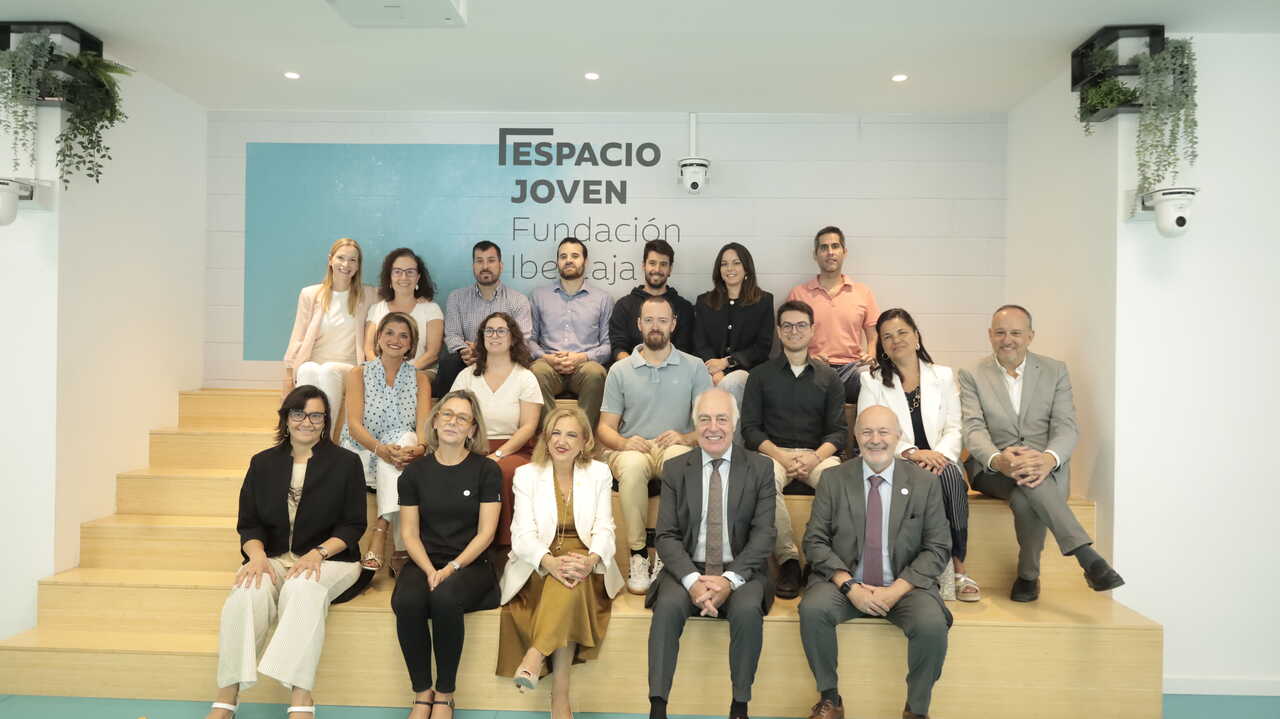
Rosa Bolea, rector of the University of Zaragoza, and José Luis Rodrigo, director general of Ibercaja Foundation, signed the agreement at the foundation’s Espacio Joven. The event also served to present some of the projects developed during the previous call and introduce this year’s selected researchers.
Bolea highlighted that the collaboration will continue supporting research talent, encouraging vocations and promoting university entrepreneurship. Rodrigo, for his part, said the partnership aims to support young people so they can develop their abilities and turn their talent into real opportunities for their professional future.
FIVE YOUNG RESEARCHERS TO RECEIVE 12,000 EUROS
One of the agreement’s main initiatives is the IMPULSA Talento Joven call, which supports research and innovation projects led by researchers from different fields. The new edition concentrates funding on a smaller number of proposals and provides 12,000 euros per project, to be used over one year.
The five selected projects cover very different areas. Luis Vicente Herrera will study new tools for analyzing lipids; Manuel Pedrón will work on boron- and nitrogen-based functional materials; and Javier Carrillo will investigate the detection of security vulnerabilities in connected devices through code analysis and artificial intelligence.
Verónica Vidal-Arenas has also been selected to use machine learning to study suicidal ideation among university students, while Eduardo Antonio Pina’s project will analyze how to improve the design and assessment of renewable energy systems. The proposals combine scientific research, digital tools and responses to social and technological challenges.
RESEARCH INTO PARKINSON’S AND RURAL ENTREPRENEURSHIP
The collaboration will also continue supporting a project by the University of Zaragoza’s Institute of Biocomputation and Complex Systems Physics to advance the early diagnosis of Parkinson’s disease. The team led by Nunilo Cremades is studying biomarkers found in biological samples and is now focusing on analyzing the data obtained.
The team has used blood samples and nasal swabs from patients and healthy people thanks to the clinical collaboration of Miguel Servet University Hospital. At the current stage, the researchers are also using advanced artificial intelligence models to identify patterns that can distinguish between the two groups and help develop a more accurate early diagnostic method.
The agreement rounds out its activities with the “Impulsa tu territorio” rural program and the “Una ingeniera en cada cole” initiative. The latter involved more than 120 volunteers, visited 34 schools and reached 3,220 students in its most recent edition. Across its previous eleven editions, more than 24,500 students have learned firsthand about the work of female engineers, scientists and technologists.