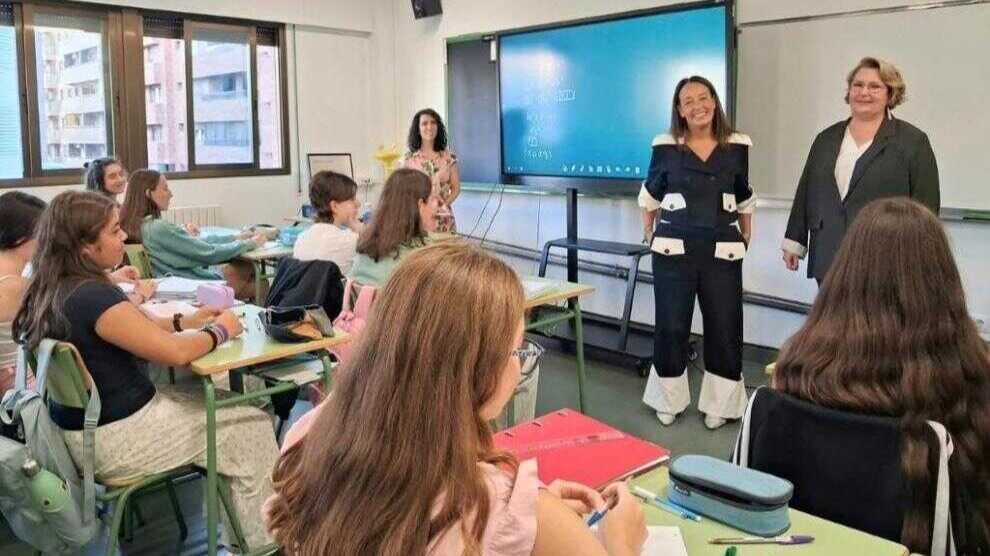
This program is geared toward research, critical thinking and the development of students’ abilities, in a learning environment that promotes deeper study in the scientific field. The regional minister for Education, Science and Universities, Carmen Susín, who visited the school on Tuesday, learned about the progress of the program and the work being carried out by the school.
“A quality education must be able to support all students, but it must also offer specific opportunities to those who want to go further, deepen their knowledge and develop their full potential. The Research and Excellence Baccalaureate responds precisely to that objective: to foster talent and bring our students closer to research and university,” Susín said. In this regard, she highlighted the importance of recognizing students “with outstanding performance” and offering them pathways that allow them to continue growing academically.
The regional minister said that the latest PISA results, the lowest recorded to date in Aragon, require action in two directions. On the one hand, she considers it necessary to strengthen support for students facing greater difficulties and, on the other, to enhance the abilities of those achieving outstanding performance. The aim, she explained, is to raise the overall level of the education system while continuing to provide tools so that the most talented students can further develop their abilities.
SCIENTIFIC TRAINING TO DEVELOP TALENT
The Research and Excellence Baccalaureate is aimed at students who have obtained the Compulsory Secondary Education diploma with an average grade of 8 or higher and who meet the academic requirements established by regulations. Admission also involves submitting a motivation letter from the student or a report from their fourth-year ESO tutor describing their abilities in relation to the program, as part of the relevant selection process.
The program aims to provide more specialized training, bring students closer to scientific methodology and promote the development of research projects, with the collaboration of universities and the possibility for students to gain a more direct understanding of the work carried out in this environment.
In the first year, students take the multidisciplinary subject ‘Introduction to Research.’ In the second year, they take ‘Research Project,’ which is linked to one of the year’s subjects and supervised in collaboration with university faculty.
In the 2026-2027 academic year, the program has been introduced at two public schools in Zaragoza. In addition to IES Medina Albaida, IES Picarral has 7 first-year students and 13 second-year students, bringing the total number of students taking the BIE at the two schools to 36.