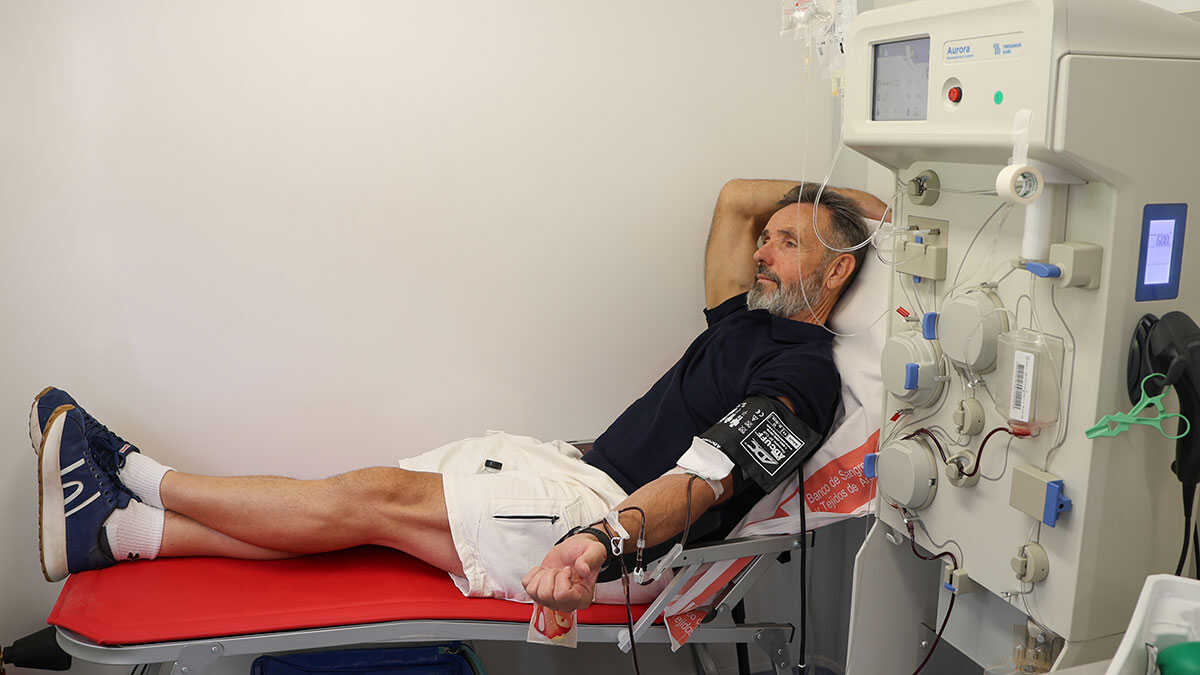
The new mobile unit was installed this Wednesday at Zaragoza’s Hospital Clínico to facilitate donations and introduce hospital professionals to this new system. It is the first time the unit has arrived at this healthcare center, after previously being deployed at Nuestra Señora de Gracia Hospital and Zaragoza’s Miguel Servet University Hospital. It will subsequently move to Royo Villanova Hospital and travel to Calatayud, Alcañiz, Huesca and Teruel. “Then we will start with health centers… We will tour the entire territory of Aragon,” said Rosa Plantagenet-White, managing director of the Aragon Blood and Tissue Bank.
The Aragon Blood and Tissue Bank’s mobile plasma donation unit consists of a container housing two apheresis machines secured to the walls, two beds for treating donors, a table, two chairs, refrigerators for storing the plasma collected, an air-conditioning system and two generators to guarantee its energy autonomy. The entire unit is transported by a tractor vehicle.
Each collection drive has a team comprising a doctor, a nursing professional and a driver, who are responsible for ensuring that the activity runs properly and that donors receive care. Once each collection is complete, the plasma obtained is transported to the Aragon Blood and Tissue Bank, where the corresponding quality and safety analyses are carried out, along with its processing, preservation and storage for subsequent therapeutic use.
VITAL FOR THE PRODUCTION OF MEDICINES
Plasma donation, the managing director stressed, is especially important because it makes it possible to produce essential biological medicines that currently cannot be manufactured artificially and whose demand continues to grow worldwide. These medicines, including Albumin and Immunoglobulins, are effective against hematological, immunological and rheumatological conditions in both adults and pediatric patients.
“It is vital. Our autonomous community is not self-sufficient, Spain is not self-sufficient and neither is Europe. All those proteins used to produce these very important medicines come from the United States. Sixty-four percent of all production is generated in the United States,” Plantagenet-White said.
Therefore, this new mobile unit, which will make donations easier, is expected to increase the number of donations and donors. In Aragon, there are around 1,400 regular plasma donors, and the number of donations of this blood component has reached 3,000.
REQUIREMENTS FOR DONATING PLASMA
Plasma donation takes about 45 minutes. It is not as well known as blood donation, although the requirements are similar: being between 18 and 65 years old and weighing more than 50 kilograms. Healthcare staff first assess whether the venous access is suitable for apheresis. It is also necessary to be a blood donor in order to donate plasma.
Each donation can be made once a month, and the process is voluntary and altruistic. Aragon has around 1,400 plasma donors and is expected to reach production of nearly 12,000 liters of plasma during 2026, a figure that represents significant progress compared with previous years.
Plasma is an essential component of blood. It accounts for approximately 55% of its total volume and is composed mainly of water, proteins, clotting factors, antibodies and other substances needed for the body to function properly.


