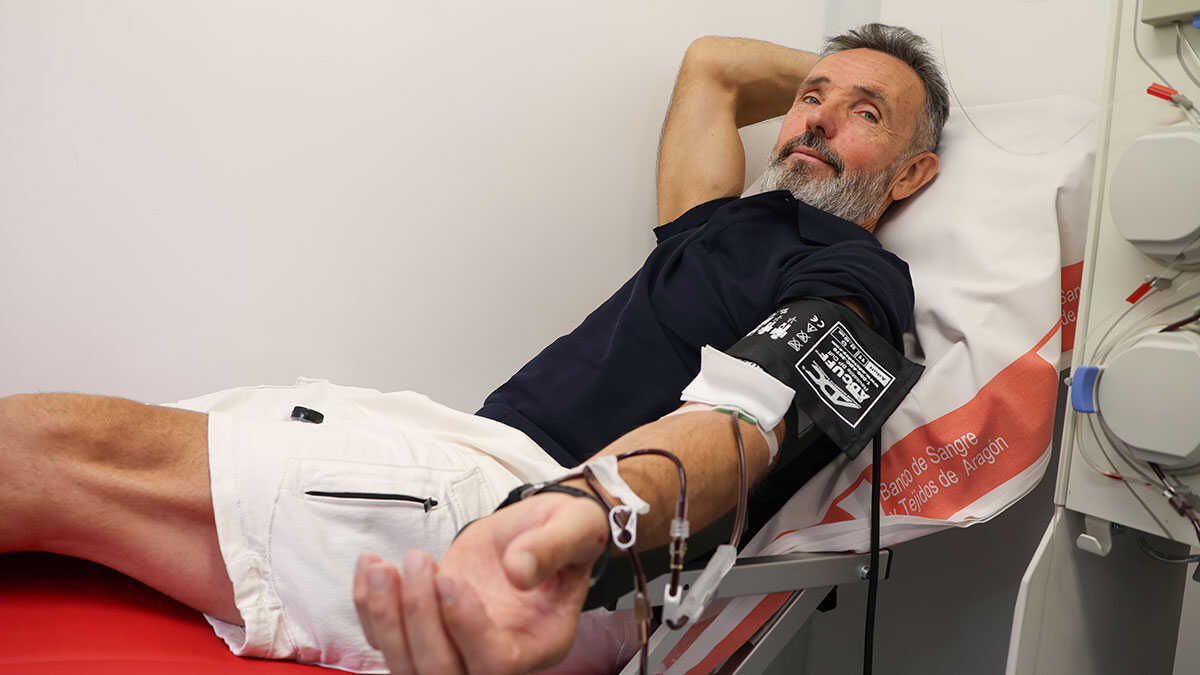
The director of the Aragón Blood and Tissue Bank, Rosa Plantagenet-White, said that neither the region nor Spain is “self-sufficient” and that they must import plasma-derived medicines from the United States. She is therefore encouraging people in Aragón to become plasma donors. To this end, the Aragón Blood and Tissue Bank has launched a mobile donation unit that will make this option available outside Zaragoza, with the aim of increasing the number of donors.
Among those already familiar with this type of donation is Juan García, who has been donating blood for more than 40 years and also began donating plasma five years ago. “They explained it to me during a blood donation and asked whether I wanted to become a plasma donor,” he recalls. Since then, García has incorporated the practice into his routine. He goes when he receives a call from the Blood Bank and, if he does not receive one, tries to organize his schedule to donate at least once every quarter.
One of the differences he values most compared with conventional blood donation is the subsequent recovery. As he explains, donating plasma allows the body to recover more quickly and makes it possible to repeat the process more frequently. “We can donate plasma almost every month or once a month,” he says, compared with the longer intervals required for blood donation.
For him, the importance of donating plasma lies in ensuring that hospitals’ needs are covered. “Hospitals need plasma, they need blood, and if there were no donors, this would be a major problem for the healthcare system and, by extension, for society,” he says.


