The way people travel on roads and in cities, including Zaragoza, Huesca and Teruel, will change from October 1, 2026. Electric scooters, bicycles, motorcycles and cars will have to comply with new obligations from today, covering everything from the clothing some users must wear to how drivers overtake cyclists or respond when a traffic jam forms.
The reform of the General Traffic Regulations, approved through Royal Decree 518/2026, places particular emphasis on so-called vulnerable road users. For the first time, the rules formally define pedestrians, cyclists, users of personal mobility vehicles, and motorcycle and moped drivers and passengers as belonging to this category. They also introduce a new specific section to regulate traffic in cities.
These are five of the most important changes taking effect on October 1, which drivers and other road users should know before setting out on the road or travelling around the city.
ELECTRIC SCOOTERS: HELMETS REQUIRED AND MINIMUM AGE OF 15
Users of personal mobility vehicles, including electric scooters, must now be at least 15 years old to ride them. Wearing a protective helmet and a reflective vest will also be mandatory when travelling at night or in conditions of poor visibility.
The reform also introduces another change for these vehicles: outside built-up areas, they will be allowed to use routes segregated from motor traffic, such as cycle paths or bike lanes, unless expressly prohibited. Permanent lighting, including during the day, will have to wait one more year and will become mandatory from October 1, 2027.
HOW DRIVERS OVERTAKE CYCLISTS IS CHANGING
Protection for cyclists is also being strengthened. On interurban roads, helmets will be mandatory for everyone, as the exemptions that existed until now are being removed.
Drivers wishing to overtake a bicycle must reduce their speed by at least 20 kilometres per hour below the road's maximum speed limit, as well as maintain a minimum lateral distance of 1.5 metres. Where a road has more than one lane in the same direction, drivers will be required to change lanes completely to overtake.
There are also changes within cities. Cyclists will preferably travel in the centre of the lane, and motor vehicles travelling behind them must maintain a minimum distance of five metres. In addition, bicycles will be allowed to travel in both directions on certain single-lane streets with a 30 km/h speed limit.
GLOVES AND CLOSED FOOTWEAR FOR MOTORCYCLISTS
Motorcycle and moped drivers and passengers will also face new obligations. Protective gloves will be mandatory on interurban roads, while closed footwear must be worn on all types of roads, including urban journeys.
The reform also allows motorcycles to use the right-hand hard shoulder exceptionally when there is congestion, although they will not be allowed to do so freely. The section must be expressly signposted for this purpose, and the maximum speed will be 30 km/h.
TRAFFIC JAMS WILL REQUIRE AN EMERGENCY LANE
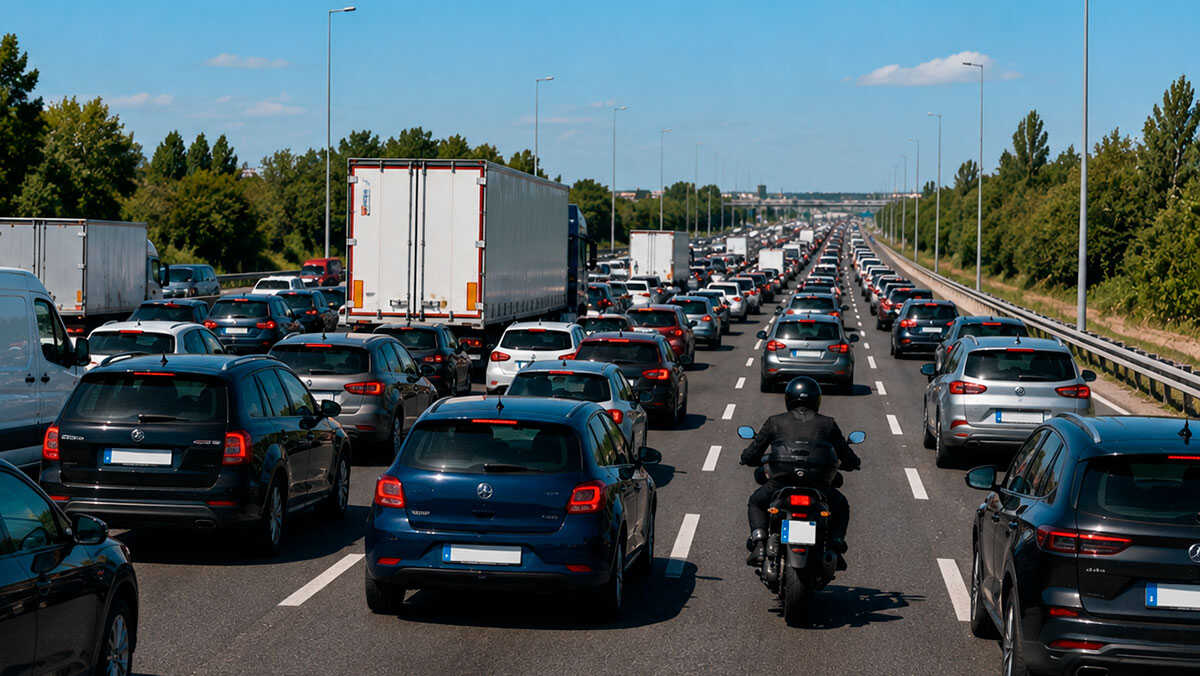
One of the changes most affecting car drivers will apply on motorways and dual carriageways. When there is a traffic queue and vehicles are stationary or moving at walking pace, they must move aside to leave an emergency corridor for ambulances, firefighters, police and other priority services.
On roads with two lanes, vehicles will move towards both sides to leave a central space. On three-lane roads, vehicles in the left lane will move towards the left, while those in the centre and right lanes must move to the right, creating the corridor between the left and centre lanes.
The procedure for passing a vehicle immobilised because of a breakdown, accident or assistance work is also changing. Drivers must leave at least 1.5 metres of lateral distance and reduce their speed by at least 20 km/h below the road's speed limit.
TRAFFIC LIGHTS, SEAT BELTS AND NEW RULES FOR PEDESTRIANS
The reform also covers urban traffic. As a general rule, at traffic-light-controlled pedestrian crossings, the flashing amber light for vehicles may no longer coincide with the green light for pedestrians.
In addition, pedestrians will have priority on streets with a single-level surface, and the concept of school routes is being legally introduced. These are routes adapted to help children reach schools on foot, by public transport or using non-motorised means.
Some exceptions to seat belt use are also being removed. From October 1, seat belts will be mandatory at all times for taxi drivers, goods vehicle drivers and driving-school vehicle drivers, with a specific exception for certain occupants of medical ambulances during emergency services.
The reform also includes changes for people who use bicycles, scooters, mopeds or motorcycles for professional purposes. So-called riders must wear a helmet and reflective vest throughout their working activity, regardless of the time of day.