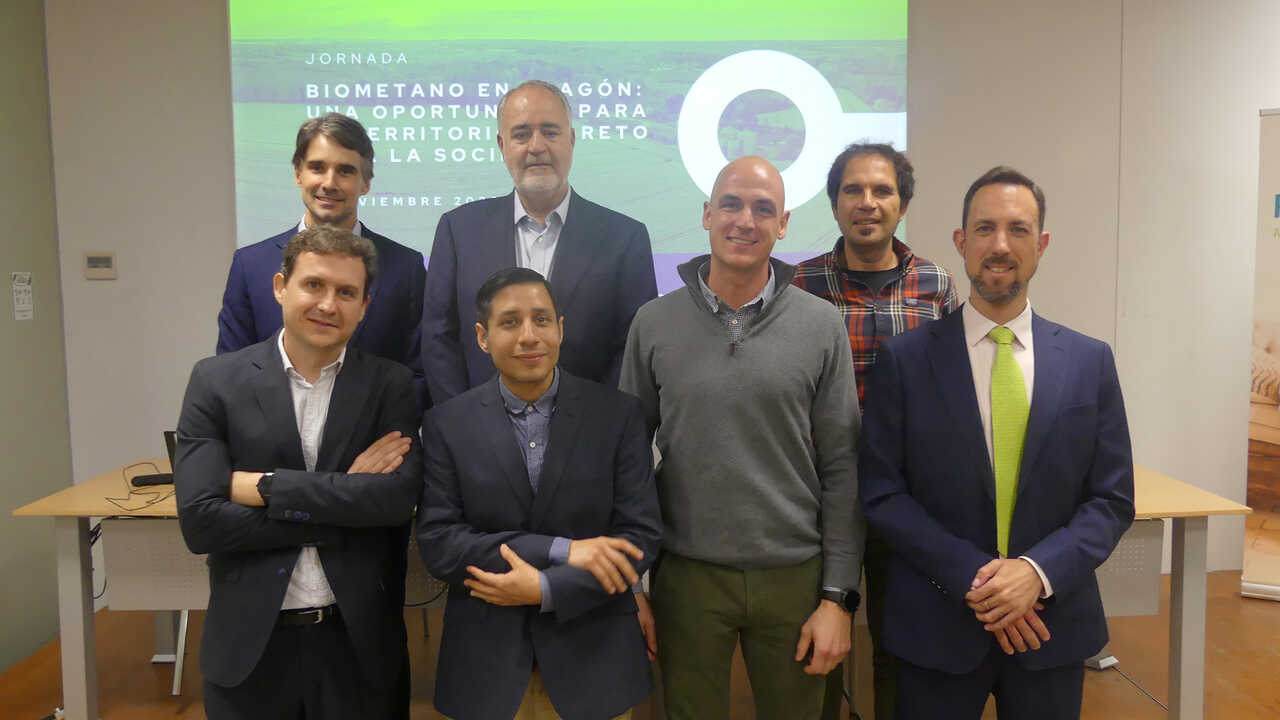
This situation was the focus of a conference held in Zaragoza on Wednesday by the Aragon Energy Cluster (Clenar), in collaboration with Redexis Renovables and CIRCE. The event brought together around 100 professionals, representatives of public administrations and companies to discuss how to promote this renewable gas, which is produced from organic matter and can replace natural gas.
POTENTIAL TO COVER ALMOST ALL GAS DEMAND
Aragon is Spain’s fourth region with the greatest production potential, according to data presented by Javier Rubio, director general of the Spanish Biogas Association (AEBIG). Estimates point to capacity equivalent to 238 plants and more than 90 projects at different stages of development. If all the available resources were used, they could cover around 96% of Aragon’s current natural gas demand.
Livestock farming would be the main source of raw material: nearly 80% of the resources needed to supply future facilities would come from slurry and manure, reflecting the importance of this activity and, particularly, pig farming. Despite these possibilities, Aragon still has no operating plants, while Spain has more than 30 and Europe around 1,975, according to figures presented at the conference.
FASTER PERMITTING AND PUBLIC TRUST
Companies have called for legal certainty and greater administrative efficiency to develop the facilities. Fernando Cortina, head of Regulation at Redexis, said that some projects remain stalled despite having completed the required procedures. He also noted that the draft royal decree to promote biomethane is in the final stage of processing. Miguel Mayrata, managing director of Redexis Renovables, called for stable rules and faster decisions on applications, together with the corresponding environmental safeguards.
Public acceptance was another central issue. Isabel Martín Ramos, head of Social Impact at Vinces, argued that residents should receive information early, in an understandable and verifiable form. Proposed measures include plans to control odors and traffic, communication channels and local monitoring committees. CIRCE, for its part, presented tools that make it possible to virtually test different waste mixtures, anticipate operating problems and study how odors disperse.
The event also highlighted experiences such as that of Alcarràs Bioproductors, which brings together 150 farming families that joined forces to build a biogas plant. The conference will continue on Thursday with a technical visit to Redexis Renovables’ biomethane facility in Almazán, in Soria, where participants will be able to learn how organic by-products are transformed into renewable gas and how a plant is integrated into its surroundings.