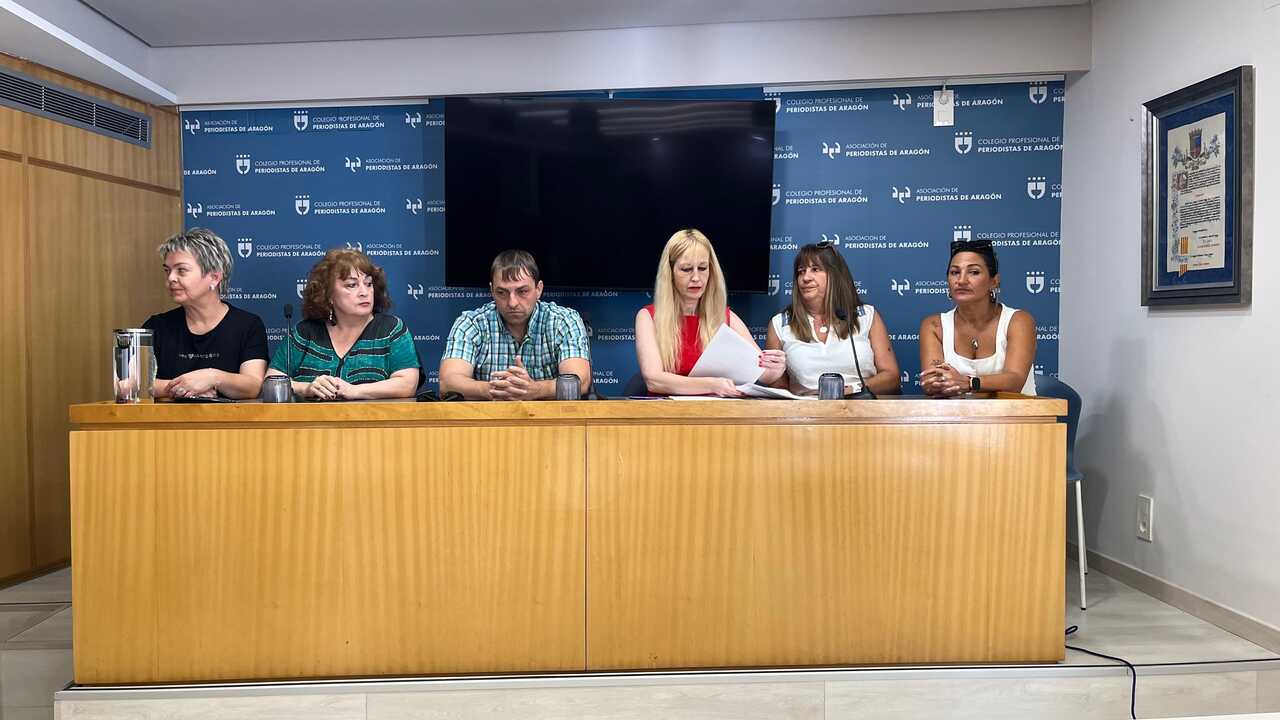
The trade unions directly point to delays in new registrations and in replacing users of the dependency service as one of the main problems. They claim that, since April, the assignment of new cases has slowed to the point of leaving some care workers with increasingly shorter working hours.
"The situation of our colleagues is reaching a critical point," warned Mariano Álvarez, secretary of Trade Union Action and Collective Bargaining at the CCOO Habitat Federation in Aragon. He also highlighted the consequences of this deadlock for dependent people waiting to receive care in their homes.
FEWER WORKING HOURS AND LOWER WAGES
The problem arises when a user no longer needs the service, whether because of death, a move to a care home or other circumstances. The hours assigned to that worker disappear from her schedule and, according to the unions, new users are taking increasingly longer to arrive. During the summer, holiday and absence cover has partially helped to cushion the situation.
With the holiday period coming to an end, however, CCOO and UGT fear that the reductions will intensify. "There are workers who do not know how much they will earn this month, whether they will be able to pay their bills or how they will feed their children. It is dramatic," said Angélica Mazo, a UGT spokesperson.
The unions estimate that losing six hours of work per week can mean “between 180 and 250 euros less net per month,” depending on the provincial collective agreement. In some cases, the drop in income can reach between 20% and 30%. "It cannot be the case that a worker does not know how much she will earn each month," Mazo insisted.
DELAYS IN DEPENDENCY SERVICES ALSO AFFECT FAMILIES
The situation also affects dependent people. UGT says that new registrations linked to the Individual Care Programme (PIA) are facing delays that can exceed 100 days and even approach 200. The unions are calling for these procedures to be expedited so that families do not spend months waiting for the service.
In addition, both organizations say they have received accounts from families who were allegedly advised to opt for financial assistance instead of receiving home care. "Most families want their relative to be cared for, to be cared for at home," Mazo explained, arguing that this financial assistance does not replace the care provided by a professional.
Álvarez also questioned whether these benefits can meet the real needs of a dependent person. "With 200 euros, who can hire someone externally to provide care? Nobody, it is impossible," he said. CCOO believes that the reduction in new users threatens to progressively weaken the service itself.
RESTORING HOURS WITHIN A MAXIMUM OF 15 DAYS
Among their main demands, CCOO and UGT are calling for the hours lost by care workers when a user leaves the service to be restored “within a maximum period of 15 days.” They are also asking for new dependency registrations to be expedited and for Aragonese regulations to be reviewed so they can be adapted to changes introduced by national legislation and increase the number of hours users can receive.
The unions are also requesting working schedules of at least 85% and progress toward full-time employment in a sector characterized by part-time work. "They deserve a decent salary," Mazo said, calling on the authorities to provide the necessary resources to prevent workers from spending months with reduced hours and wages.
CCOO and UGT also want to establish a dialogue forum bringing together the IASS, the unions and the companies managing the service to address working conditions and user care. According to their estimates, around 1,500 workers provide these services in Zaragoza, while the figure could be around 2,500 across the region. "A solution must be found now," Angélica Mazo concluded.


