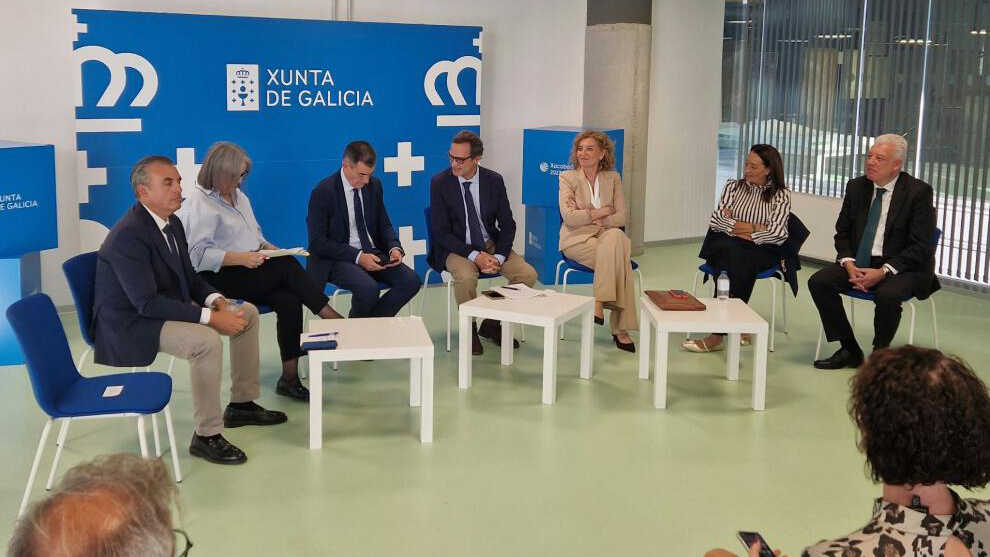
Education, Science and Universities Minister Carmen Susín took part in a working meeting with education officials from different autonomous communities to share experiences and analyse the main challenges posed by this technology. The event also addressed issues related to the state of the education system and the results of the latest PISA report.
LESS PAPERWORK SO TEACHERS HAVE MORE TIME TO TEACH
One of the main objectives of Aragon’s strategy is to use artificial intelligence to reduce the administrative burden on teachers. The ministry wants these tools to free up time currently spent on management tasks so that teachers can devote it to teaching and supporting students.
The plan is not limited to schools. The Education Department is also working on an AI training programme for families, as well as a teacher digital literacy guide aligned with the UNESCO framework. This will be complemented by the creation of observation and research networks among schools to study the conditions under which these tools improve learning and critical thinking.
The regional strategy proposes that artificial intelligence be introduced gradually and supported by data. The Aragon Government therefore argues that training, innovation and evaluation should move forward together before new applications are rolled out across classrooms.
ALMOST 3,000 TEACHERS HAVE ALREADY BEEN TRAINED IN ARTIFICIAL INTELLIGENCE
Juan José Mejías, director of the Aragon Centre for Education Technologies (CATEDU), outlined the main steps taken during the 2025/2026 academic year at the forum. One of the most notable is a 140-hour AI training programme, which has already been completed by nearly 3,000 teachers from Aragon’s three provinces.
The programme was based on a survey of 1,574 teachers and was divided into six modules covering ethics and responsibility, curriculum design, practical application across different subject areas, assessment, accessibility and inclusion, and a final project. The training has been available on AulAragón since March 2026.
The programme was followed by Aragon’s Artificial Intelligence Week, held from 23 to 27 February through the region’s 12 teacher training centres. The initiative concluded on 28 February with the 1st AI in Education Conference at the Huesca Conference Centre, aimed at teachers, specialists and families.
ARAGON BRINGS ITS EXPERIENCE TO EUROPEAN PROJECTS
The region is also participating in the European PAIDEIA project (2023-2026), במסגרת which Zaragoza hosted one of its technical meetings. Aragon also attended the international closing event held in Malta. As part of the project, an international course was developed and piloted by more than 500 Aragonese teachers within the Erasmus+ programme, alongside governments and universities from Belgium, Ireland, Italy, Greece, Turkey, Bulgaria and Malta.
Aragon’s position at the forum is that the challenge is no longer simply to introduce artificial intelligence into primary and secondary schools, but to prepare the education system for a technology that is already part of society. The Education Department believes its use should help strengthen mathematical, language and scientific skills, as well as a culture of effort and equality.
The European EducaIA Forum, organised by Siena Educación and the Magisterio newspaper with the support of the Xunta de Galicia, will now compile the experiences and proposals presented during the event in a White Paper on artificial intelligence and education, prepared together with the European University of Madrid.