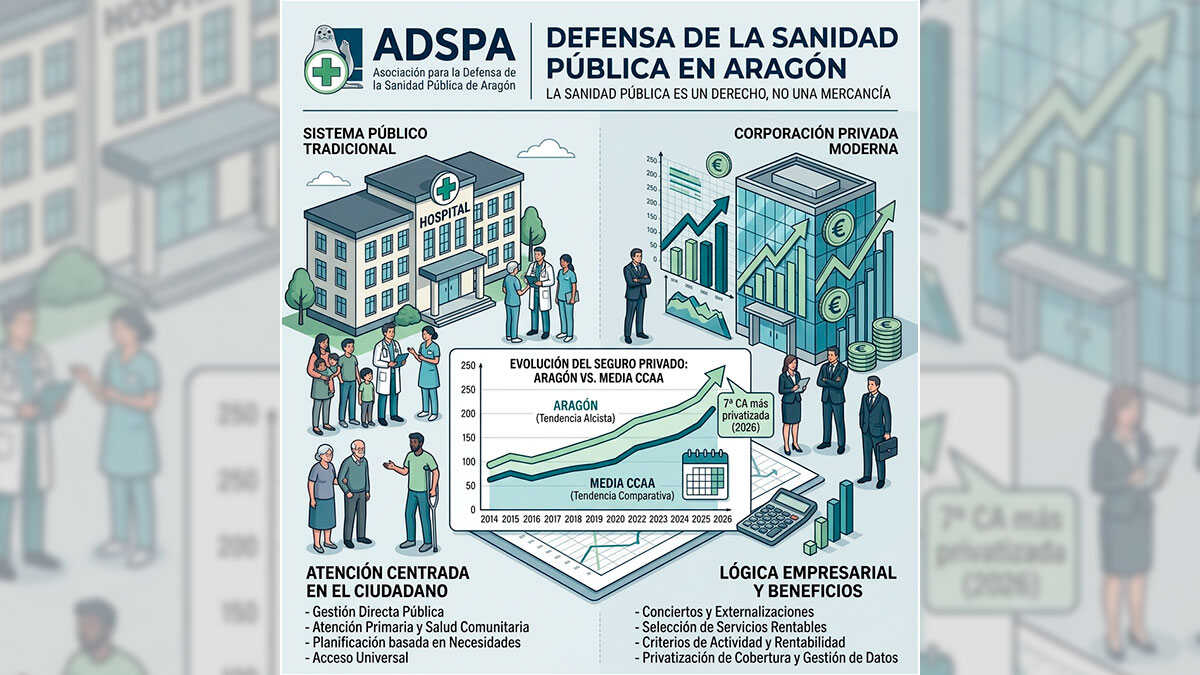
The report analyzes spending on medical insurance, healthcare agreements, outsourcing and the money families spend directly on their health. The organization says that 2026 has seen “an increase in privatization” across the country and warns that the figures for contracts with the private sector could even be “underestimated” because of the presence of the civil servants’ mutual insurance system.
The association also argues that privatization “does not begin when public money is handed over to private interests” in the form of healthcare agreements or outsourcing. According to the document, “it begins when the priority is no longer the population, but the sick, and the system is transformed into an apparatus for repairing illnesses, guided by a business logic imported from the private sector that penetrates the public sphere.”
MORE THAN €117 MILLION FOR HEALTHCARE AGREEMENTS
One of the report’s main findings concerns healthcare agreements. Adspa points out that Aragon’s 2025 budget set aside nearly €115 million to purchase services, while a subsequent budget amendment added a further €2.6 million. The association includes this allocation among the channels used to transfer public resources to the private sector.
The document also includes services such as respiratory therapies, dialysis, medical transport and patient referrals in this category, as well as activities such as laundry, catering and maintenance. The association views these arrangements as part of the growing “outsourcing of healthcare services from the public to the private sector.”
According to the report, this role is also reflected in citizens’ spending. Aragon is the fourth Spanish region with the highest expenditure on private health insurance, at €235 per person per year, and the sixth with the highest out-of-pocket healthcare spending, at €623.59 per person. Adspa warns that access to private healthcare depends on “those who can afford it.”
MAZ AND THE HIRING OF DOCTORS IN THE SPOTLIGHT
The association pays particular attention to the Mutua de Accidentes de Zaragoza (MAZ). It directly refers to the “transfer to MAZ” of part of the public healthcare system and says the organization provides hospital emergency care, including emergency admissions, to more than 11,000 residents, as well as care and tests in several specialties for 56,000 people in Zaragoza Health District I.
Another point of contention is the hiring of companies to fill medical positions. Adspa says the problem affects hospitals in Teruel, Alcañiz, Barbastro, Calatayud, Huesca and Jaca, and cites the hiring of staff through Ribera Salud. In its view, this formula means “higher costs, less public oversight and a weakening of public healthcare.”
The report says Ribera Salud has accumulated up to €3.2 million in contracts over 14 months. In response to the argument that there are not enough doctors willing to work in the public system, the association says that “competitive examinations for vacant positions have been delayed” for years and links this situation to deteriorating care, particularly in rural areas.
WAITING LISTS AT THE CENTER OF THE DEBATE
Waiting lists occupy another of the document’s most critical sections. Adspa believes that insufficient public services are used to justify turning to private providers, but attributes delays to structural and organizational problems. “Neither extra shifts, healthcare agreements nor temporary hiring” have solved the problem, it maintains.
The organization also directs its criticism at the external management of healthcare data, from medical records and electronic prescriptions to Salud Informa. The association believes this situation “puts users’ highly sensitive data at serious risk” and denounces the lack of transparency, which makes it difficult to compare indicators and assess the healthcare system’s evolution.
In response, Adspa is calling for more funding, stable staffing and a restoration of the central role of Primary Care and Public Health. Its conclusion is particularly forceful: “Public healthcare is not a company that provides healthcare services,” the report states, defining it as a social institution serving a right and calling for its public ownership to be strengthened.