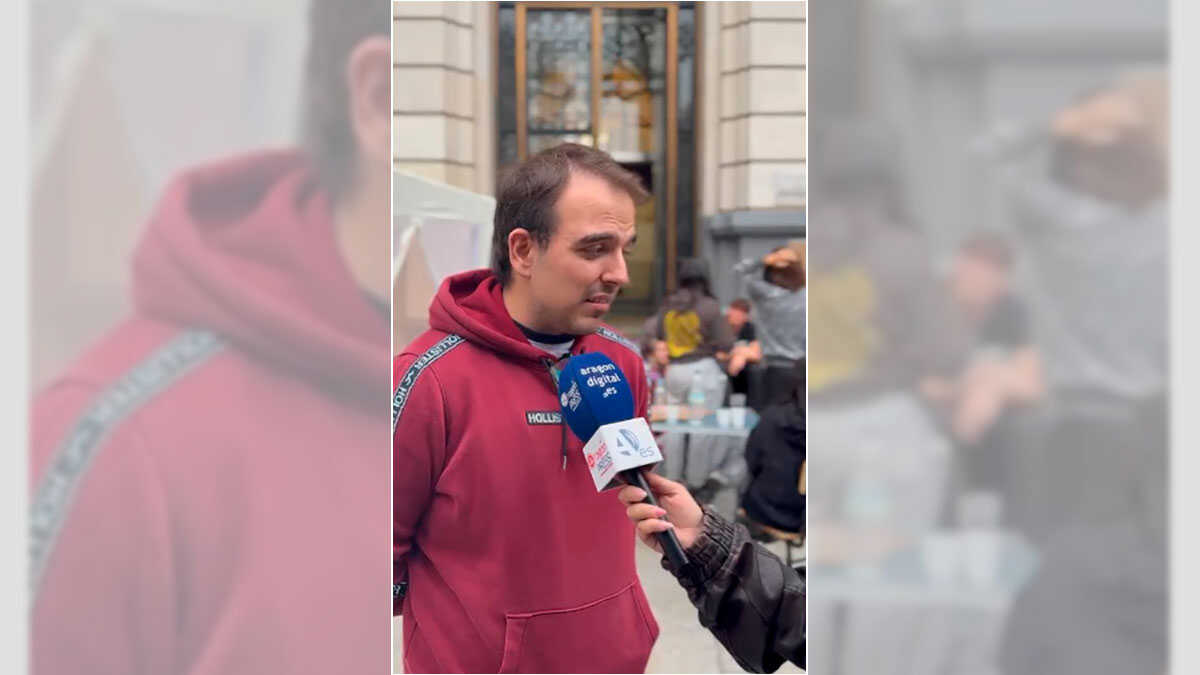
Aarón says Maricarmen’s case and the protests that began in Madrid served as a catalyst, but insists the problem goes back much further. “People are fed up with working one, two or more jobs, often precarious, temporary and miserable, and people can’t even afford rent,” he says. Even sharing a flat, he adds, has become an option that many find difficult to afford. “If you’re lucky enough that your parents own a home, that’s already a stroke of luck,” he concludes.
The first night passed, according to the campers themselves, without any major incidents. Aarón describes the atmosphere as “very calm” and says the intention is to continue “for as long as necessary”. The protest, he points out, is not limited solely to housing, and some participants want to use the mobilization to link this demand with other labor, education and social issues.
“UNTIL THERE IS A SOLUTION, WE’RE NOT LEAVING”
Erika, for her part, acknowledges that the first few hours were marked by uncertainty. “All of this is very new for all of us. We arrived yesterday and were super dazed, a little overwhelmed,” she says. During the night, they organized themselves so that there would always be people awake in case of any possible problem. Amid some shouting, street noise and the usual activity in central Zaragoza, she says she managed to sleep “even if only for a couple of hours”.
Despite the fatigue, she maintains that the goal is to extend the camp. “Until there is a solution, we are not leaving here,” she says. Among her main demands, she cites an indefinite and automatic extension of rental contracts and a significant reduction in prices. She also calls for a different relationship between landlords and tenants and asks for “a little more empathy” toward those who rent their homes.
Daniela agrees that housing costs absorb too large a share of wages. “Most of our salary can’t be taken up by housing,” she says. Her demands also include greater regulation of large property owners and investment funds, and she calls for access to housing to be guaranteed for workers.
The night was not without tense moments. Daniela says that some people passing through the square shouted at the campers and even sang songs such as “Cara al sol” or shouted expressions such as “go get a job”. Even so, she says those incidents were isolated and that, beyond the noise of the tram and nighttime traffic, the camp continued normally.
The participants also accept that the protest will not end even if the tents are removed in the coming days. “It probably won’t end now,” Daniela warns. Their intention is for the camp to bring together more people affected and keep active a mobilization that has spread from Madrid to other cities. In Zaragoza, for now, the camp remains set up in Plaza de España while its participants continue to press their demands regarding rents, evictions and access to housing.